Saturday, October 8, 2022

Old Bestseller Review: A Confederacy of Dunces, by John Kennedy Toole

A Confederacy of Dunces, by John Kennedy Toole

a review by Rich Horton

Many years ago I read John Kennedy Toole's A Confederacy of Dunces, and I loved it. But I recently realized that I hardly remembered it! So I decided to read it again.
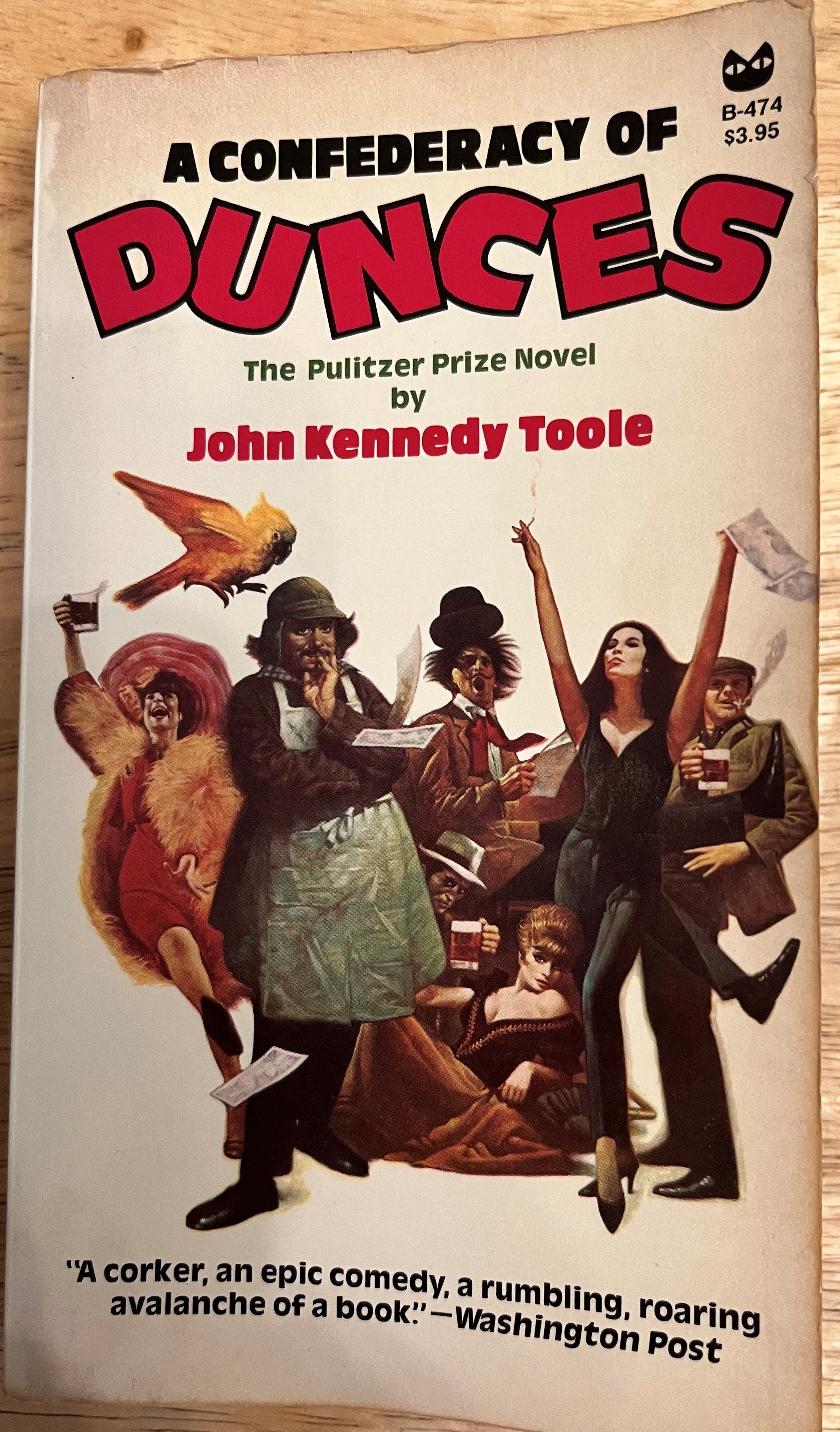
The novel's backstory is rather famous. John Kennedy Toole (1937-1969), a native of New Orleans, graduate of Tulane with a Master's from Columbia. He spent time teaching at what is now the University of Louisiana at Lafayette; and also at Hunter College in New York, while he worked on a Ph. D. at Columbia (he never completed this degree.) He was drafted into the Army and posted to Puerto Rico, where he began working on A Confederacy of Dunces. After his discharge he finished it. He revised it several times with the advice of the legendary editor Robert Gottlieb, but Gottlieb eventually passed. Increasingly mentally ill, Toole committed suicide at the age of 31. His mother (who, one imagines, perhaps unfairly, was not always a benign influence on him) remained convinced of his genius, and eventually barged into the office of the great Louisiana novelist (and SF writer!) Walker Percy. Percy, in his introduction, recounts his fear that the novel would be the usual horrid thing; and his growing disappointment that it was good enough he had to keep reading, succeeded by shock as he realized it was actually quite remarkable. He eventually managed to convince LSU Press to publish it -- it appeared in 1980, was a critical success, eventually a bestseller, and it won the Pulitzer. (Only two other writers have won a posthumous Pulitzer in Fiction, and the other two were also distinctly Southern writers: James Agee, from Tennessee, and William Faulkner, from Mississippi (make of that what you will.)) The Neon Bible, a novel Toole wrote when he was 16, heavily influenced by Flannery O'Connor (speaking of Southern writers), was later published.

Ignatius J. Reilly is the antihero, though in reality the novel is an ensemble work (and pretty much everyone is more "anti" than "hero".) But Ignatius is the fulcrum. He is a fat man of about 30, well educated but unwilling to work, discontented with everything about the modern world (he is fond of advocating a return to the monarchy.) He lives at home with his mother, his father having died long before. Ignatius spends his time writing either long philosophical screeds, combative letters to his one time fellow student/sworn enemy/almost girlfriend Myrna Minkoff, or accounts of his everyday travails on Big Chief notepads. He drinks Dr. Nut (a then popular New Orleans soft drink), eats too much, and complains constantly about his troublesome pyloric valve. His favorite recreation is the movies, where he likes to yell at the screen protesting the obscenity he sees (which is a joke given that Reilly's favorite actress appears to be Doris Day, whose movies were so "clean" she was called "America's Oldest Virgin".) One day Ignatius attracts the unwelcome attention of a hapless policeman named Angelo Mancuso, and, distressed, he and his mother venture into the Night of Joy, a sleazy nightclub, after her work, and she ends up drunk and wrecks the car as well as a nearby building. And then Ignatius is forced to find a job.

His jobs are disasters of course -- the first is with Levy's Pants, a nearly moribund clothes factory. Ignatius' job is to file the records, which he does by burning them. He also incites the (largely black) factory workers into protesting their conditions. After losing his job there, he more or less at random finds a position at Paradise Vendors, pushing a hot dog cart (though eating most of the product.) 

But the other characters are busy too. The owner of Levy Pants is trying to find a way to get rid of the place, but his wife has taken up the cause of the aging Miss Trixie, who really wants to retire. The office manager, Mr. Gonzalez, is afraid of offending anyone. Ignatius writes a vicious letter to one of Levy's customers, who sues in response, which may at last serve as his business' mercy killing. The proprietor of the Night of Joy is selling pornographic pictures of herself to high school kids, while unwillingly allowing one of her employees to start a striptease act. The Night of Joy also hires a black man, Burma Jones, at much less than what he calls "minimal wage" -- a job he needs to avoid being jailed as a "vagran". Mrs. Reilly makes friends with Patrolman Mancuso's aunt, who quickly divines that Ignatius is the source of all her problems, and urges Mrs. Reilly to have him committed, while also trying to set her up with the old man who Patrolman Mancuso arrested in lieu of Ignatius. And Mancuso's career proceeds from bad to worse -- forced to wear outlandish costumes and wait in cold bathrooms hoping to arrest suspicious characters ...

There's more than that going on, and not much point in me detailing it -- I've probably already written too much! The novel is extremely funny throughout. Is it offensive? Well, objectively, Ignatius' views and rants are offensive, though in an oddly innocent way. Most of the other characters are just as, to use a tired phrase, politically incorrect. Even Myrna Minkoff, Ignatius' Jewish social justice warrior frenemy, is wackily off base. Probably the only scene that descends to lazy cliché is a gay party that Ignatius stumbles into -- I found that also quite funny, but was uneasily never sure that the gay scene described ever existed anywhere besides Toole's imagination. 

It's clear that Ignatius is too disconnected from reality to ever succeed in this time -- but also clear that he's just crazy enough to stumble through life never knowing how much trouble he's causing, and never knowing how close to disaster he hews. He's also in a cockeyed way intelligent enough to fascinate, intelligent enough to hold our interest. It's a weird ride, and an inimitable book. It's really great fun to read. 

Thursday, October 6, 2022

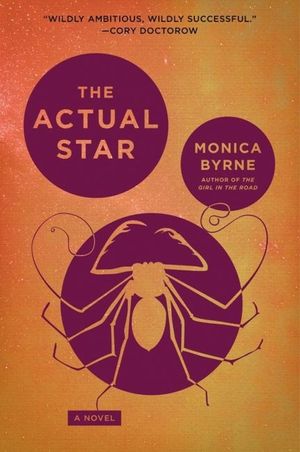
Review: The Actual Star, by Monica Byrne

The Actual Star, by Monica Byrne

a review by Rich Horton

The Actual Star is Monica Byrne's second novel, appearing in 2021, 7 years after her first, the Otherwise Award winning The Girl in the Road. And the seven years of work shows -- in a good way! This book is wildly ambitious and mostly successful. It depicts Mayan society of a thousand years ago convincingly, and depicts an utterly fascinating post-climate catastrophe future a millennium from now intriguingly. There's a present day thread as well -- and it's well done too but to be fair in some ways that's easier.

The novel's structure, as I hinted above, revolves around three threads -- one a millennium ago as Mayan society is collapsing -- or, at least, its traditional structure is changing. Another is set in the present day, as Leah Oliveri, a 19 year old girl from Minnesota decides to visit her (dead, and never part of her life) father's home, Belize. And the third is set a thousand years in the future, with a radically different future social organization under threat due to conflict between a free thinking "sophist" and a conservative "scroop" about what people should be allowed to think, and about what change might be possible to a society founded on principles aimed at living lightly on the land in the wake of climate disaster. 


There is another, not quite as obvious, structural aspect. The novel features no fewer than four sets of twins. And in each case those twins represent paired qualities, not necessarily the same pairs. The Mayan section, set in 1012, focuses on Ajul, the King to be, and Ixul, his fierce and ambitious sister. Their parents have disappeared, presumably capture and/or killed by enemies; and their coronation approaches. Their kingdom is declining (this is the period when the Mayan civilization collapsed, or at least radically altered in structure.) It is an open and scandalous secret that they are incestuous lovers. The action is set primarily on the day of their coronation, and concerns their younger sister Ket's initiation into bloodletting, which is said to facilitate access to Xibalba, an Underworld or perhaps parallel realm; and her interactions with a strange black jaguar; and also the preparation for the coronation, which will include traditional human sacrifice; and then the shocking events at the ceremony.

In the year 2012, Leah Oliveri decides to travel to Belize. Once there she visits a famous cave; guided at first by Xander. The cave itself has a number of well-preserved skeletal remains, some of which we soon gather may be those of Ajul or Ixul or perhaps their victims. Leah is fascinated by the cave, and immediately determines to visit the cave as often as possible, and to find a way to stay in Belize. She meets Xander again, and his estranged twin Javier, who is also a guide; and some other locals. She is attracted to both Xander and Javier, who have radically different personalities -- she sleeps with both, and hears Xander's goal to study abroad (he is a brilliant autodidact) ... all the while plotting to travel deep into the cave despite the rules against that.

And in 3012, Niloux de Cayo makes an assertion that violates some of her future societies core beliefs: she is skeptical about the "disappearances" that have been witnessed over the past millennium, beginning with the disappearance of St. Leah Oliveri from a cave in Belize. Leah's lovers, the Consort Twins, Xander and Javier, then found Laviaja -- something of a religion, something of a political, social and economic way; and this way of living has come to dominate life after the climate catastrophes of the early third millennium. As an SF reader, this was the most fascinating part of the book to me: people live nomadic lives, staying no more than 9 days in any place. They do not accumulate possessions. They do not form long term relationships. They do not raise their blood children. All this is buttressed by some impressive technology, and by radical body modifications (for one thing, everyone is a hermaphrodite.) As a reaction to the depredations humans made to the natural world, they live extremely lightly on the Earth -- though the fact that there are only some 8,000,000 living humans certainly helps that lightness! Niloux's assertion prompts two reactions -- a group who see in her an inspiration for more openness, more flexibility, in their society; and a group who (paradoxically violently) oppose any change, any risk of change, to a society that seems to have served people -- and the Earth -- very well for centuries. This second group is led by Tanaaj de Cayo -- as her name indicates, born in the same area as Niloux -- and it becomes clear that Niloux and Tanaaj are bound for a confrontation at the Jubilee that will be held in Belize, 1000 years after St. Leah's disappearance. 

The book moves nimbly between the three threads. Ajul and Ixul's story is historical fiction, with an overlay of fantasy (in the sense that what we now regard is magical things are truly believed -- and perceived -- by people of that time.) Leah's story is contemporary realistic fiction, about an American tourist becoming entranced with a different culture -- very well and honest depicted. And Niloux and Tanaaj inhabit a truly intriguing future, with neat technology, and a wonderfully thought out future society, with radically different economics, gender organization, social organization, habits of work and entertainment. These ideas are fascinating -- and also invite argument, in the way the best speculative fiction does. (For example -- how did a society of 8,000,000 people who do not stay in any one place for any period of time create the remarkable technology they rely on?)

The novel is long, but reads compellingly. It is very well written -- one of very few recent SF novels that did not have me reaching for my blue pencil. It is not perfect -- I think the climactic events are perhaps a tad convenient -- one character in particular is let off rather easily, to my mind. The ending is ambiguous, but I ended up sold on it. The structure is well-maintained but at times there is a bit of strain, a sense that one section may have dithered a bit to maintain pace with the others, perhaps -- but never in a truly harmful way. I was reminded a bit of Ursula Le Guin's Always Coming Home, and of John Crowley's Engine Summer, and the author (in conversation) acknowledges the influence of Le Guin (especially The Dispossessed) and of Kim Stanley Robinson (pervasively, I suspect, but especially the Mars Trilogy.) 

This is a tremendously ambitious novel, that reaches for the (actual!) stars and achieves most of its goals. It has not been ignored, but it surely deserves more notice. This is the kind of SF we need now, I think -- SF that does not by any means abandon the goal of entertainment, SF that shows real attention to craft, to prose and structure; and most of all, SF that excitingly thinks about the future, and about the past, and about how we live, how we should live, how we might live. 

Saturday, September 24, 2022

Rambling Notes on The Shadow of the Torturer

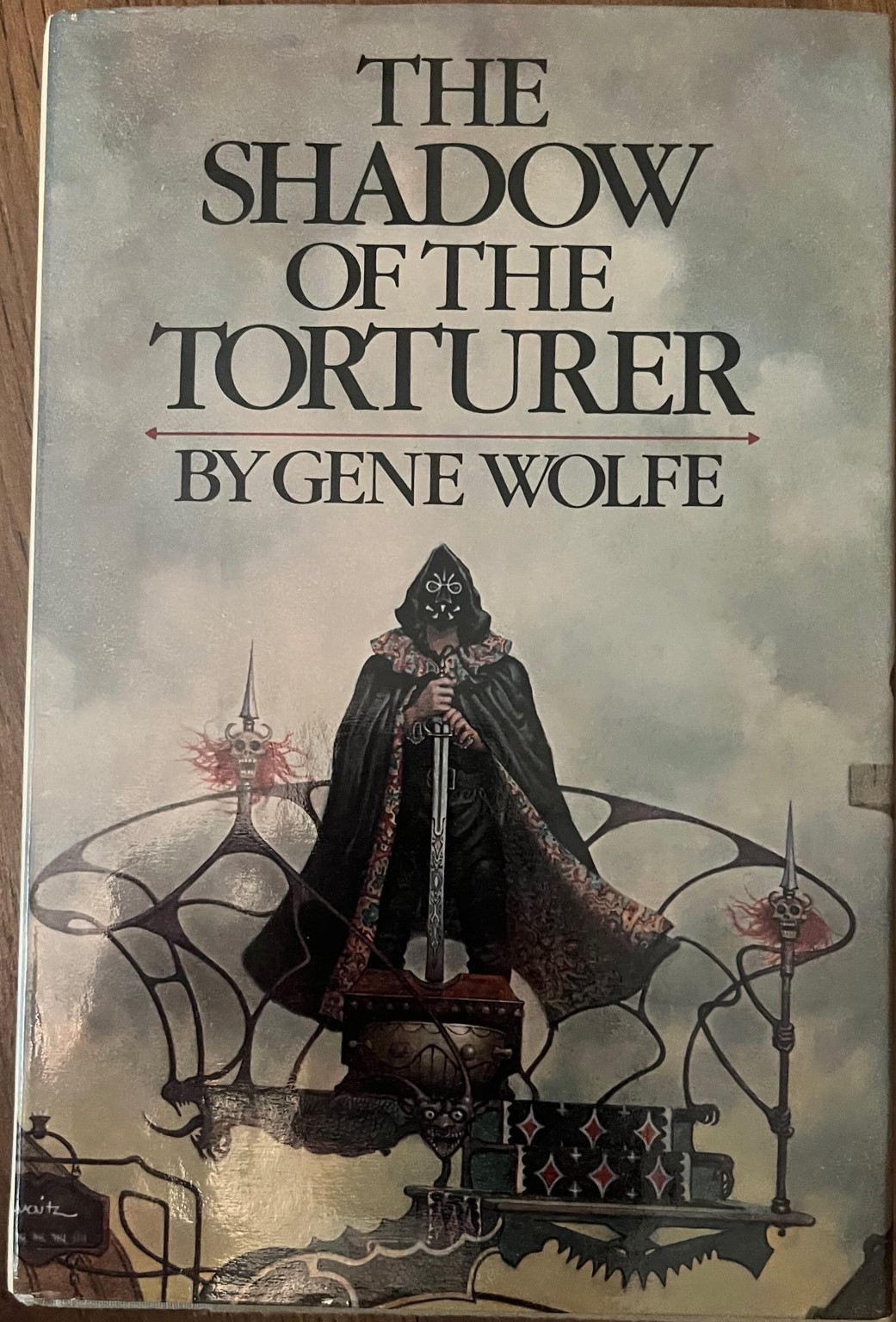
The Shadow of the Torturer, by Gene Wolfe

rambling notes by Rich Horton

(Cover by Don Maitz)

I read this book in 1980, shortly after it appeared. (My copy is a first edition.) I was already a great fan of Gene Wolfe (that's why I bought the hardcover right away!) and this seemed (still seems) a confirmation of his status as one of the most exciting, most complex, most original SF writers. This is a view I have not abandoned since. 

We discussed the book in my regular book club (run by Mark Tiedemann) for September, so I reread it. Shortly thereafter I attended a panel on Gene Wolfe at Chicon 8. All this was energizing -- I'll be paying extra attention to Wolfe in the near future. For one thing, I'll certainly finish my reread of the New Sun books. And I'll catch up to some of the late Wolfe I haven't yet read. 

But what about The Shadow of the Torturer? In a way, I don't have much to say. Not that there isn't a lot to say, but most of it has been said by others, and I don't think I have the energy to attack that now. Maybe after I've finished the whole set? For now, some, I guess, rambling notes.

What is the book about? I think most people know that -- it's the account of Severian, a member of the Guild of Seekers for Truth and Penitence (which is to say, Torturers), beginning with his youth in the Guild, and following him until he leaves his home city, Nessus. We soon gather that the older Severian is now the Autarch, ruler of this far future Urth. But this volume concerns only his life mostly from roughly puberty until his expulsion from the Guild. 

The central sequence concerns his relationship with the Chatelaine Thecla, an aristocratic woman who has been imprisoned by the Autarch, presumably because her sister is involved with a revolutionary group led by one Vodalus. (Severian very briefly encounters this sister (and Vodalus) in the opening scene of the novel.) Thecla's fate is to be tortured, to attempt to extract information about Vodalus, though more likely really as a sort of petty revenge against her sister. (Thecla may well know nothing.) Severian, as a pubescent boy, falls hard for the beautiful Chatelaine. In his telling he seems to think she returns his affection, but in my reading she at most regards him as sort of a cute puppy, and also as the only source of human companionship available to her. And, of course, as potentially her savior. For, indeed, Severian betrays his oath and gives Thecla a knife with which to commit suicide and thus escape torture. For this crime Severian is expelled from the Guild, and exiled to a remote provincial town, Thrax, to serve as carnifex, or executioner.

While in my memory Severian's time with Thecla dominates this first book, in fact more than half the book concerns Severian wandering the city after his expulsion. In this sequence he meets several important people: the seductive and treacherous woman Agia; her brother Agilus, who covets Severian's sword; the giant Baldanders; the strange Dr. Talos and his group of players, including the beautiful Jolenta; and of course Dorcas, a long dead woman whom he retrieves from a strange pool and resurrects. He is challenged to a duel to the death. He visits the Botanic Gardens, which are much bigger on the inside than the outside. And, significantly, he comes into possession of the jewel called the Claw of the Conciliator.

I've skipped over almost every incident, but that's OK, these are best encountered in the reading. What I remember still is, partly, the mysteries. The famous picture of the armored man in a desolate landscape. The Matachin Tower where the witches live (and the realization that all the guild towers are spaceships.) The hut in the Jungle Garden. The note Severian receives. Dr. Talos' play. 

A couple of things struck me in particular on this rereading. One is that Severian, throughout this book, is very young, perhaps 15 at the conclusion. I had always thought of him as older, perhaps because his narrative voice is that of a much older man. (Wolfe is always very careful to control point of view, and keeping track of who is telling his stories, and from which point of view, is essential. This story is told by an older man with perfect memory, but a man who has his own agenda. (Contrast the games played in the Soldier books, in which the narrator forgets everything each night; or how a story like "Tracking Song" is told: via notes recorded each day by a man who knows little of even his identity.)) It seems important to me now though to keep in mind that Severian is a callow adolescent. This colors in particular his relationships with women ...

Which brings me to the question of women, and their characterization. Wolfe is often criticized for his women characters, and often with good reason. The women in this book -- Thecla, Agia, Dorcas, Jolenta, even the prostitute with whom Severian loses his virginity, all fit, more or less, into the old virgin vs. whore duality. There are complexities, of course, that make that bald dichotomy an over-simplification. And it should be remembered that all these women are seen through the eyes of a callow adolescent (admittedly, perhaps also through the memory of a much older man.) But still -- Thecla as portrayed is an idealized woman. (I am convinced, though, that truly we know little of her real self, only what Severian sees.) Agia is a treacherous schemer. Dorcas is nearly a pure innocent, in that she seems literally newly reborn. We learn little of Jolenta in this volume -- we see her only through Severian's eyes, and Severian's response is sheerly lustful. And of course the the prostitute really is a whore (and one who is imitating Thecla, to boot.) I have seen it suggested that all the women are improbably attracted to Severian -- but I think that's a misreading. It is only Dorcas who may be sincerely attracted to him. We know little (yet) of Jolenta. Thecla's relationship is unequal and constrained by her imprisonment. Agia's motivations are clearly transactional -- there is no reason to believe she cares a whit for Severian. (I will add one thing about Severian's relationship with Thecla -- it is never directly said that he and Thecla have sex, but I think there are sufficient hints that they do.) In sum -- I don't think this book has fully realized female characters -- which is to day that Wolfe's critics aren't wrong -- but I also think, that for this particular book, that is not a weakness, simply a result of the book's focus. (Though I can understand that for some readers, this aspect of the book may be a failure.)

I don't have any overarching conclusion to reach, and I don't think I will until I complete the four volume sequence. I'll simply say that The Book of the New Sun's high reputation is deserved, and this reread of the first volume has not changed my mind.

Finally, a look at two Gene Wolfe signatures -- one stamped on the front cover of my edition of The Shadow of the Torturer, the other written in my copy of The Fifth Head of Cerberus. (Alas, I can't just now put my hands on the copy of my first Best of the Year volume which I got Wolfe to sign next to his story in that book, "Comber".) The signatures are definitely the same!


Monday, September 19, 2022

Review: The Burglar Who Met Fredric Brown, by Lawrence Block

Review: The Burglar Who Met Fredric Brown, by Lawrence Block

by Rich Horton


I've previously read several Lawrence Block books with enjoyment, but I hadn't yet tried his Bernie Rhodenbarr series, about the title man, a burglar, who gets involved in murder cases and helps solve them (or so I deduce.) I received an advance copy of the latest in the series, the thirteenth, The Burglar Who Met Fredric Brown. My interest was piqued in part because I know Brown as both a science fiction writer and a mystery writer, of some note in both fields. So, odd as it may seem to begin a series at book 13, I gave it a go. And I enjoyed it a great deal.

(I'll note in advance that this book won't be released for another month -- October 18th. But go ahead and pre-order -- it's available in audio, or for Kindle, or in print.)

We open with Bernie at his antiquarian bookstore, Barnegat Books. Books and bookselling are his love -- burgling is just a way to make money. Sadly, in these days technology has made both jobs harder -- omnipresent surveillance and modern locks are tough on burglars, and internet bookselling is killing physical book stores. Bernie notes the shoppers glancing at his books then look for deals online, for instance. A former regular customer is now selling him books he found cheap. But he's still able to live his fairly comfortable life, feed his cat, and meet his best friend, Carolyn, for lunch and/or drinks, and to complain about the state of modern life -- the eyesore skyscraper that replaced the Bowl-Mor, or Amazon killing Bernie's business, or all of Carolyn's favorite dyke bars closing. Bernie dreams of stealing the Kloppman Diamond from sleazy Pharma Bro Orrin Vanderbrinck, but the cameras everywhere are a problem. So it's off to bed with Fredric Brown's classic noir, The Screaming Mimi.

The next morning things seem strange. Business at the bookstore is brisk. One of his favorite customers is back. A couple of very intriguing women buy a lot of books ... and seem interested in more. And ... the Bowl-Mor is back! What is going on? A meeting with Carolyn reveals that she has notices odd changes as well ... And -- hey, there aren't any security cameras around Orrin Vanderbrinck's penthouse.

Before long we gather -- Bernie gathers -- that somehow he and Carolyn have ventured into "the best of all possible worlds". Bernie's business is booming because there are no internet bookstores. Carolyn's favorite dyke bars are back. And Orrin Vanderbrinck's diamond might be accessible to a skillful burglar!

I won't say much further ... suffice to say that complications arise. There are a couple of murders. Bernie is accused of a crime he didn't commit -- or, maybe, this universe's version of Bernie did? And he and Carolyn's relationship takes an unexpected step. Can Bernie figure out what's happening? Well, sort of, because this book isn't about the mystery, really. It's about -- well, more than anything it's about friendship, and beautifully so. It's also about Fredric Brown (and his SF book What Mad Universe.) It's about long series of mysteries. It's about books, and if getting everything you want is the best thing. And it's a very funny book -- much of it is Bernie and Carolyn talking, finishing each others' sentences in the manner of best friends, joshing with each other. It's simply -- warm and sweet and clever.

It's also SF, and Lawrence Block isn't really an SF writer (though he did have an early story in one of Judith Merril's Best of the Year annuals.) But he plays nicely with the old multiverse trope. Maybe not much makes sense, and that's part of the point! I'll be looking for more Bernie Rhodenbarr books -- if I have time, because Lawrence Block promised to tell Bernie to save some Jeffery Farnol books for me the next time I can make it to Barnegat Books!

Saturday, September 17, 2022

Old Non-Bestseller Review: The Angelic Avengers, by "Pierre Andrézel" (Karen Blixen)

Old Non-Bestseller Review: The Angelic Avengers, by "Pierre Andrézel" (Karen Blixen)

by Rich Horton

Karen Dinesen was born in Denmark in 1885. Her father was wealthy and had a small literary reputation, but he committed suicide when Karen was 9. She made an unfortunate marriage to the Swedish Baron Bror Blixen in 1914, and they opened a coffee plantation in Kenya. Bror was unfaithful and lazy, and by 1921 the marriage had collapsed. Blixen stayed in Kenya until 1931, living since 1925 with the big game hunter Denys Finch-Hatton, until he died in a plane crash. After the coffee plantation failed, Karen Blixen returned to her family's home in Denmark, where she remained for the rest of her life, dying in 1962. (She was on the shortlist for the Nobel Prize that year (Steinbeck won) and she may have been chosen had she not died, though apparently the Swedish Academy was worried about showing too much favoritism to Scandinavians. This is an appropriate concern, that seems not to have bothered them with such later controversial picks as Eyvind Johnson. I personally think Dinesen a much more interesting writer than Steinbeck, and I wish she had won the Prize.)

She had written stories for literary magazines as a young woman, published in Danish as by "Osceola", but she doesn't seem to have intended to have a literary career until late in her time in Kenya. Her first book was Seven Gothic Tales, completed in 1933. She wrote it in English (which she primarily spoke while in English-speaking Kenya.) After some difficulty, she found a publisher in the United States (who did not pay an advance!), using the semi-pseudonym Isak Dinesen, which she retained for the rest of her career. (I say semi-pseudonym as after all Dinesen was her maiden name.) Her best known work seems to be her memoir of her time in Kenya, Out of Africa, though its fame must rest in some part on the popular movie. I far prefer her fiction -- especially Seven Gothic Tales, but really all of her works in that mode, including Winter's Tales, Last Tales, Anecdotes of Destiny (which includes "Babette's Feast", also made into a successful film), and Ehrengard. All these are moody, colorful, usually set in the past, and often with a touch of the supernatural. Beautiful work. There was some resentment in Denmark about the fact that her first book was written in English (she published a Danish version as a free translation, with some details changed) and her subsequent work was usually published simultaneously in Danish and English, and it's not clear to me if she wrote in one language and then translated the work, or if she did the writing sort of simultaneously. Her life story is quite interesting, often dark -- marred by her father's suicide, her husband's unfaithfulness, her lover's untimely death, and chronic illness (including syphilis contracted from her husband, and various other medical issues due in part to poor treatment of the syphilis, or so it is believed.) 


In this context The Angelic Avengers, her only full-length novel, is something of an outlier (though it does bear some similarity to her other fiction.) She wrote it during the War, and it was published in Danish in 1944 as Gengaeldesens Veje, and in English in 1946. She seems to have been a bit dissatisfied with it, and she chose a new pseudonym, "Pierre Andrézel". For some time she denied that she had written it, or claimed that she had merely translated a lost French novel. For myself, I found the book at an estate sale quite a while ago, and figured it was worth a shot for a dollar. I had no idea who Pierre Andrézel was, but it looked like the kind of goofy over the top romantic/Gothic fiction I often enjoy. And so it proved to be! I was quite surprised (and somewhat gratified) when I looked up Andrézel to see if "he" had written any other books, and found that "he" was actually one of my favorite writers. I reread it just now, partly in service of the 1946 Project at the recent Worldcon.

The Angelic Avengers is set in the 1840s. A young English girl, Lucan Bellenden, an orphan, has lost her position as a lady's companion, and finds a new one as governess to a blind young boy. She soon grows attached to the boy, and the boy's widowed father begins to pay attention to her. Lucan senses that he may be about to propose, and she has decided she must refuse -- she does not love him. And then she is shocked and embarrassed when instead he suggests she become his mistress. So she runs away.

With no chance of another position without a reference, she can only think to throw herself on the mercy of an old school friend, Zosine, and she ends up at her house, on their mutual 18th birthday. Zosine is happy to see her, and invites her to her birthday ball ... and, shockingly, the ball ends with the revelation that Zosine's father has had to run away to avoid his creditors -- a business venture collapsed terribly. Zosine too is now destitute, with only her father's estranged cousin, Aunt Arabella, and her  old black nurse, Olympia, from Hispaniola (where Zosine was raised.)

(I will add immediately that the portrayal of Olympia, though quite positive in the sense that she is a good person and treated sympathetically, also trades quite broadly on racist stereotypes, and rather diminishes the fact that Olympia was a slave and though she claims to have loved Zosine's father, and had a child of his, was also clearly a victim of sexual predation in that sense.)

Zosine and Lucan need to find another position, and after some difficulty receive what seems a remarkable offer -- to come to France to live with an old English couple, a retired clergyman and his wife. Their duties will be light, primarily to take studies in history and religion from the old man. And so they go, and at first things seem wonderful. The old man, Mr. Penhallow, is very learned and teaches them a great deal. The place, in the Languedoc, is quite pleasant. There are some jarring notes -- the servant boy, Clon, who seems simple minded and apparently has a criminal past, for one. And the housekeeper is somewhat sinister. Finally, the neighboring estate, Joliet, seat of the Baron de Valfonds, has a curious history -- the Baron's family has vowed never to leave their province, ever since his ancestor was murdered during the French Revolution. The two girls do meet some interesting young men -- Baron Thésée, for one; and an Englishman, Noël Hartranft, who seems to fall for Zosine, but who admits he is engaged and will not go back on this promise; plus the handsome young Magistrate, Emmanuel Tinchebrai, who may be a byblow of one of the Valfonds ...

The sense that something is wrong mounts, and the reader will not be surprise to learn that there is a terribly dark secret behind the supposedly idyllic home the girls have been provided. The action turns on them finding a secret letter; on a serious accusation against Mr. Penhallow that seems to be disproved; and on the girls' realization that they are in desperate danger, and soon all hope of escape seems gone ...

It's all terribly melodramatic, of course. The villain(s) are satisfyingly horrible, and the two protagonists are engaging. The motivations are deeply weird in a very old-fashioned way: the attitudes, both religious and as to the proper place of women, are absurd. The romances are a bit thin, to be sure. But if one simply accepts the attitudes as a weird fantasy situation, and reads the novel just for the over the top fun, it's quite entertaining. Definitely not for everyone -- and not as powerful as Dinesen's great "Tales" -- but I liked it. It's sometimes considered fantastical, and certainly there are a few occurrences that can be regarded as supernatural, but I think it's best considered a Gothic historical novel.

(Evidently it was regarded in Denmark as partly a satire/allegory of the German occupation, though Dinesen always denied this.)

Tuesday, September 13, 2022

Old Non-Bestseller Review: The Unfortunate Fursey, by Mervyn Wall

Old Non-Bestseller Review: The Unfortunate Fursey, by Mervyn Wall

by Rich Horton

Mervyn Wall (1908-1997) was an Irish civil servant, and also a writer of plays, stories, novels and non-fiction. The Unfortunate Fursey was his first novel (though he had written plays before that.) It was published in 1946, and a sequel, The Return of Fursey, appeared two years later. These are darkly comic works, satirical commentary on the Church and on Irish life. His later four novels seems to have abandoned the humor and the fantastical elements, and instead are deadly serious -- though well respected -- works of social realism. He retains a significant if minor reputation, both for the Fursey books and the later novels.

I heard about The Unfortunate Fursey only a few years ago, when the new Valancourt Press edition appeared with an introduction by Michael Dirda. I read the introduction somewhere and I was convinced I should read the book -- but I didn't get around to it until a couple of weeks about, spurred by the 1946 project at Chicon 8 to consider it as a potential "Hugo" candidate had there been Hugos then. And, indeed, The Unfortunate Fursey is definitely one of the best fantastical novels of its year (though Wall would probably be pipped at the post by another Mervyn, Peake, with his novel Titus Groan.)


The Unfortunate Fursey begins at the monastery of Clonmacnoise, some time in the 10th Century. This long peaceful community is under siege from by a plague of demons, and the monks turn to prayer and proven chants to conquer the devils. Alas, one monk, the simple Fursey, is so frightened by the unholy visitors that his prayers are ruined by his stuttering. Before long, the demons concentrate in Fursey's room, and the monks decide the only solution is to expel him.

So Fursey begins his travels, wholly unprepared for life on the road. The devil shows up with an offer for him -- for the minimal price of his soul he will have peace. (As with so many novels about the devil, he gets a lot of the best lines.) Fursey ends up forced into marriage with a suspected witch, after he has saved her from drowning (of course, the fact that she was drowning proved she wasn't a witch.) That marriage doesn't last long after after a sorcerous battle with a neighboring sexton. Fursey is soon trying to return to Clonmacnoise, but his fellow monks will have none of it. So then it's to a King's city to be executed, with the help of a fierce friar who will conduct the examination of Fursey. But with the help of a Byzantine prince (real identity easily deduced) Fursey escapes again.

The story is very funny throughout, and never loses its satirical edge. Fursey soon has a reputation as a formidable sorcerer, and despite his sincere faith he begins to be tempted -- for the devil never leaves him alone. He meets a beautiful woman at a temporary place of refuge, but soon the King starts a war ... No need to detail the plot any further (and my recitation so far is likely somewhat muddled.) The Unfortunate Fursey remains a success -- funny, dark, piercing, uncompromising. It's a novel that has never been precisely famous, but also never forgotten, and contemporary readers should definitely take a look.

Thursday, September 8, 2022

Hugo Nomination Recommendations, 1947

Potential Hugo nominees from 1947 (1946 Worldcon)


For Chicon 8, the 2022 Worldcon, I participated in a panel on potential Hugo nominees for the 1947 Worldcon, from 75 years previously. Chicon 8 decided not to have Retro Hugos -- a good decision, I believe -- but instead hosted a series of panels on SF in 1946, including this one. The best thing about Retro Hugos is that they can spur discussion and rereading of stories from the past -- and a panel like this is doing exactly that!

Thanks to Cora Buhlert, David Ritter, Dave Hook, Trish Matson, Michael Haynes, and others who made suggestions!

One category that fans back then might have wanted to vote for that really isn't considered much by Hugo voters today is anthologies, and there is little doubt that Adventures in Time and Space, edited by Raymond Healy and J. Francis McComas; as well as The Best of Science Fiction, edited by Groff Conklin, each landmark anthologies of short fiction, were the favorite SF books of that year. In addition, 1946 marked the first book publication of two exceptionally popular novels (neither of which have really retained their reputation at this late date): Slan, by A. E. van Vogt; and The Skylark of Space, by Edward E. Smith and Mrs. Lee Hawkins Garby. I should also mention that there were some significant SF movies that year, the best of them likely A Matter of Life and Death (aka Stairway to Heaven), directed by Michael Powell and Emeric Pressburger, and starring David Niven and Kim Hunter.

Novels:

Titus Groan, by Mervyn Peake

The Unfortunate Fursey, by Mervyn Wall

Mistress Masham's Repose, by T. H. White

The Angelic Avengers, by "Pierre Andrezel" (Karen Blixen)

The Murder of the U. S. A., by Will F. Jenkins (better known to SF fans as "Murray Leinster")

It seems clear to me that Titus Groan is the major work here, the one best known these days. The Unfortunate Fursey is an interesting alternate choice, I think. Very darkly funny, a satirical look at Irish life and the church in particular, set in the 9th century. Mistress Masham's Repose is a very fun "YA" book. The Angelic Avengers is a curious possibility -- it reads to me like historical fiction, but there are some strange happenings that you can squint at and call fantastical. 

Note that I list nothing from within the genre. (Even the Jenkins novel was marketed as a mystery, and first published in Argosy (hence the use of his real name.)) None of the novel length things from the magazines are familiar to me, to be honest. Does anyone know enough about, say, "Slaves of the Lamp" by Arthur Leo Zagat? Or "Pattern for Conquest", by George O. Smith? Or "The Fairy Chessmen", by Kuttner and Moore? (The latter is a long novella but would be eligible as a novel.) 

Novellas:

"The Chromium Helmet", by Theodore Sturgeon (Astounding, June) 

"The Last Objective", by Paul A. Carter (Astounding, August)

"Special Knowledge", by A. Bertram Chandler (Astounding, February)

"Lorelei of the Red Mist", by Leigh Brackett and Ray Bradbury (Planet Stories, Summer)

"The Blast", by Stuart Cloete (Collier's, April)

"Metamorphosite", by Eric Frank Russell (Astounding, December)

I'm not sure which of these to choose. My real preference would be to reclassify "Vintage Season" here! "The Chromium Helmet" is an intriguing piece about technological pyschological changes with a strong human story at its center -- but it leans too heavily into meaningless tech jargon. Had Sturgeon written it a decade later it would have been half the length and twice as good. The Brackett/Bradbury story (finished by Bradbury after Brackett left for Hollywood) is actually rather disappointing. This is, really, a set of good but not great stories.

Novelettes:

"Evidence", by Isaac Asimov (Astounding, September) 

"Rescue Party", by Arthur C. Clarke (Astounding, May)

"A Logic Named Joe", by "Murray Leinster" (Will F. Jenkins) (Astounding, March)

"Daemon", by C. L. Moore (Famous Fantastic Mysteries, October)

"Vintage Season", by "Lawrence O'Donnell" (C. L. Moore) (Astounding, September)

Other possibilities:

"This is the House", by "Lawrence O'Donnell" (Henry Kuttner and C. L. Moore) (Astounding, February)

"Dead City", by "Murray Leinster" (Will F. Jenkins) (Thrilling Wonder, Summer)

"The Toymaker", by Raymond F. Jones (Astounding, September)

"Hobbies", by Clifford D. Simak (Astounding, November)

"Vintage Season" is the runaway winner here. One of the greatest SF stories of all time -- a beautifully written and quite powerful story about a man who lets his house to a group of strange people -- learning eventually that they are time travel tourists, and that they are fascinated by disasters. It is usually regarded as primarily a C. L. Moore story -- and I agree with primarily -- but it does seem to me that Kuttner also likely had a hand in it. If we move that to novella (at about 17,300 words, it would be eligible) my somewhat sentimental vote would go to "Rescue Party". "A Logic Named Joe" is famous for "predicting the Internet" but people don't quite realize how well Leinster did predict it, from someone looking up how to kill your wife to kids finding porn ... it's a damn good story. "Daemon" is an effective fantasy about a simple man who can see the "souls" of other people (so he thinks). "Evidence" is one of the later stories in I, Robot; a good story if not one of Asimov's best.

Short Stories:

"The Million-Year Picnic", by Ray Bradbury (Saturday Evening Post, September 23)

"Placet is a Crazy Place", by Fredric Brown (Astounding, May)

"The Last Generation", by Miriam Allen de Ford (Harper's, November)

"Absalom", by Henry Kuttner (with C. L. Moore) (Startling, Fall)

"Alexander the Bait", by "William Tenn" (Philip Klass) (Astounding, May)

Other possibilities:

"The Machine", by "Allison V. Harding" (Jean Milligan) (Weird Tales, September)

"Rain Check", by "Lewis Padgett" (Henry Kuttner and C. L. Moore) (Astounding, July)

"Memorial", by Theodore Sturgeon (Astounding, April) 

"The Million-Year Picnic" is Ray Bradbury's first great story, the final story in The Martian Chronicles, truly outstanding. A personal favorite. "Alexander the Bait" was Tenn's first sale, and it's good if not great. "Absalom" is a pretty powerful Kuttner story (probably in collaboration with Moore.) "The Last Generation" was presumably not widely noticed in the SF field until its reprint in F&SF in 1950, but it's an impressive piece, more a philosophical meditation than much of a story. "Placet is a Crazy Place" is a well-known story about a very strange planet, and "Absalom" is a powerful story about successive generations of "supermen". 

I thank Michael Haynes for uncovering "The Machine". The story of "Allison V. Harding" is interesting in itself: Jean Milligan married Lamont Buchanan, who became an Associate Editor at Weird Tales under Dorothy McIlwraith, and all her stories were sold to either Weird Tales or another McIlwraith magazine, Short Stories. Her reputation is uneven. Some have suggested that the stories were actually written by her husband, who published several nonfiction books -- I find the evidence for that unconvincing though it's not impossible. The two lived frugally and rather reclusively, Jean dying in 2004 at 85, and Lamont living until 2015. At his death he left a fortune of some $15,000,000. (Both the Milligan family and the Buchanan family were wealthy -- it wasn't the Allison Harding stories and the Lamont Buchanan books that made their money!) Buchanan was also one of the few people to interview J. D. Salinger, though his interview was in 1940, long before Salinger's success.

Sunday, August 28, 2022

Old Bestseller Review: Mistress Masham's Repose, by T. H. White

Old Bestseller Review: Mistress Masham's Repose, by T. H. White

by Rich Horton

T. H. White (1906-1964) is of course primarily -- almost exclusively -- remembered for The Once and Future King, his brilliant tetralogy (or single novel) aboout King Arthur. But he wrote a great deal, including two science fiction novels in the 1930s (Earth Stopped and Gone to Ground.) He wrote the first three parts of The Once and Future King (The Sword in the Stone, The Witch in the Wood, and The Ill-Made Knight) in the late '30s and early '40s, but just after the war he produced this delightful children's book, Mistress Masham's Repose. It was first published in the US in 1946, and the next year came out in the UK. (The Once and Future King was published in full in 1958, with the first and second sections much revised (and the second retitled The Queen of Air and Darkness) and a new fourth section added, The Candle in the Wind. There is a pendant, The Book of Merlyn, written in 1941 but not published until 1977.) 


My copy of Mistress Masham's Repose appears to be a true first edition. (Not that that is impressive -- the same book in the same condition runs about $10 at Abebooks.) It is inscribed "Vera and Gene Brown. Oct. 1946." The illustrations are by Fritz Eichenberg. (I called this an "Old Bestseller Review" -- I doubt this was a true bestseller, but I think it was very well-received from the beginning.)

The story concerns Maria, a 10 year old girl living on a decaying estate, Malplaquet, in Northamptonshire. She is an orphan, and her guardians are an extremely unpleasant pair, Miss Brown and the Vicar. The two of them are conspiring to steal Maria's inheritance; and in the mean time are abusive, and are embezzling from her. One day while the Vicar and Miss Brown are malingering (a common event) she takes advantage of her freedom to take a boat on one of the little lakes or ponds on the estate, and comes to a tiny island. She goes ashore, and with difficulty reaches a structure (a folly) on the island, and while poking around she sees a tiny person. Fascinated, she picks the little woman up and decides to take her home, as sort of a doll, despite the fierce resistance in the form of tiny pinpricks from a tiny man ... Back in her room, the little woman refuses to be fed and refuses to cooperate, and Maria takes her to her only friend (besides the Cook): the Professor, an aging Latin scholar. The Professor immediately rebukes her -- surely she must realize that these little people have as much right as anyone for liberty, and he urges her to return the little woman to her home.

Eventually, Maria reluctantly agrees, and takes the woman back to the island. She hatches a plan to benefit the islanders -- there are a few hundred -- and after some suspicion, they start to accept her. But her clumsy attempts to help, and her desire to be praised for that, backfire as well, and the Professor urges her again to understand that these are independent agents, and know best how to live their lives. (He uses the Cargo Cult story as a bad example.) By now they have found out that these little people are Lilliputians, brought to England by a sea captain who had rescued Gulliver and knew their location. The captain had planned to make a fortune exhibiting them, but the Lilliputians were happily able to escape and make their way to this now neglected small island. 

The rest of the plot revolves around the danger of the Lilliputians being discovered by Miss Brown and the Vicar, who will doubtless exploit them much as the captain had planned. In addition, they are increasing their pressure on Maria, hoping to find a way to extract all of her inheritance, either by killing her (by accident, of course) or by finding the document establishing her title and altering it. Maria and the Professor and the Lilliputians end up cooperating to mutually save themselves and to send Miss Brown and the Vicar to their deserved fate. All this is intriguing enough (though some of the action is a bit overdone, even tedious): daring escapes and heroic Lilliputian treks across the dangerous miles (as it seems to them) of the estate, with dungeons and vile punishments and locked rooms etc.

The real joy, though, at least for an adult reader, is the comical asides. The Professor is the ur-Absent Minded Professor, obsessed with figuring out the meaning of obscure Latin words. The Cook is a sweet old lady with her own ideas about treatment of little girls. There is a Lord Lieutenant obsessed with horses who gets an extended comic segment involving the various toy horses he uses to dispense his cigars and candy etc. The various Lilliputians are nice individuals with their own comic aspects. And there are constant hilarious references to the history of the estate, and the many famous individuals who stayed there. (Those alert to English history will recognize allusions to, for example, the Duke of Marlborough (for example, one of Marlborough's great victories was at the Battle of Malplaquet. My actual knowledge of Marlborough is mostly derived from Thackeray's Henry Esmond, and may be distorted, as Esmond (and presumably Thackeray) disliked him.) This is a book I think I'd have loved had I discovered it as a child; and that I greatly liked discovering it late in life.

Tuesday, August 23, 2022

Review: Finder, by Suzanne Palmer

Review: Finder, by Suzanne Palmer

by Rich Horton

Suzanne Palmer has been publishing short fiction since 2005, and, curiously perhaps for an American writer, she first made her mark with stories for Andy Cox's magazines in the UK (Interzone and Black Static) and for the Australian publication Andromeda Spaceways Inflight Magazine. I first noticed her with the Black Static story "Zombie Cabana Boy" in 2010, which won me over despite being about perhaps my least favorite horror trope. She has been publishing more widely in the last decade, with stories both thoughtful and full of adventure and action; and she has a Best Novelette Hugo for "The Secret Life of Bots".


Finder
was her first novel, from 2019. It has spawned two sequels (Driving the Deep (2020) and The Scavenger Door (2021)), neither of which I've read. I will say that Finder is a perfectly successful standalone; though its protagonist is clearly, on the first hand the sort of character who could be the driver of an entire series, and on the second hand, one who has a personal situation that could drive a more tightly connected set of books with a true narrative arc. I read the book by listening to the audio version. The narrator is Joe Hempel. (I will likely misspell some names, or forget some, in the review -- a hazard of reading by listening. Also, there is a map in the printed book, which might have helped!) 

This main character is named Fergus Ferguson. He was born on Earth in a climate-ruined future, and after a fraught childhood in flooded Scotland, escaped to Mars as a teen. He became an accidental hero of the Martian resistance in a losing fight, but having lost his closest friend, a combination of survivor guilt and perhaps some PTSD led him to keep escaping, it seems; and his current job is to find things; wherever they might be in the human occupied Galaxy. This Galaxy appears to be the fairly typical sort we see in a lot of SF: connected by wormholes of some sort, with planets and space habitats scattered widely, some home to humans, others to a variety of alien species. 

Fergus has come to Cernekan, a loose collection of different types of space-based habitats, in search of Venetia's Sword, a spaceship which was stolen by a criminal named Arum Gilger. On arrival, he meets a woman named Mother Vahn, and learns quickly that she and Gilger are enemies ... and almost immediately their transport is sabotaged, and Mother Vahn is killed. Fergus manages to escape and is rescued by the rest of Mother Vahn's family, who appear to be clones. Fergus learns -- despite the fierce suspicions of some of the Vahns, especially the teenager Mari, that Cernekan is politically divided into roughly five power centers: the Governor, the "Wheels" (which is to say, the habitats where the Vahns (lichen farmers) and the arms dealer Harcourt live), the medical satellite, the criminal organization running the mines, and Arum Gilger's upstart criminal group. (There are also the mysterious Shielders, who live in the sunshields that control solar radiation for Cernekan, and are very reclusive.) The Vahns somewhat reluctantly trust Fergus, believing that his mission to recover the stolen spaceship puts him on the same side as them, who want Gilger stopped.

The novel's pace is extremely rapid, with neat action segments following each other relentlessly. It soon becomes clear that Gilger is making a play for control of Cernekan. He's a sociopath, and his chief henchman, Bor Graf, is even more clearly a psychopath, given to murdering people (especially Vahns) on a whim. Gilger has formed an alliance with the miners, with the aim of destabilizing Cernekan. Fergus begins to take actions in support of the other side (basically the Governor and the Wheels) with help from Harcourt (another ex-Martian) and (reluctantly) Mari Vahn. Full scale war breaks out, and it soon is clear that Gilger is winning. But Fergus is able to do some good (taking Venetia's Sword out of action is one thing) until Harcourt's daughter on Mars is kidnapped by Gilger's thugs, and the price for her life is that Harcourt stay out of the battle. All may be lost ...

I've not mentioned a key outside factor -- the alien Asiig, who have lurked near Cernekan for decades, occasionally taking a person, and either not returning them, or returning them much changed. It's clear to the reader that the Asiig will eventually play a key role. And, indeed, that is one of a couple of quibbles I had with the book -- the Asiig's actions have a certain deus ex machina feel. My other quibble is one I have with many novels these days -- the bad guys are so bad, so sneeringly, pyschopathically horrible, that they stretch belief. Moreover, one has to ask -- what kind of polity would tolerate an Arum Gilger -- or especially a Bor Graf -- for any period of time? Really, one comes to the conclusion that Cernekan is a pretty dreadfully flawed society.

At any rate -- the novel is still a very enjoyable read. As I said, the pace is headlong, and well-maintained (though a side trip to Mars perhaps is a bit of a distraction.) At first it seemed set up to be rather light, a caper novel; but it's not. Fergus has his own troubled backstory, and the novel itself is a war novel, with a pretty extreme body count. But it's still a good deal of hectic fun, with some very clever plotty bits, and some nice humor mixed throughout. It's a first novel, and I'd say that shows, but it's a good first novel, and I'm definitely going to be checking out the sequels.

Saturday, August 20, 2022

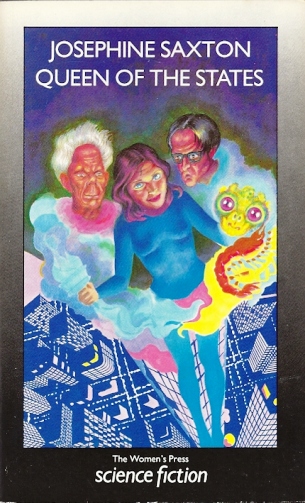
Review: The Hieros Gamos of Sam and An Smith; and Queen of the States; by Josephine Saxton

The Hieros Gamos of Sam and An Smith; and Queen of the States; by Josephine Saxton

a review by Rich Horton

I recently reviewed Josephine Saxton's Vector for Seven, so I won't rehash the potted bio I did then. Suffice it to say that Saxton was a significant figure in the English SF New Wave of the late 1960s (though she never appeared in New Worlds, and in fact F&SF was her primary short fiction market.) I say that, yet I think her fiction so individual that she should be thought of as a writer with her own vision, who was associated with the New Wave because at that time that seemed the proper home for anyone as strange as she. Here I've considered her first (and likely still best known) novel, and also one of her last, perhaps her last full length novel.


Her first novel was The Hieros Game of Sam and An Smith, which was published by Doubleday in 1969. Doubleday published her first three books in three consecutive years, no further books appeared until 1980. And on the face of it none of her novels seem likely to have been big sellers to the SF audience. Doubleday at that time relied heavily on library sales, and I sense that they could sell a reliable quantity of any book they could slap an SF label on. That allowed them, perhaps, to take risks that other firms might not. It also sometimes put a cap on the exposure of their books. At any rate, only Saxton's first Doubleday novel got a paperback reprint, from the fairly low end publisher Curtis Books. (None of this, I add, should imply that they are not good books!)

The Hieros Gamos of Sam and An Smith opens with a boy of about 14 wandering what seems an entirely deserted landscape. There are apparently a very few other people somewhere, who he avoids, and there is trash visible. Sometimes, it seems, he can scrounge food or clothing from places. For an SF reader, the immediate thought it that he is a survivor of some apocalyptic event. (We learn that Saxton has very different plans for us!) The boy hears a sound, and against his better instincts he investigates, and finds a dead woman, with an apparently newborn girl. The boy tries to make himself leave -- he knows this is the safest course -- but eventually takes the infant, drawn by her cries, and takes her with him, trying to comfort her. Soon he must feed her, and after much distress finds some cans of condensed milk. And so he begins walking again, with the baby in his arms. So far, so post-apocalyptic!

But their next stop is a town, still seemingly empty, but full of stores -- well-stocked stores, but empty of people. The two end up in a sort of department store, where the boy finds food for the baby (and for him) and clothes, etc. And occasional hints of a mysterious other. They hole up in the department store for some four years, the boy raising the baby as best he can, with apparently unlimited necessities available in this store. Then they set out walking again. And the novel continues ... an ongoing journey, a story of growth. The boy teaches the girl to talk and she learns about the world as best she can by asking him questions. Their walking takes them through a series of still curiously empty places, but full of what seem typical 1960s English structures. They give each other names (Beryl and George.) And the time comes when they must decide what do with their lives, together or apart. They must, in essence, grow up, perhaps? I won't say how it ends (and if you don't know what the title of the novel means, don't look it up until after reading the book.) But it's effective, and moving, and the very end is -- not perhaps what we expect.

It's hard for me to quite describe how strange, how unexpected, this novel is. It never goes where one expects. It is also often quite funny (Saxton is always funny) -- not laugh out loud funny, not sitcom stuff, but slyly funny. It's also sweet, and powerful, and oddly mesmerizing.

Queen of the States (The Women's Press, 1986) is a very different novel, but shares some of the same weirdness I find in The Hieros Gamos of Sam and An Smith (and for that matter in Vector for Seven.) It opens with Magdalen Hayward having left her husband Clive, driven off somewhere remote, to consider her new life, or a return to Clive. She gets out of her car and -- is sucked up into an alien spaceship.

On the spaceship she wakes to find the very odd aliens communicating with her, about the simulacra they have made of a room for her, some food, etc. It seems she is an object of study, very interesting to them. And they are willing to make her whatever she wants -- another room, great food, even, eventually, other people. (But not her cherished toy bear.) 

And then we are told (unreliably) that Magdalen is in an asylum, having committed herself, presumably due to stress resulting from Clive's cheating, and his generally erratic behavior. The nurses there are cruel, the other patients generally batty, and Magdalen is soon considering leaving. Of course, when she leaves she will return to the White House, and her role as Queen of the United States.

And the novel, in short chapters, zigs and zags from reality to reality. We are often in Magdelen's POV but we also have scenes with Clive, with his student/lover, with another patient, with a couple of Magdalen's lovers (in the past? present? or in another reality?) And also we see the POV of a psychiatrist, who seems to be treating at times both Magdalen and Clive's young lover. The psychiatrist also has an experience with a UFO, and soon is trying to write a book that will revolutionize his field. Magdalen contemplates leaving the asylum, or leaving the aliens, or confronting Clive ...

It's a wild enough ride, and it never takes itself too seriously. It never commits to the truth of any of the suggested realities. It's quite funny, in a noticeably Saxtonian way. It's got the same sort of extra-real affect that the other two Saxton novels I've read have. I don't want to suggest it's weird like, say, Robert Shea Wilson. It's a very grounded weird, a very real-seeming weird. It didn't work as well on the whole, for me, as either Hieros Gamos or Vector for Seven, perhaps because it was never quite as involving, and never quite as moving, as those books. But I'm glad I read it. 

Monday, August 15, 2022

Alternate Hugo Nominations of the 1950s

This post organizes links to all 11 posts I made on potential or alternate Hugo nominees, and winners, for the years 1949 through 1959. I should note that I have made some revisions, often significant (adding a story or two in some cases, fixing typos and other mistakes, and adding a lot of additional possibilities to the post about stories from 1957.)

In each case the title refers to the year of the convention at which the Hugos would have been (or actually were) awarded, so the stories are from the prior calendar year. 

I will note that where possible I've referred to the excellent work done by Jo Walton in her book An Informal History of the Hugos, and also to Richard Lupoff's What If? anthologies, which chose one potential alternate Hugo winner for each year from 1952 through 1973.


Hugo Nomination Recommendations, 1950

Hugo Nomination Recommendations, 1951

Hugo Nomination Recommendations, 1952

Hugo Nomination Recommendations, 1953

Hugo Nomination Recommendations, 1954

Hugo Nomination Recommendations, 1955

Hugo Nomination Recommendations, 1956

Hugo Nomination Recommendations, 1957

Hugo Nomination Recommendations, 1958

Hugo Nomination Recommendations, 1959

Hugo Nomination Recommendations, 1960

Sunday, August 14, 2022

Hugo Nomination Recommendations, 1960

Potential Hugo nominations for the 1960 Hugos (stories from 1959)

Here's my last planned post on potential Hugo nominees from the past. This is for the 1960 Hugos, for stories from 1959. Thus I close out the decades of the 1950s. Also, I was born in 1959, in October, and so this is a pretty important year for me! (Not that I remember it well!) The 1960 Worldcon was in Pittsburgh. I highlight the actual Hugo nominees and winners below.

I will once again mention Jo Walton's exeptional book An Informal History of the Hugos, in which she discusses the Hugo Awards from 1953 through 2000, including the nominees and potential additional stories to consider. I will also mention Richard A. Lupoff's What If? series of anthologies, which chose a single alternate story for each year (of story publication) from 1952 through 1973. 

Novel:


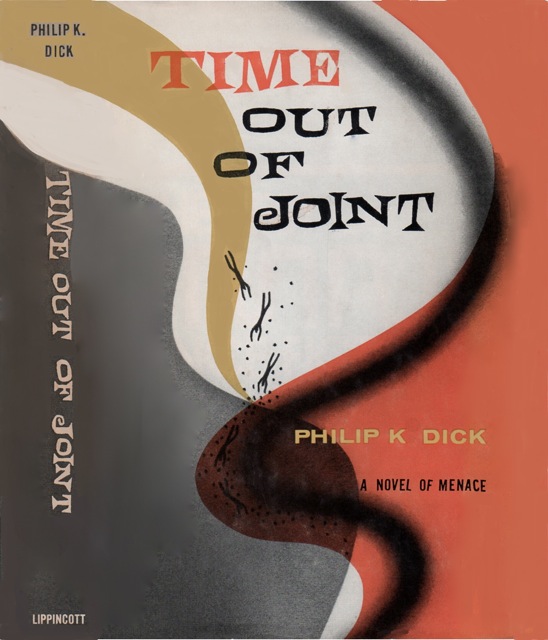
Time Out of Joint, by Philip K. Dick

Starship Troopers aka "Starship Soldier", by Robert A. Heinlein Hugo winner

The Haunting of Hill House, by Shirley Jackson

A for Anything aka The People Maker, by Damon Knight 

The Sirens of Titan, by Kurt Vonnegut, Jr. Hugo nominee

Other possibilities:

We Claim These Stars! aka "Hunters of the Sky Cave", by Poul Anderson

The Manchurian Candidate, by Richard Condon

Dorsai! aka The Genetic General, by Gordon R. Dickson Hugo nominee

Alas, Babylon, by Pat Frank

First to the Stars, by Rex Gordon

Providence Island, by Jacquetta Hawkes

"The Pirates of Ersatz" aka The Pirates of Zan, by "Murray Leinster" (Will Jenkins) Hugo nominee

The Beast Master, by Andre Norton

"The Sweet Little Old Lady" aka Brain Twister, by "Mark Phillips" (Randall Garrett and Laurence M. Janifer) Hugo nominee

Wolfbane, by Frederik Pohl and C. M. Kornbluth

Level 7, by Mordecai Roshwald

My choice for the Hugo would be Time Out of Joint, one of my favorite Philip K. Dick novels. I don't mind the Hugo for Starship Troopers, however, as I think it an interesting and pretty well done novel (even if I don't approve of the political organization the novel suggests.) I haven't read the Jackson novel but it sure sounds like it is worthy of a nomination. The Sirens of Titan is quite good, too. A for Anything is a decent novel, but not great -- Knight wouldn't really figure out how to write a fully satisfying novel for a couple of decades at least. Based on what I've read about them, very possibly Mordecai Roshwald's Level 7 and Jacquetta Hawkes' Providence Island are also Hugo-worthy, and perhaps even The Manchurian Candidate.

This was the height of the Cold War, and the height of fears of Nuclear War, and that is emphasized by the popular success of out and out "End of the World due to Nuclear War" books like Level 7; Alas, Babylon; A Canticle for Leibowitz; and On The Beach, all published in this time frame. For that matter, Providence Island is about a lost race resisting the use of their island for nuclear tests, and The Manchurian Candidate is surely a Cold War novel to the max!

I list Pohl and Kornbluth's Wolfbane, but a shorter version (perhaps just novella length) appeared in 1957. I was amused to learn, in searching for it in the ISFDB, that the slight variant title Wolfsbane turns out to be a very oft-used title -- at least eight novels and a dozen or more short stories. Note also the two titles with exclamation points -- Dorsai! was the title of the Astounding serial, clumsily retitled, because Don Wollheim, for the Ace Double (which was also abridged.) And Anderson later collected We Claim These Stars! in Agent of the Terran Empire, retitled "Hunters of the Sky Cave" (and possibly revised.) Despite its presence in a collection, it is novel length by my estimate, 45,000 or more words.

Jo Walton suggests that Starship Troopers was going to win against this competition no matter what, and that despite its controversial aspects it's a major novel that has lasted. She hints that she might prefer either Eric Frank Russell's Next of Kin (which I mentioned in the post about 1958 novels in its slightly shorter form as The Space Willies) or Jackson's The Haunting of Hill House.

A couple of novels worth mentioning that don't quite qualify are Psycho, by Robert Bloch, which isn't SF or Fantasy (there's no supernatural element at all), and A Canticle for Leibowitz, by Walter M. Miller, which is a fantastic novel and a very worthy Hugo Winner -- in 1961! It is often cited (for example by the ISFDB) as a 1959 novel, but though it is copyrighted 1959 is was not published until February 1960. (Thanks to Denny Lien for the research that established this.) Likely the publisher originally scheduled it for late 1959 but delayed it until 1960 for marketing reasons (better chances to get reviews, something like that.) Reputedly Algis Budrys was bitter that his great novel Rogue Moon lost the Hugo to A Canticle for Leibowitz, which he thought ineligible due to the 1959 copyright -- but he had no case to complain, as the book really was a 1960 book.

Novella:

"A Handful of Stars", by Poul Anderson (Amazing, May)

"Sister Planet", by Poul Anderson (Satellite, May)

"The Whole Man", by John Brunner (Science Fantasy, April)

"Someone to Watch Over Me", by "Christopher Grimm" (Floyd C. Gale and H. L. Gold) (Galaxy, October)

"The Alley Man", by Philip José Farmer (F&SF, June) Hugo nominee

Another fairly thin novella list. I'd lean towards "The Alley Man" though I haven't read Brunner's "The Whole Man", which I assume is an early version of the novel of the same title -- the novel, at least, is strong work, and if the novella is as good perhaps it would have got my Hugo vote. The Anderson stories are solid work. The Christopher Grimm story is pretty enjoyable -- the Gold brothers (Floyd was Horace's brother, though he used Gale for his SF work, perhaps to avoid accusations of nepotism?) were a pretty strong writing team.

Novelette:

"The Waiting Grounds", by J. G. Ballard (New Worlds, November)

"Take Wooden Indians", by Avram Davidson (Galaxy, June)

"What Now, Little Man?", by Mark Clifton (F&SF, February)

"Jordan", by Zenna Henderson (F&SF, March)

"Flowers for Algernon", by Daniel Keyes (F&SF, April) Hugo winner

"Lean Times in Lankhmar", by Fritz Leiber (Fantastic, November)

Other possibilities:

"Brave to be a King", by Poul Anderson (F&SF, August)

"The Sky People", by Poul Anderson (F&SF, March)

"Despoilers of the Golden Empire", by "David Gordon" (Randall Garrett) (Astounding, March)

"What Rough Beast", by Damon Knight (F&SF, February)

"Wherever You Are", by "Winston P. Sanders" (Poul Anderson) (Astounding, April)

"The Silver Eggheads", by Fritz Leiber (F&SF, February)

"Dodkin's Job", by Jack Vance (Astounding, October)

"Cat and Mouse", by Ralph Williams (Astounding, June) Hugo nominee

Well, my vote for best novelette of 1959 goes to the obvious choice, the same choice the voters in 1960 made for the Best Short Fiction Hugo, "Flowers for Algernon". I will say that "Take Wooden Indians" is one of my favorite Avram Davidson stories; and "Lean Times in Lankhmar" is one of the best Fafhrd and the Grey Mouser stories, and "What Now, Little Man?" is Mark Clifton at his bleak best, and "Jordan" is a major People story (indeed, as I recall, the "First Contact" story in that set) and "The Waiting Grounds" is one of the first J. G. Ballard stories to make a significant impact ... but, yeah, it's "Flowers for Algernon". (Jo Walton also endorsed the choice of "Flowers for Algernon".)

Of the other possibilities, one might note that "Despoilers of the Golden Empire" isn't really SF, though it's a bit of an, er, despoiler to say so. "Dodkin's Job" is uncharacteristic Vance, but it's pretty good. And I confess I know nothing about the Ralph Williams story, though Williams did do some interesting work.

Short Story:

"The Pi Man", by Alfred Bester (F&SF, October) Hugo nominee

"Dagon", by Avram Davidson (F&SF, October)

"Adrift on the Policy Level", by Chan Davis (Star #5)

"All You Zombies ...", by Robert A. Heinlein (F&SF, March)

"The Man Who Lost the Sea", by Theodore Sturgeon (F&SF, October) Hugo nominee

Other possibilities:

"A Man to My Wounding" aka "State of Assassination", by Poul Anderson (EQMM, December)

"The Shoreline at Sunset", by Ray Bradbury (F&SF, March)

"The Distant Sound of Engines", by Algis Budrys (F&SF, March)

"The Man Who Tasted Ashes", by Algis Budrys (If, February)

"The Montavarde Camera", by Avram Davidson (F&SF, May) 

"Angerhelm", by "Cordwainer Smith" (Paul M. A. Linebarger) (Star #6)

"Golden the Ship Was - Oh, Oh, Oh", by "Cordwainer Smith" (Paul M. A. Linebarger and Genevieve Linebarger) (Amazing, April)

"The Clone", by Theodore Thomas (Fantastic, November)

"Plenitude", by "Will Worthington" (Will Mohler) (F&SF, November)

Once again, a slam dunk for me, despite a very strong shortlist. "The Man Who Lost the Sea" is hands down one of the greatest SF stories of all time. I would have voted for it ahead of "Flowers for Algernon" for "Best Short Fiction" on the 1960 Hugo ballot. That said, "The Pi Man" is brilliant. "All You Zombies ..." is brilliant. "Dagon" is brilliant. I mean, heck, what a shortlist!

Richard Lupoff's choice for an "alternate Hugo" in his What If? series of anthologies was Bester's "The Pi Man". I note, by the way, that F&SF for the month of my birth -- October 1959 -- included three (!) great stories: "The Pi Man", "Dagon", and "The Man Who Lost the Sea".

There is plenty of good stuff in the "other possibilities" too -- notably a first rate Ray Bradbury story, some examples of Algis Budrys at close to his obsessive best, a neat biter-bit story from Avram Davidson, a couple of good early Cordwainer Smith stories, and a solid work by the nearly forgotten "Will Worthington".

Sturgeon's "The Man Who Lost the Sea" was selected for Martha Foley's The Best American Short Stories 1960. Indeed, under Foley's long editorship of that series, only two SF stories from genre sources were reprinted, the other being Judith Merril's "Dead Center" in the 1955 volume. Foley died in 1977, and after that the series had different guest editors each year, allowing, one presumes, a more diverse, more varied, perspective, and increasing the likelihood of genre pieces being selected. Offhand, I can think of four such stories making it: Harlan Ellison's "The Man Who Rowed Christopher Columbus Ashore" in the 1993 volume (guest editor Louise Erdrich); two from the 2005 volume, guest edited by the notoriously SF friendly Michael Chabon: Tim Pratt's "Hart and Boot" and Cory Doctorow's "Anda's Game"; and Ted Chiang's "The Great Silence" from the 2016 volume, edited by another SF friendly writer, Junot Diaz. (Very possibly other SF/F stories have been chosen as well in recent years.) Note that there were occasional fantastical stories from traditional literary publications in the series all along, though not, I think, very many. But Karen Russell, for example, has appeared several times, with distinctly fantastical stories -- but always from publications like Granta and the New Yorker.

Saturday, August 6, 2022

Hugo Nomination Recommendations, 1959

 Potential Hugo nominations for the 1959 Hugos (stories from 1958)

One more post about potential Hugos from 1950s conventions: this one for 1959, so that stories from 1958 were eligible. This was the first year that the dates of eligibility were essentially standardized. (A couple of minor tweaks were made later.) Thus, as of the 1959 Worldcon, stories from the previous calendar year (defined by publication date for novels, and cover date for stories from magazines) were eligible. Also in 1959, a formal nomination process was established, and a final ballot was issued. (Prior to this, there were tentative moves in this direction a couple of the conventions.) One thing that was not standardized was the short fiction categories. (Also, I'm not sure if the novel length limit had been set.) That didn't settle down until the early '70s, probably partly under the influence of the Nebula Awards.

I have cited Jo Walton's excellent Informal History of the Hugos before, and in that book you can find Jo's comments on the short lists, her choices for the winners, and comments by a variety of people (myself included) discussing the stories and often offering additional possible nominees or winners. I'll list Jo's choices below, along with Richard Lupoff's short fiction selection from What If, Volume 1. And for the years from 1960 on, I'll leave the field to Jo! (After all, my thoughts are generally recorded in her book anyway.) I've decided to go ahead and make one additional post for stories from 1959, for two reasons: one, to round out the decade of the 1950s by story publication year, not just Worldcon year; and, two, because I was born in 1959.

The 1959 Worldcon was called Detention, and was held in Detroit, MI.

(Note that the 1959 Hugo short fiction shortlists are pretty long, and that novelette and novella are combined. Also note that 1958 was the year magazine distribution collapsed, and there was a decrease in the amount of short fiction published.)

Novel:

Non-Stop aka Starship, by Brian W. Aldiss

The Enemy Stars aka "We Have Fed Our Sea", by Poul Anderson Hugo Nominee


A Case of Conscience
, by James Blish Hugo Winner

Who?, by Algis Budrys Hugo Nominee

Have Space Suit, Will Travel, by Robert A. Heinlein Hugo Nominee

The Once and Future King, by T. H. White

Other possibilities:

The Cosmic Rape aka "To Marry Medusa", by Theodore Sturgeon

War of the Wing-Men aka "The Man Who Counts", by Poul Anderson

The Triumph of Time, by James Blish

VOR, by James Blish

The Survivors, by Tom Godwin

The Big Time, by Fritz Leiber Hugo Winner 1958

Star Gate, by Andre Norton

The Time Traders, by Andre Norton

The Space Willies aka Next of Kin, by Eric Frank Russell

Immortality, Inc., by Robert Sheckley Hugo Nominee

The Lincoln Hunters, by Wilson Tucker

The Languages of Pao, by Jack Vance

My choice here is still A Case of Conscience, though The Once and Future King would have been an intriguing option. Andre Norton's The Time Traders was one of the first Andre Norton books I read, and it remains in my memory as one of my favorites. Blish's VOR is interesting in part because it's an expansion of a collaboration -- the original short story was written with Damon Knight, titled "The Weakness of RVOG". I note that with Next of Kin (actually a slightly expanded version published in the UK in 1959) and a few other stories that year, Russell essentially packed it in as a writer. (Two more novels followed, The Great Explosion (an inferior expansion of "And Then There Were None") and The Mindwarpers, plus a couple of stories. He was only 60 in 1965, when The Mindwarpers appeared -- I'm not quite sure why he quit. Couldn't have been the pay, could it? :)

Jo Walton didn't express a preference among the five Hugo nominees.

Novella:

"Captivity", by Zenna Henderson (F&SF, June) Hugo Nominee

"Two Dooms", by C. M. Kornbluth (Venture, July)

"Be My Guest", by Damon Knight (Fantastic Universe, September)

"Hunt the Space Witch!", by Robert Silverberg (Science Fiction Adventures, January)

"The Big Front Yard", by Clifford D. Simak (Astounding, October) Hugo Winner

"The Miracle Workers", by Jack Vance (Astounding, July) Hugo Nominee

It's a thin novella list (though strong at the top.) I would have to choose the same story the voters picked, "The Big Front Yard". (Jo Walton also agrees.) The Henderson, Vance, and Kornbluth are close to it, though. The Silverberg is there because it's perhaps the most fun early Silverberg novella I read. Richard A. Lupoff's selection for an alternate Hugo was Kornbluth's "Two Dooms". 

Novelette:

"Unwillingly to School", by Pauline Ashwell (Astounding, June) Hugo Nominee

"The Ugly Little Boy" aka "Lastborn", by Isaac Asimov (Galaxy, September)

"It Walks in Beauty", by Chan Davis (Star Science Fiction, January)

"Among the Dangs", by George Elliott (Esquire, June)

"A Deskful of Girls", by Fritz Leiber (F&SF,  April) Hugo Nominee

"Second Game", by Katherine MacLean and Charles V. de Vet (Astounding, March) Hugo Nominee

Other possibilities:

"Segregationist", by Brian W. Aldiss (New Worlds, July)

"Big Sword", by "Paul Ash" aka Pauline Ashwell (Astounding, October)

"Aristotle and the Gun", by L. Sprague de Camp (Astounding, February)

"The Immortals", by James Gunn (Star #4)

"Shark Ship" aka "Reap the Dark Tide", by C. M. Kornbluth (A Mile Beyond the Moon) Hugo Nominee

"Rat in the Skull", by Rog Phillips (If, December) Hugo Nominee

"Ullward's Retreat", by Jack Vance (Galaxy, December)

In this list I'd pick Chan Davis' "It Walks in Beauty", I think most present day readers would choose "The Ugly Little Boy", and I really don't dispute that. I just think "It Walks in Beauty" is underrated, too little known, and original and moving. Richard Lupoff chose "Unwillingly to School", which is lots of fun also!

Note that Star #4 is the fourth edition of Frederik Pohl's seminal original anthology series, while Star Science Fiction for January was his abortive attempt to turn it into a magazine. 

Short Story:

"But Who Can Replace a Man?", by Brian W. Aldiss (Infinity, June)

"The Men Who Murdered Mohammed", by Alfred Bester (F&SF, October) Hugo Nominee

"Pelt", by Carol Emshwiller (F&SF, November)

"Casey Agonistes", by Richard McKenna (F&SF, September)

"The Yellow Pill", by Rog Phillips (Astounding, October)

"A Touch of Strange", by Theodore Sturgeon (F&SF, January)

Other possibilities:

"They've Been Working On", by Anton Lee Baker (Astounding, August) Hugo Nominee

"That Hell Bound Train", by Robert Bloch (F&SF, December) Hugo Winner

"Triggerman", by J. F. Bone (Astounding, December) Hugo Nominee

"The Edge of the Sea", by Algis Budrys (Venture, March) Hugo Nominee

"Or All the Seas with Oysters", by Avram Davidson (Galaxy, May) Hugo Winner 1958

"The Burning of the Brain", by Cordwainer Smith (If, October)

"Far From Home", by Walter Tevis (F&SF, December)

"Examination Day", by Henry Slesar (Playboy, February)

"The Statistomat Pitch", by Chan Davis (Infinity, January)

"The Advent on Channel 12", by C. M. Kornbluth (Star #4) Hugo Nominee

"Theory of Rocketry", by C. M. Kornbluth (F&SF, July) Hugo Nominee

"Try and Change the Past", by Fritz Leiber (Astounding, March)

"Space Time for Springers", by Fritz Leiber (Star #4)

"Rum-Titty-Titty-Tum-TAH-Tee", by Fritz Leiber (F&SF, May) Hugo Nominee

"Space to Swing a Cat", by Stanley Mullen (Astounding, June) Hugo Nominee

"Nine Yards of Other Cloth", by Manly Wade Wellman (F&SF, November) Hugo Nominee

I would have chosen "The Men Who Murdered Mohammed" (and Jo Walton agrees with me.) The Aldiss story might be second, or perhaps the Emshwiller. Behind that, the next four stories plus the Bloch, Budrys, Davidson, Slesar, Smith, all three Leiber stories, and "Theory of Rocketry" are very very close. Note that Kornbluth had died in 1958, and this was the last we'd see from him, except for the Pohl collaborations that showed up later. Finally, I admit I know almost nothing about the Stanley Mullen, J. F. Bone and Anton Lee Baker stories, which are listed because the Hugo nominators thought them worthy. I have been assured by multiple people that J. F. Bone's "Triggerman" is quite good.