Wednesday, February 16, 2022

Review: The Unraveling, by Benjamin Rosenbaum

 The Unraveling, by Benjamin Rosenbaum

a review by Rich Horton

I'll begin with the meat -- this is the best SF novel I've read from 2021, by some margin -- my favorite novel since Piranesi, indeed. It succeeds on multiple axes. It is absolutely pure quill science fiction, set in the far distant future, on (or in) a world hundreds of light years from Earth. It features characters who are recognizably human but very strange -- they have multiple bodies, for instance, and are very long-lived. It both displays and interrogates a significantly different economy (essentially reputation based, complete with betting pools.) It is deeply interested in a radically different family structure. Perhaps most noticeably, this is a story of a highly gendered society -- and the genders are quite different from those in traditional contemporary societies. 

The Unraveling is, plotwise, several different entities at once. It is a bildungsroman, following its main character from early childhood to early adulthood. It is a romance, and a powerfully affecting one. It is in a curious way a traditional sort of YA novel, about characters who are not quite adults rebelling (to a degree) against their parents' expectations, and against what they perceive (unwillingly?) as their society's faults. It speculates intriguingly about a different model of family. It is about a near utopia, and about that apparent utopia's faults -- and in so doing confronts the age-old questions about utopias (are they too boring? too static?) In a way, the book sometimes seems to be about social media, even! And it is also about what I think SF's most achingly central theme -- exploration. And it's about literature's most achingly central theme -- what is the purpose of human life, either as individuals, or as a community?

Is it perfect? Of course not. "Nobody's perfect," said Joe E. Brown, in perhaps the most perfect movie comedy of all time. At times the YA-ish aspects of the plot seem a bit too pat. Our heroes perhaps a bit too -- not perfect, but "good". But really this is not badly handled, and perhaps it's unavoidable. The society is so excellently different from ours that I felt at times that the narrative shied away just a bit from allowing that difference to overwhelm us,It's understandable -- you don't want to end up with a Murder in Millennium VI situation (this a reference to Curme Gray's 1951 novel, widely regarded as incomprehensible, though Damon Knight praised it.) But the book does sag just a bit towards the middle, after the first major climax, by when we understand the society and its strains fairly well, but it regains its footing later and finishes powerfully. The bottom line remains -- this is a lovely book, a thoughtful book, a powerful book ... and it sticks its landing.

Benjamin Rosenbaum has been one of the most original and intriguing SF writers, one of my favorites, really, since his debut in 2001. He has mostly published short fiction. I've reprinted a few of his stories in my anthologies, most notably, for our purposes, "Fift and Shria", from the 2014 original anthology Solaris 3. Fift and Shria are the main characters of The Unraveling, and the story "Fift and Shria" is a slighly different version of an episode in the novel. Rosenbaum was born in the US, but has lived for some time in Switzerland, and (perhaps as a result) this novel was first published in German translation in 2018, as Die Auflösung. The English version was published by the very intriguing new imprint Erewhon Books in 2021, and I have that edition, and I also got the audio edition, read by Fred Berman. 


The novel centers on Fift, a "Staid", one of the two genders of the humans living in his polity -- the other gender being "Vail". The other main character is Shria, who is of course a Vail. Rosenbaum presented the short story "Fift and Shria" as a rendering in contemporary English, and as such he rendered the pronouns of the two genders ("Staid" and "Bail" at that time) as "she" and "he", while cautioning that those genders don't cleanly map to "female" and "male". In the novel, the pronouns are "ze" and "ve", and this change is essential and very well handled. Staid and Vail have nothing to do with genitalia (indeed, different genitalia can be adopted at different times in this world) -- instead, they represent, essentially, emotional states -- Staids are the "still center", and Vails are more flamboyant, more expressive, more violent, more sexual. And these genders are assigned, in early childhood, by the somewhat mysterious Midwives, who live apart from the rest of this polity.

Their world is a terraformed planet hundreds of light years from Earth. The humans live inside it, with the rarely visited surface devoted to nature. There are several "nations" on the inside, and these nations are further subdivided into habitation. We meet Fift as a young child (nearly 5,) as Staid, ready to be introduced to the Long Conversation, in the company of his nine parents ... one Mother, eight fathers, two Staids, seven Vails. (Later we learn that the cohorts that raise children can come in almost any permutation of genders.)  Fift (and Shria) live in the nation of Fullbelly, and the habitation of Foo. They become friends on a field trip to the surface, at age 9 or so; and by the age of 15 they are feeling romantic attraction to each other, which is quite taboo, at that age, between Staids and Vails. And then they get tickets to the Cirque, a presentation of the Clowns. And there they meet Thavé, an ancient human, something of an historian mainly ... and Thavé makes some observations about their world and civilization that seem to question its central values. And shortly later things are temporarily plunged into chaos, as a revolutionary group of Vails cuts the "Feed" and urges people -- Vails, at least -- to abandon the cultural limits placed on them. And, somehow, Fift and Shria become, entirely involuntarily, celebrities, and symbols of this "revolution" -- though they are by no means sure they support it.

I don't want to say much more -- I think I'm garbling things a bit, and I think the wonders of this novel are best revealed by reading it. My expectations kept changing as my understanding grew. I was surprised again and again. Sometimes I wanted to argue. I was challenged too -- in particular by my default (and often false) genderized assumptions about Staids and Vails, because they so beautifully don't match "male" and "female", and also don't match contemporary non-binary expectations. I was moved to wonder -- by things like the Long Conversation of the Staids, which we only barely begin to comprehend; or by the polysomatic identity of these people, for by Thavé's half-million year perspective on human civilization(s). And I was emotionally moved, by Fift's yearnings, and by Shria's, and even Thavé's. Two short lines, each close to the end of the novel, brought me to tears: "Oh: It was joy." and "Be alive, Siob. You have to be alive." 

Sunday, February 6, 2022

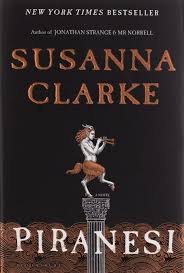
Review: Piranesi, by Susanna Clarke

Piranesi, by Susanna Clarke

a review by Rich Horton


Susanna Clarke's first novel, Jonathan Strange and Mr Norrell, from 2004, was a sensation. It won the Hugo for Best Novel, and eventually became a TV series. It deserved all the accolades it received -- and for me, it is the best fantasy novel of the 21st Century (well, now -- one of the best two!) Naturally, readers wanted more from Clarke -- but aside from an excellent story collection, The Ladies of Grace Adieu, nothing was forthcoming. The reasons are wholly understandable -- Clarke has had considerable health challenges. But, finally, in 2020 her second novel appeared. (And a third is reportedly soon to follow.) This second novel is Piranesi -- and it is as different to her first novel as any novel also describable as fantasy might be. It is also, in its own way, quite as good.

As a side issue, I will note that this was the first book I ever "read" by listening to an audio recording. The book was read by the first rate screen actor Chiwetel Ejiofor. Perhaps I was a bit spoiled by this -- I think he did an exceptional job. I should say, however, that most of the audiobook readers I have encountered since then have been just fine, and none have been bad. (As with almost all the audiobooks I've read, I also got the physical book -- for one thing, it's hard to write about a book without the text to check! (If for no other reason than getting character names right!))

Piranesi bears almost no resemblance to Jonathan Strange and Mr Norrell. It is far shorter, It is set in what seems roughly the present day, not an alternate Regency. It is almost claustrophobic in setting (though strangely manages to not feel claustrophobic despite being mostly set in a single building) and for much of the novel the main character is completely alone. For all that, it is as good as its predecessor.

I read the novel over a year ago, and for a variety of reasons have not yet written about it. So what I write may be a little briefer than usual. I dare say that may be a feature, not a bug!

Piranesi is primarily set in a single House, which is also for all practical matters the World. It is of indefinite size, though there is a visible outside. At the time of this narrative it is occupied by only one person, the narrator, who is called Piranesi by the only other person he knows, whom he calls the Other, and who shows up at irregular intervals. Piranesi knows of 13 other people who have lived in the World -- all skeletons that he has found. The story is mostly told through entries in Piranesi's diary, which records his attempts to catalog things he finds in the House, and to discuss his relationship with the Other.

The Other, who is somewhat older than Piranesi (who believes himself to be in his mid-30s) is in search of the Great and Secret Knowledge he believes can be found in the House. Piranesi is allowed to assist the Other in this pursuit. We soon gather that their relationship is unequal and indeed abusive, though Piranesi does not seem to realize this. And so the plotty center of the story (though truly this is not a novel of plot, even though the plot is important) concerns the unraveling of the secret of why Piranesi is confined in this House, and who Piranesi and the Other really are, and what is their history, and who are the other people who have lived (and died) in the House. A fulcrum is the appearance of another person, a woman, whom Piranesi calls 16.

All this is effectively revealed to us over time, and it's a deeply sad story that I won't detail. Best by far to have it come slowly clear while reading the novel. The conclusion is honest, and moving -- nothing is truly restored but what small justice can be done is done. Piranesi's fate, even after he learns his original identity, is ... appropriate. 

But what remains after we learn all this is beauty, and mystery. As the novel's closing sentence reads: "The Beauty of the House is immeasurable, its Kindness infinite." Piranesi's existence is extremely confined throughout the events of the book, but he learns to see in the House its loveliness. And Clarke manages to show us this. The statues of the house -- The Statue of a Woman Carrying a Beehive, The Statue of a Shepherdess, The Body of the Attacking Centaur, etc, and other things like The Biscuit-Box Man, or Piranesi's fishnets, or the birds he finds in some of the chambers, or the varying water levels, or the maps of the stars ... all these seem truly wonderful. Piranesi's own innocence and wonder are contagious (if also in some way sad.) Ultimately the House is truly a fantastical place; and the knowledge the Other is pursuing is quite mysterious, if by no means what the Other expects. 

Great novels often bring tears to my eyes independent of tragic events ... it is wonder and beauty that truly make me cry. Piranesi works on me in this way, even as I write this review. Perhaps in an odd way I am reminded of an otherwise wholly different novel, John Crowley's Little, Big. Susanna Clarke's career output is small, but it is remarkable, and she must be counted as one of the great English fantasists. 

Monday, January 24, 2022

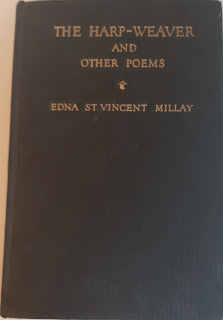
Old Bestseller Review: The Harp-Weaver and Other Poems, by Edna St. Vincent Millay

The Harp-Weaver and Other Poems, by Edna St. Vincent Millay

a review by Rich Horton


When I was first reading poetry, Edna St. Vincent Millay had a reputation as a fusty old traditionalist, a minor poet, out of step with the times. Essentially two lines of all her poetry seemed to be remembered: "My candle burns at both ends" and "Euclid alone has looked on beauty bare". I will be honest and admit I read nothing of her work beyond those two poems.

The thing is, that while Millay was indeed a traditionalist in the formal sense, and in that sense out of step with the direction of 20th Century poetry at that time, she was in no other sense "fusty". Least of all, I suppose, in her personal life -- she carried on passionate affairs with both men and women throughout her life. She married an older man, Eugen Boissevain, in 1923, and they remained married (in a notably open marriage) until his death in 1946. Millay died in 1950, at age 58, of a fall, though her health had been poor for years. (Her candle really did burn at both ends!) Throughout her life she was a passionate feminist, anti-war activist, and socialist. 

Her literary career took flight in 1912 when her long poem "Renascence" was entered in a context sponsored by The Lyric Year. She did not win, but the actual winner (Orrick Johns) avowed that she had deserved to win -- at any rate, this cemented the reputation of "Renascence" as a major poem. (Millay had publshed some well-received juvenilia before this.) Millay attended Vassar, then moved to New York City, and began publishing additional poetry, plays, and also short fiction (which she apparently did not respect, and published as by "Nancy Boyd"). She won the Pulitzer Prize for poetry in 1923, for "The Ballad of the Harp-Weaver', which is included in this collection. (The citation is ambiguous -- perhaps it is for the entire collection, and mention is also made of her earlier collection Figs from Thistles.) Millay became a celebrity, for her poetry and for her live readings of the poems.

I found a used copy of The Harp-Weaver and Other Poems at an estate sale recently, the First Edition from 1923, in excellent condition (but no dust jacket.) (I'm not sure if it's a True First, that is, if it's from the first printing of the first edition -- there is a code on the copyright page: L-X. Not sure what that means.) It is signed by the first owner (I assume) -- alas, I can't read the name. "Minette Douglas, 1923" perhaps? 

This is an excellent collection of poems, deserving its Pulitzer, I'd think. Millay's reputation has been restored in recent decades from the low ebb I detected 40 or 50 years ago, and she definitely deserves to be read widely. Millay, as noted, writes in traditional forms (most famously, the sonnet), complete with rhyming and with regular meter. She is very skilled in wielding these forms. Her themes are her own, and thoroughly of her time, not old fashioned at all.

The book is divided into 5 sections. The first is short lyric poems, all in rhyme, linked (I suppose) by themes of nature's beauty -- which for Millay is found as much (or more!) in non-traditional, perhaps conventionally ugly, places than in traditionally beautiful settings. (As she writes in the opening poem, "My heart, being hungry, feeds on food/the fat of heart despise./Beauty where beauty never stood,/and sweet where no sweet lies." The second is also mostly short lyric poems, rhymed, but more about characters. It closes with the longish title poem, "The Ballad of the Harp-Weaver," which is a sort of dark fairy tale about a poor widow who cannot afford clothes for her boy, and her magic harp. I was amused by one poem, "The Return from Town", in which the first person narrator tells of passing a couple of attractive men on her way home, but close "Then in I turned at my own gate.--/and nothing to be sad for--/to such a man as any wife/would pass a pretty lad for." -- a nice sentiment and well turned but rather in contrast with Millay's own love life.

The third part also contains short poems, but these are unrhymed, indeed mostly free verse, and generally of a philosophical nature. Finally, the fourth and fifth sections are all sonnets -- part four is a collection of unrelated sonnets, and part five is given over to an impressive sonnet sequence: "Sonnets from an Ungrafted Tree". I said part four is unrelated sonnets, but a number of them are love sonnets, at least some of them to women (or one woman?). There are also meditations on death, and one sonnet about an urn, and the section closes with the famous "Euclid alone has looked on beauty bare."

As for "Sonnets from an Ungrafted Tree", it is a striking work. It opens "So she came back into his house again/and watched beside his bed until he died,/loving him not at all." It is, thus, telling, in 17 sonnets, the story of an estranged wife who, out of duty, returns to her husband to care for him on his deathbed. There really arises a sense of the woman's character, a sense of their life together and why she left (more lack of love, I gather, than abuse or anything of that sort,) as well as a fine depiction of the house and what she did in caring for him. 


Sunday, January 23, 2022

Best Short SF, 2002-2021


Some interest was expressed in this list, so I'm posting it here on my blog. It was originally published in the January 2022 Locus, as part of a Spotlight feature on, well, me.

Here are my choices for my favorite stories I reviewed at Locus. That's essentially my "Best of the past two decades." As with all my lists, it might change if I compiled it tomorrow! Also, I limited it to one story per author. There are, thus, writers like Kelly Link who surely could have been listed two or three or four times!

- “Lull”, by Kelly Link
- “The Path of the Transgressor”, by Tom Purdom
- “The Voluntary State”, by Christopher Rowe
- “Pip and the Fairies”, by Theodora Goss
- “The House Beyond Your Sky”, by Benjamin Rosenbaum
- “Three Days of Rain”, by Holly Phillips
- “Tenbrook of Mars”, by Dean McLaughlin
- “Exhalation”, by Ted Chiang
- “Eros, Philia, Agape”, by Rachel Swirsky
- “The Maiden Flight of McCauley’s Bellerophon”, by Elizabeth Hand
- “A Small Price to Pay for Birdsong”, by K. J. Parker
- “A Guide to the Fruits of Hawai’i”, by Alaya Dawn Johnson
- “Sadness”, by Timons Esaias
- “Mutability”, by Ray Nayler
- “Everyone From Themis Sends Letters Home”, by Genevieve Valentine
- The Dream-Quest of Vellitt Boe, by Kij Johnson
- “Empty Planets”, by Naomi Kanakia
- “An Account of the Land of Witches”, by Sofia Samatar
- “Dayenu”, by James Sallis
- “Green Glass: A Love Story”, by E. Lily Yu
- “Laws of Impermanence”, by Ken Schneyer
- “Crazy Beautiful”, by Cat Rambo
- “If the Martians Have Magic”, by P. Djeli Clark

(I limited myself to one story per author, which means I didn’t mention such other favorites such as “The Faery Handbag”, “Magic for Beginners”, “26 Monkeys, also the Abyss”, “The Sandal-Bride”, “Cimmeria: From the Journal of Imaginary Anthropology”, and some more.)

(I also feel like the incredibly prolific Robert Reed should have been mentioned -- perhaps my two favorites appeared in the same year: "Eight Episodes" and "A Billion Eves".)

Saturday, January 15, 2022

Answers to BIPOC SF/Fantasy Quiz

Here are the answers to my quiz on SF and Fantasy by BIPOC creators ...

Here's the original quiz -- check it out if you don't want to see the answers first! I'll add covers from books by a couple of the more obscure authors featured here.


1. Ava DuVernay, the acclaimed director of Selma, became the first Black woman to direct a live action feature with over a $100,000,000 budget with which 2018 film, an adaptation of a beloved Newbery Award winner?

Answer: A Wrinkle in Time

2. Jeannette Ng, a British writer born in Hong Kong, won the John W. Campbell Award for Best New Writer in 2019. She used her acceptance speech to call out the "fascism" of Campbell, and also to support protesters in favor of democracy in Hong Kong. A year later they won a Hugo Award for Best Related Work for that speech, which had led to a new name for the Best New Writer award. What is that new name?

Answer: Astounding Award

3. The Artistic Director of Opera Siam is a native of Thailand who was raised in England and holds dual Thai and American citizenship. He has written multiple operas and symphonies, and is also a major writer of SF, Fantasy, and Horror in English, including the early stories that became his novel Mallworld, as well as the World Fantasy Award winning novella "The Bird Catcher," and the novel Vampire JunctionWho is this man? (Either his given name or surname will be accepted as answers, as he has published under pen names using both as "last name".)

Answer: Somtow Sucharitkul (or S. P. Somtow)

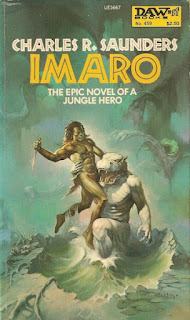
4. Set in the fantasy continent of Nyumbani, which is overtly based on Africa, the Imaro sequence is pioneering Sword and Sorcery (or "Sword and Soul") stories, created by what Pennsylvania-born Canadian writer, whose death in Nova Scotia in 2020 went unnoticed by the SF/F field for months?

Answer: Charles Saunders

(This one played quite hard -- I hope to write a review of Imaro in the near future, to do my tiny bit to spread the word (if belatedly) about him.)

5. SF and Fantasy have been much enriched over time by contributions from writers with reputations established in the broader literary field -- one might mention the Nobel Prize winner Doris Lessing; or the Booker Prize winner Kingsley Amis. More recently, Jamaican writer Marlon James, who won the Booker Prize for his novel A History of Seven Killings, published which colorfully titled fantasy novel, first of a planned trilogy based on African history and mythology?

Answer: Black Leopard, Red Wolf

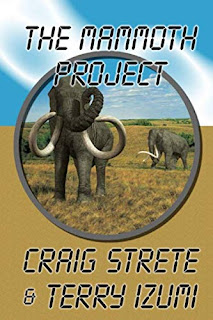
6. Contemporary Native American writers of speculative fiction include such luminaries as Stephen Graham Jones and Rebecca Roanhorse. One of the pioneers among Native American SF writers received Nebula nominations for his stories "Time Deer" and "The Bleeding Man" back in 1976, and also edited a magazine of Native American SF: Red Planet Earth. He has remained active, with novels such as Death in the Spirit House (1989) and The Mammoth Project (2019) (with Terry Izumi). Who is this writer?

Answer: Craig K. Strete

(This one played incredibly hard on the trivia site -- only two players got it out of over 350. It was a misjudgement on my part -- I remember Strete very well from his appearances in Galaxy way back in the '70s, but I guess the number of people in the general audience -- or even the SF audience of 2022! -- who read Galaxy in the 1970s isn't that high!)

7. Black writers made significant contributions to the SF canon even before the first genre magazines appeared in the mid-'20s. One great example from 1920 is "The Comet," about a Black man and a white woman who meet as perhaps the only survivors of a deadly encounter with a comet. Which prominent sociologist, the first African-American to receive a doctorate from Harvard, wrote this story?

Answer: W. E. B. Du Bois

8. The author of Mexican Gothic, the 2021 winner of the Locus Award for Best Horror Novel, was born in Mexico and now lives in Canada. In addition to several outstanding novels spanning genres such as horror, noir, and science fiction, she has made major contributions as the co-editor of magazines such as Innsmouth and The Dark, and of anthologies such as Dead North: Canadian Zombie Fiction. Name this writer/editor.

Answer: Silvia Moreno-Garcia

9. The first novel originally published in a language other than English to win a Hugo Award as Best Novel was translated into English by an American writer who shares his surname with the author of the original version. (The American writer has also had great success with his own writing, including a huge "Silkpunk" series The Dandelion Dynasty; plus winning multiple Hugos for his short fiction.) Please give the name of either writer, both surname and given name please. [Extra credit for giving both names!]

Answer: Liu Cixin, Ken Liu

10. The Hugo Award for Best Dramatic Presentation usually goes to TV episodes or movies, so it was surprising to see an experimental rap group nominated in the Dramatic Presentation (Short Form) category two years running for an album (Splendor and Misery) and a song ("The Deep"), both SF-themed. ("The Deep" garnered them a third Hugo nomination when Rivers Solomon turned it into a collaborative novella.) (One group member, Daveed Diggs, is probably better known for his work on a certain historical musical than for his SF-related work!) Name this group.

Answer: Clipping

11. The Canadian poet and short fiction writer Amal El-Mohtar has won a Nebula and a Hugo award. She is also a reviewer of SF on NPR, and also is Science Fiction and Fantasy columnist for what very important review outlet? (Her columnist role was previously held for many years by Gerald Jonas and later by N. K. Jemisin.)

Answer: New York Times Book Review

12. A key text highlighting the tremendous contributions of African-descended writers to speculative fiction throughout the 20th Century is Dark Matter: A Century of Science Fiction from the African Diaspora,which won the World Fantasy Award in 2001. The editor won another World Fantasy Award for Dark Matter: Reading the Bones in 2005, and was nominated for the James Tiptree Jr. Award (now the Otherwise Award) for a collection of her own fiction in 2016. She is now the editor of The Magazine of Fantasy and Science FictionWho is she?

Answer: Sheree Renee Thomas

13. Fandom in its early days was almost exclusively white (with the notable exception of Warren Fitzgerald, founder and president of what is often called the very first SF fan club, the Scienceers) -- so much so that in the late 1950s a group of Bay Area fans invented a Big Name Fan who wrote faanfiction such as The Cacher in the Rye and My Fair Femmefan and who happened to be Black. While this man was a hoax, his name was adopted for a Society founded in 1999 to address "the representation of people of color in the fantastical genres." This Society sponsors two awards, one for SF by POC writers and one for SF about racial and ethnic issues, the Parallax Award and the Kindred Award. What was the name of this hoax fan?

Answer: Carl Brandon

(I chose not to use this question in the main quiz -- nor the next one -- because they don't as directly highly BIPOC creators ... but I do love this particular bit of trivia.)

14. One way in which SF writers can address the racist history of some admired predecessors is to directly reconsider their work, as Victor La Valle does in "The Ballad of Black Tom", his 2016 Shirley Jackson Award-winning story that retells the events of "The Horror at Red Hook", a story by which notorious writer of the '20s and '30s, who is also namechecked in the title of a HBO series that debuted in 2020?

Answer: H. P. Lovecraft

15. One of the most versatile contemporary SF writers is the Nigerian-American Nnedi Okorafor, who has won awards ranging from the Wole Soyinka Prize to the Kurt Laßwitz Prize to the Eisner Award (not to mention the odd Nebula and Hugo!) for her work in young adult fiction, adult science fiction, and comics. She is also writing for films and TV, including co-writing the screenplay for a forthcoming Viola Davis-produced Amazon Prime adaptation of Wild Seed, a novel by which true giant of science fiction?

Answer: Octavia Butler

16. Shortly after the great Samuel R. Delany opened the tap for Black writers in SF, partly by publishing some of his early novels as Ace Doubles, a much less successful Black writer began publishing with a couple of Ace Doubles -- Crown of Infinity and The Age of Ruin. Alas, after two more novels this writer left the field somewhat bitterly, partly because of publishers' habits of whitewashing his characters on his books' covers. Who was this writer?

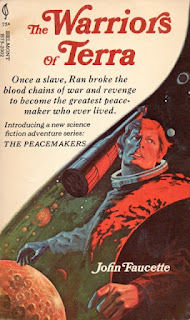
Answer: John Faucette

(This question was even harder than the Craig Strete question, I think! (Even with my oh so clever hint via pun in the first sentence!) So I didn't use it in the quiz, but I think Faucette deserves at least some notice, though if truth be told I don't love his novels. Here's the cover to one of his books, showing the blatant whitewashing of his heroes (something that may have contributed to his leaving the field.) 

17. This writer was born in the US, to French and Vietnamese parents. She grew up in Paris, speaking French, but writes in English. Her published fiction includes series set in Paris, in Aztec-based worlds, and in futures with living spaceships and a polity based on Vietnamese culture. Her stories "Immersion", "The Waiting Stars", and "The Tea Master and the Detective" have won Nebula Awards. Who is she?

Answer: Aliette de Bodard

18. Native American writer William Sanders made a mark with his novels Journey to Fusang and The Wild Blue and the Grey, and with short stories like "Elvis Bearpaw's Luck", "Jennifer, just Before Midnight", and most of all "The Undiscovered", which imagines an alternate life in North America for which famous playwright? (The story could arguably be a sequel to a certain late-90s Best Picture Oscar winner.)

Answer: William Shakespeare

(This was a last minute question, too late for the quiz: an attempt at a question about an Native American writer that would be a bit easier than the Craig Strete question. Maybe too easy -- how many playwrights would come to mind, especially who might have been featured in a Best Picture winner?)


Thursday, January 13, 2022

Another Quiz: BIPOC SF and Fantasy

I've written another quiz for the trivia league I'm a member of. The subject this time is SF (and Fantasy and Horror) by Black people, indigenous people, and people of color. The quiz ran on Tuesday, so the results are in at the site. I figured, as with my previous quizzes, I'd post it here on my blog for anyone who is interested to try. I'll post the answers in a couple of days.

The official quiz had 12 questions, the first 12 posted below. I wrote a total of 18, and I've posted all 18 here. I tried to pick the best (by some heuristic) 12 to use ... not sure I succeeded! I had a lot of help from a group of playtesters in the trivia league; and I also asked for help from some of my SF friends, in this case Steven H Silver, John O'Neill, and Chris Barkley.

Caveats: The quiz ended up playing very hard -- harder than I wanted. But, hey, lots of y'all are SF experts, so it might be easier for you! But there are two extra hard questions in this set!

Go ahead and post your guesses in the comments if you want (but don't cheat and look at the comments first!) 

[Addendum -- I've made a separate post with the answers now.]

1. Ava DuVernay, the acclaimed director of Selma, became the first Black woman to direct a live action feature with over a $100,000,000 budget with which 2018 film, an adaptation of a beloved Newbery Award winner?

2. Jeannette Ng, a British writer born in Hong Kong, won the John W. Campbell Award for Best New Writer in 2019. She used her acceptance speech to call out the "fascism" of Campbell, and also to support protesters in favor of democracy in Hong Kong. A year later they won a Hugo Award for Best Related Work for that speech, which had led to a new name for the Best New Writer award. What is that new name?

3. The Artistic Director of Opera Siam is a native of Thailand who was raised in England and holds dual Thai and American citizenship. He has written multiple operas and symphonies, and is also a major writer of SF, Fantasy, and Horror in English, including the early stories that became his novel Mallworld, as well as the World Fantasy Award winning novella "The Bird Catcher," and the novel Vampire Junction. Who is this man? (Either his given name or surname will be accepted as answers, as he has published under pen names using both as "last name".)

4. Set in the fantasy continent of Nyumbani, which is overtly based on Africa, the Imaro sequence is pioneering Sword and Sorcery (or "Sword and Soul") stories, created by what Pennsylvania-born Canadian writer, whose death in Nova Scotia in 2020 went unnoticed by the SF/F field for months?

5. SF and Fantasy have been much enriched over time by contributions from writers with reputations established in the broader literary field -- one might mention the Nobel Prize winner Doris Lessing; or the Booker Prize winner Kingsley Amis. More recently, Jamaican writer Marlon James, who won the Booker Prize for his novel A History of Seven Killings, published which colorfully titled fantasy novel, first of a planned trilogy based on African history and mythology?

6. Contemporary Native American writers of speculative fiction include such luminaries as Stephen Graham Jones and Rebecca Roanhorse. One of the pioneers among Native American SF writers received Nebula nominations for his stories "Time Deer" and "The Bleeding Man" back in 1976, and also edited a magazine of Native American SF: Red Planet Earth. He has remained active, with novels such as Death in the Spirit House (1989) and The Mammoth Project (2019) (with Terry Izumi). Who is this writer?

7. Black writers made significant contributions to the SF canon even before the first genre magazines appeared in the mid-'20s. One great example from 1920 is "The Comet," about a Black man and a white woman who meet as perhaps the only survivors of a deadly encounter with a comet. Which prominent sociologist, the first African-American to receive a doctorate from Harvard, wrote this story?

8. The author of Mexican Gothic, the 2021 winner of the Locus Award for Best Horror Novel, was born in Mexico and now lives in Canada. In addition to several outstanding novels spanning genres such as horror, noir, and science fiction, she has made major contributions as the co-editor of magazines such as Innsmouth and The Dark, and of anthologies such as Dead North: Canadian Zombie Fiction. Name this writer/editor.

9. The first novel originally published in a language other than English to win a Hugo Award as Best Novel was translated into English by an American writer who shares his surname with the author of the original version. (The American writer has also had great success with his own writing, including a huge "Silkpunk" series The Dandelion Dynasty; plus winning multiple Hugos for his short fiction.) Please give the name of either writer, both surname and given name please. [Extra credit for giving both names!]

10. The Hugo Award for Best Dramatic Presentation usually goes to TV episodes or movies, so it was surprising to see an experimental rap group nominated in the Dramatic Presentation (Short Form) category two years running for an album (Splendor and Misery) and a song ("The Deep"), both SF-themed. ("The Deep" garnered them a third Hugo nomination when Rivers Solomon turned it into a collaborative novella.) (One group member, Daveed Diggs, is probably better known for his work on a certain historical musical than for his SF-related work!) Name this group.

11. The Canadian poet and short fiction writer Amal El-Mohtar has won a Nebula and a Hugo award. She is also a reviewer of SF on NPR, and also is Science Fiction and Fantasy columnist for what very important review outlet? (Her columnist role was previously held for many years by Gerald Jonas and later by N. K. Jemisin.)

12. A key text highlighting the tremendous contributions of African-descended writers to speculative fiction throughout the 20th Century is Dark Matter: A Century of Science Fiction from the African Diaspora,which won the World Fantasy Award in 2001. The editor won another World Fantasy Award for Dark Matter: Reading the Bones in 2005, and was nominated for the James Tiptree Jr. Award (now the Otherwise Award) for a collection of her own fiction in 2016. She is now the editor of The Magazine of Fantasy and Science Fiction. Who is she?

13. Fandom in its early days was almost exclusively white (with the notable exception of Warren Fitzgerald, founder and president of what is often called the very first SF fan club, the Scienceers) -- so much so that in the late 1950s a group of Bay Area fans invented a Big Name Fan who wrote faanfiction such as The Cacher in the Rye and My Fair Femmefan and who happened to be Black. While this man was a hoax, his name was adopted for a Society founded in 1999 to address "the representation of people of color in the fantastical genres." This Society sponsors two awards, one for SF by POC writers and one for SF about racial and ethnic issues, the Parallax Award and the Kindred Award. What was the name of this hoax fan?

14. One way in which SF writers can address the racist history of some admired predecessors is to directly reconsider their work, as Victor La Valle does in "The Ballad of Black Tom", his 2016 Shirley Jackson Award-winning story that retells the events of "The Horror at Red Hook", a story by which notorious writer of the '20s and '30s, who is also namechecked in the title of a HBO series that debuted in 2020?

15. One of the most versatile contemporary SF writers is the Nigerian-American Nnedi Okorafor, who has won awards ranging from the Wole Soyinka Prize to the Kurt Laßwitz Prize to the Eisner Award (not to mention the odd Nebula and Hugo!) for her work in young adult fiction, adult science fiction, and comics. She is also writing for films and TV, including co-writing the screenplay for a forthcoming Viola Davis-produced Amazon Prime adaptation of Wild Seed, a novel by which true giant of science fiction?

16. Shortly after the great Samuel R. Delany opened the tap for Black writers in SF, partly by publishing some of his early novels as Ace Doubles, a much less successful Black writer began publishing with a couple of Ace Doubles -- Crown of Infinity and The Age of Ruin. Alas, after two more novels this writer left the field somewhat bitterly, partly because of publishers' habits of whitewashing his characters on his books' covers. Who was this writer?

17. This writer was born in the US, to French and Vietnamese parents. She grew up in Paris, speaking French, but writes in English. Her published fiction includes series set in Paris, in Aztec-based worlds, and in futures with living spaceships and a polity based on Vietnamese culture. Her stories "Immersion", "The Waiting Stars", and "The Tea Master and the Detective" have won Nebula Awards. Who is she?

18. Native American writer William Sanders made a mark with his novels Journey to Fusang and The Wild Blue and the Grey, and with short stories like "Elvis Bearpaw's Luck", "Jennifer, just Before Midnight", and most of all "The Undiscovered", which imagines an alternate life in North America for which famous playwright? (The story could arguably be a sequel to a certain late-90s Best Picture Oscar winner.)

Saturday, January 8, 2022

Fantastic fiction by Elisabeth Sanxay Holding (Miss Kelly and 3 F&SF stories)

 Fantastic fiction by Elisabeth Sanxay Holding (Miss Kelly and 3 F&SF stories)

I discovered the great mid-century noir writer Elisabeth Sanxay Holding several years ago when I ran across a copy of her Ace Double The Blank Wall/The Girl Who Had to Die in a Kansas City antique mall. I had never heard of her, but I soon learned that she had a major reputation as a writer of noir fiction -- though, like many noir writers, especially women, that reputation had been dimmed for many years before something of a revival in the past couple of decades. Here's what I wrote back then about her:

She was born in 1889, died in 1955. She began her writing career as a romance novelist, but switched to mysteries during the depression. Her novels sold fairly well, and she was well-praised. She wrote at least one YA fantasy, Miss Kelly, which Anthony Boucher praised in the pages of F&SF. But she did seem to be mostly forgotten after her death.

That said, The Blank Wall, generally considered her best novel, had already been filmed in 1949 as The Reckless Moment (starring Joan Bennett and James Mason). It was filmed again in 2001 as The Deep End, starring Tilda Swinton. (This was pretty much Swinton's "breakout" film, "breakout" here being relative to Swinton's career -- that is, she didn't become a major movie star, she just moved from a well-respected indie actress to an even more respected Hollywood actress, who would contend for Academy Awards (and, indeed, eventually win one).) More recently, a number of Holding's books have been reprinted by Persephone Press and by Stark House (the latter, neatly, are double editions). The Blank Wall was even featured in a Guardian list, in 2011, of the "Ten Best Neglected Literary Classics". She has been called "The Godmother of Noir". So she's not forgotten, and indeed I think her reputation is slowly increasing at last.

The Blank Wall, in particular, is first rate. But naturally I was intrigued by her fantastical stories, so I found copies of her one fantasy book, Miss Kelly, which is actually a middle grade book; and of the three issues of F&SF which feature stories by her. I suspect she was "recruited" to contribute to F&SF by editor Anthony Boucher, who was also, of course, a writer of crime fiction and a very prominent reviewer of crime fiction. I wonder how much additional fantastical work she might have done had she not died somewhat young in 1955. Here are some short reviews of those stories, plus one additional story cited in the ISFDB, even though it is not fantasy.

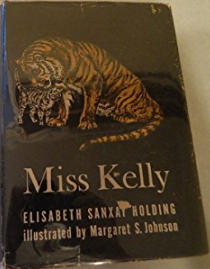
Miss Kelly

Miss Kelly is a a middle grade book, published in 1947 by William Morrow. It is illustrated by Margaret S. Johnson. It runs about 19,000 words. 

It is a talking animal story. Miss Kelly is a cat, living in the house of Mr. and Mrs. Clinton, their two children, and their Black cook Janet. She is very happy with her family, and with Janet, and with their dog, Rover. (This was the era in which "Rover" and "Spot" seemed the default dog names.) Miss Kelly can understand and also speak English, as well as of course the language of animals, though her mother strictly warned her never to let humans know she can understand them, and especially not that she can also speak. Then the circus comes to town, and Miss Kelly is very interested, but of course cannot go herself. Her dog friends warn her, anyway, that circus animals can be dangerous, especially the tigers, which they describe as like Miss Kelly, only 100 times bigger.

But then, coincidentally, a tiger escapes from the circus, and comes right to the Clinton home, on a night where the parents are out and Janet is babysitting. It crashes into the house and threatens the children. Miss Kelly intervenes, and manages to talk the tiger down, as it were -- it seems he hates the circus (understandably) and want to kill as many humans as he can in revenge. She convinces him not to do so, and leads him outside to the woods, hiding him and promising to help.

But before Miss Kelly can return with food or additional help, the tiger is captured, and given to a zoo. Miss Kelly has become a celebrity, for saving the children from the tiger. But she feels compelled to live up to her promise and find and help the tiger. In the end she realizes she must disobey her mother's instructions, and talk to Mr. Clinton and convince him to take her to the zoo. And this, of course, leads to further and further complications: the Clintons are somewhat discombobulated (as her mother warned) by her speech; and when she gets to the zoo she eventually realizes that all the animals there need her help. Holding accepts her premise and works things out as logically as possible ... with an ending that is not exactly what Miss Kelly might have originally desired for her life but which seems to fit her responsibility.

It's an enjoyable read, but I don't think I liked it quite as much as Boucher. In part, even with Miss Kelly's input the zoo seems still not a great place for animals (I think zoos have improved greatly in intervening decades -- perhaps a result of Miss Kelly's influence? :) ) The book never seems to have been reprinted, and Holding wrote no more children's books. 

"Friday, the Nineteenth" (F&SF, June 1950)

This a striking darkish fantasy. Donald Boyce is tired of his wife Lilian, and ready to have an affair with Lilian, his best friend's wife Molly. The story details the couple's friction, and Donald and Molly flirting at a couple of gatherings. The overall picture of Donald is not complimentary ... whatever issues he has with Lilian seem more a product of his attitude than her failings. Anyway, Donald and Lilian make a date for a drink after work one Friday, and agree to a rendezvous for more than just a drink the next day ... and then things get strange. For next day is Friday again ... This is a pretty fine story, with a real touch of eeriness by the end.

"Shadow of Wings" (F&SF, July 1954)

This is a rather curious science fiction story, fairly dark in its implications. One day, apparently, all the birds disappear. Which means they stop eating ... which of course will lead to ecological disaster, and all kind of trouble for humanity. This remains a complete mystery, until one man decides to try to follow the flocks of birds that are still seen sometimes ... and he finds -- well, I won't give it away. The actual solution is highly implausible in a number of ways; and it ends up involving aliens who want to take over the Earth, and who think humans unworthy of this planet. That message -- which is left unvarnished -- is disquieting, but the mechanics of the story, and the resolution, are rather clumsy.

"The Strange Children" (F&SF, August 1955)

This is a story that begins rather eerily, with Marjorie babysitting at the house of a couple unfamiliar to her. The children, who are nice enough, act very strangely. They won't have anything to do with her ... eventually she learns their story. They have a visitor, a youngish man named George, who comes and plays with them, but won't come for anyone else. Eventually Marjorie is also able to meet this young man, who tells her that he's a ghost -- he died five years earlier. The explanation eventually comes out, and this part resolves as a somewhat routine (but believable) crime story involving the children's mother and a lover; and the resolution turns rather darkly on the mother's character. All the parts of this story are pretty cool, and it's a good way to use a fantastical element (the ghost) to tell a crime story. Somehow for me they didn't quite fit together as well as I hoped, but I think it's solid work.

Boucher's blurb for this story mentions Holding's death, in February of 1955, and laments that this will be the last of her stories they can publish. And I regret that too -- her metier was the crime story, but I think she might well have continued to produce the occasional dark fantasy to good effect.

"The Married Man" (Munsey's Magazine, December 1921)

I'm adding a bit about this story, from early in her career, only because it is listed in the ISFDB, though it is not SF or Fantasy by any stretch. I can only assume they included it because they include the entire contents of a 2014 anthology called Psychology: A Literary Introduction, edited by Laura Kati Corlew and Charles Waugh. That anthology has a story by Philip K. Dick ("Second Variety") plus a couple more SF or SF-adjacent stories from the mainstream ("The Country of the Blind" and "The Curious Case of Benjamin Button" for example,) which must be why it's in the ISFDB.

"The Married Man", subtitled "A Modern Comedy of Enlightened Thought", is about an ordinary '20s married couple, Andy and Marian, in their mid-30s, with three young children. But Marian, who presents herself as a very dutiful and perhaps somewhat dull wife, not interesting in literature or anything else intellectual, realizes her husband is not happy. And, indeed, on their 10th anniversary, instead of a present, he proposes that they separate. Not, he says, because he doesn't love her, nor that she has been unsatisfactory as a wife, nor that there is another woman. No, he has simply come to realize that men are not suited for marriage -- marriage is a prison for the modern man. Marian is crushed, but she agrees to go to her mother's house for a time, and she engages a babysitter for the children, while Andy goes off to give his lecture on "Marriage from a Man's Point of View". The rest of the story shows what happens to Andy's life without Marian -- in essences, he is pestered by other women who are perversely excited by his rejection of marriage, and who paradoxically seek to lure him into marrying them. Three women are presented: an innocent very young woman who decides that Andy would be an improvement on her conventional fiance, an immoral married woman who wants to start an affair with Andy, and the very modern babysitter, who wants to marry Andy and raise the children by her unconventional lights. We see where this is going from the start, with the inevitable conclusion as Marian returns and sets Andy's life back in order, so that he realizes how much he needed her.

It's actually kind of funny, and Marian is an interesting character (Andy is kind of a pompous nothing.) Very much a story of its time, and a touch hackneyed, but not badly done.

Thursday, January 6, 2022

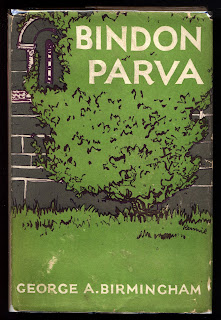
Old Bestseller Review: Bindon Parva, by George A. Birmingham

Old Bestseller Review: Bindon Parva, by George A. Birmingham

At last I return to the roots of this blog -- "Old Bestsellers", my term here for popular fiction of (mostly) the first half of the Twentieth Century. I use the term bestseller loosely -- many of the books I review were indeed huge bestsellers (even if many are all but forgotten today,) but others were more in the category of good sellers, and a few probably didn't sell well at all. The goal is to review popular fiction -- but I won't shy away from serious literature (and I'll note that that distinction can be pernicious -- much fiction that was very popular was very "serious" as well.) (For the record, I will continue posting about other interests of mine: Science Fiction, short fiction, Ace Doubles, etc.)

George A. Birmingham was an author I had never heard of until I stumbled across this book, Bindon Parva, in an antique store. For a couple dollars I figured it was worth a try. I learned that "George A. Birmingham" was the pseudonym used for his writing by James Owen Hannay (1865-1950), an Irish clergyman (born in Belfast) of Scottish descent. Hannay was a leading light of the Gaelic League, a generally Irish Nationalist organization that also advocated for the use of Irish Gaelic (instead of, or in a addition to, English) as a way of emphasizing Ireland's differences from England. As Hannay was a Protestant, and not of Irish descent, and his parents were staunch Unionists, he tended to be distrusted by both sides. Later in his life (after Irish independence was achieved) he did in fact move to England, taking a position at a church near London. 

As a relatively poor curate in an Irish church Hannay needed money, and he began to write, at first some short fiction, then some theological works. As far as I can tell he used the name "George A. Birmingham" from the start -- perhaps he felt it best to dissociate his writing from his pulpit, even though his fiction and nonfiction seemed to generally be on religious themes. His first novel, The Seething Pot, appeared in 1905. His early novels seem to be on the subject of Irish Nationalism, and seemed to enrage both sides of the conflict, as they supported the Nationalist cause but also portrayed some Nationalists in a negative light (not to mention having Protestant protagonists.) His later works seem less political (presumably in part because Ireland became independent.) He wrote some 60 novels and story collections, and another couple of dozen nonfiction works: travel books, theological books (including a book called Do You Know Your Bible?) and many others. 


The book at hand, Bindon Parva, was published in England in 1925 by, of all houses, Mills and Boon, though it is not at all a romance novel. I have the US edition (probably the first), from Bobbs-Merrill. There is a preface for American readers in which "Birmingham" says that to his surprise the book was well received in England. In general, it seems to me that "Birmingham" was a fairly successful writer -- publishing over 80 books is proof enough of that, and he does seem to have been financially successful as well (buying a boat, for example.) I don't think he ever published an out-and-out bestseller, but I think his books were generally "well received". Yet he seems to me all but completely forgotten now.

Bindon Parva is a curious construct. It is at heart a collection of short stories, about four or five thousand words apiece, for a total of some 60,000 words. But the stories are framed -- doubly framed, really -- as, first, a set of stories told by Sylvester Maturin, the pastor of the Anglican church at Bindon Parva (a fictional town, on the southern coast of England, near Portland), to the narrator, an architect who has been engaged to restore some murals uncovered at that church. The second "frame" is that Maturin tells the stories of several (11, actually) of his predecessors at the church, from the 15th Century through the 19th Century -- and it seems that Maturin has these stories directly from the ghosts of those people. (This makes these technically ghost stories but the "ghost" aspect, though given some play, is really more of a framing device than a true supernatural element.)

Birmingham was a real writer, of solid if not spectacular prose, with a way of promoting his ideas, and a good grasp of character. Maturin -- an honest and convinced if somewhat shabby cleric, comes to life, as does the narrator, an intelligent man but (as portrayed) a somewhat empty cynic. The uncovered murals are of the Seven Deadly Sins and the corresponding Virtues. But the heart of the books is the stories of the various clerics -- which also in a way present a brief history of England from the time of Edward IV to Queen Victoria. 

The first pastor is Hugh Freyne, who betrays his (then Catholic) vows to get a girl pregnant, and so abandons his priestly vows to marry the girl, and thus establish the (Anglicized) De Fresney family, becoming eventually baronets and essentially the Lords of the small fishing town of Bindon Parva. The succeeding tales recount crises in the parish of Bindon Parva, encompassing its (somewhat forced) conversion to Anglicanism, and subsequent eras of varying religiosity, a conflict of sorts with dissenters (Methodists) and the eventual revivification of the Anglican tradition, and the High Church. So there are a couple of episodes during the English Civil War, the Restoration, the Titus Oates anti-Catholic hysteria, et cetera. Other episodes deal more directly with crises of faith for individual pastors, involving their own sins, or their vainglorious attempts at hymn-writing, or their involvement in smuggling, or their dealing with a parishioner whose daughter has become a prostitute, etc. The resolutions are more or less what you might expect from a clergyman -- but really none the worse for that, emphasizing compassion and honesty and a true belief in God.

The book is quite readable throughout. It seems to me one of those once popular books that seem to have deserved the popularity they may have earned in their time, but at the same time not necessarily to require a revival. Even so, I enjoyed reading it, and though it will likely never have a wide readership, it's a nice book, and not by any means to be disparaged. 

Saturday, January 1, 2022

Happy New Year: and 2021 Awards Eligibility Post

Happy 2022, and let's hope it's far better than the previous 2 years!

I'll open with an announcement -- I have "retired" from my post as Locus Short Fiction reviewer. My final column will appear in the February 2022 issue, exactly 20 years after the first column appeared. I've written a couple of things that appear in Locus -- in the January issue (available now) and in the February issue, talking about my decision. But the reasons are simple: I've been at it for a long time, and I sort of feel it's time for a) a different voice; and b) for me to have more time to do some other things I want: concentrate more on some other projects such as my forthcoming anthology (with Eric Schwitzgebel and Helen De Cruz) on the best philosophical SF of all time, for MIT Press; to write more about other subjects (getting back to my project about Cele Goldsmith's Amazing/Fantastic career, for example); and just plain to read more -- to keep up with SF novels, to read more in other fields (Victorian novels, early 20th century popular fiction, contemporary fiction, etc.) I also still plan to contribute occasional pieces to Locus; and my Best of the Year anthologies will continue as long as my publisher wants them.

Also, there is a great personal reason: my grandchildren: Addy is 15 months old today, Gus is two weeks old, and another grandson is due May 31! I'll certainly be devoting plenty of time to doting on them! (And this is a reminder to me that even when things are depressing in the wider world, there is joy!)

Having said that, I figured I'd make a post about my awards eligibility. The only award I'm really eligible for is Best Fan Writer. (Whether I'm worthy is not for me to decide.) I think my columns in Locus are fan writing, for one thing, and I'm certainly very proud of them. In addition, there are my posts at this blog, which include a great many looks at SF novels, both recent and old; and occasional other discussions. And this year I contributed several pieces to fanzines, mostly to Black Gate, but also a piece on Firefly to the special issue of Journey Planet on the subject of SF TV shows that were Cancelled Too Soon

Here are my Black Gate posts. I'm particularly proud of the several I've written (with more to come) taking a close look at how some notable (and maybe less notable) SF stories work. I'll start with the first of that series, which actually appeared in 2020, then the ones from 2021:

"The Star Pit", by Samuel R. Delany;

Three Stories by Idris Seabright;

"Winter Solstice, Camelot Station", by John M. Ford;

"It Opens the Sky", by Theodore Sturgeon;

(The next planned entry will be on "Winter's King", by Ursula K. Le Guin (both versions,) hopefully sometime this month; and then, I hope, one on "The Last Flight of Dr. Ain", by James Tiptree, Jr.)

Other Black Gate posts (a couple of reviews, a look at an old F&SF, and something slightly different):

Review of The Gentleman, by Forrest Leo;

Review of Underneath the Oversea, by Marc Laidlaw;

Snippet about finding a signed copy of the Twayne Triplet Witches Three;

Retro-Review of F&SF, Summer 1950;

Here's a few highlights from this blog (in my opinion):

The Complete Stories of Robert H. Rohrer (an obscure Goldsmith discovery);

Quiz: Aliens in SF (with Images);

Space Opera: Then and Now;

Review: Lent, by Jo Walton;

Review: The Goblin Emperor, by Katherine Addison;

Cordwainer Smith Award Review: The Continuous Katherine Mortenhoe, by D. G. Compton;

Review: Tropic of Kansas, by Christopher Brown;

Review: Sorcerer to the Crown, by Zen Cho;

Review: Beer! Beer! Beer!, by Avram Davidson;


Monday, December 20, 2021

A Newly Discovered Avram Davidson Novel: Beer! Beer! Beer!

Beer! Beer! Beer!, by Avram Davidson

a review by Rich Horton

Avram Davidson is a favorite writer of mine. His prose is charming, eccentric in a good way. His esoteric interests, particularly in the odder corners of history, inform many or most of his stories, and also, for example, the essays making up the book Adventures in Unhistory. I think much of his best work is at short lengths, but he wrote in the neighborhood of 20 novels to go withe dozens and dozens of shorter fictions.

Davidson was born in Yonkers, NY, in 1923. He served in the US Navy in World War II, notably spending time in China. After the War, he spent some time in Israel, but soon returned to the US, and began publishing stories and essays, at first in Orthodox Jewish publications. By the mid-1950s he was regularly publishing SF, Fantasy, and crime fiction, and his novels began appearing in the early '60s. He was editor of The Magazine of Fantasy and Science Fiction from 1962 to 1964. His fiction won him a Hugo Award, a Nebula Award, and an Edgar. He spent some time in Mexico, and later settled in California. He and his wife, the writer Grania Davis, had a son, Ethan, in 1962. They later divorced, though they remained close, indeed collaborating on a couple of novels, and in fact Avram was godfather to Grania's son Seth, from her second marriage. He died in 1993.

Besides his published fiction, Davidson tantalized his readers with a great many abortive projects -- several series that were discontinued after one or two novels, and some hinted at but never finished works -- one of them a planned collaboration with Harlan Ellison (of which I believe perhaps 10,000 words were written.) And much of his work that was published is now hard to find -- many magazine stories were never collected, and those books that were published are mostly out of print. However, Avram has the benefit of devoted family and friends; and his aforementioned godson, Seth Davis, has taken on the ambitious project of reissuing many of Davidson's works as audiobooks, and some even in print. A collection of at least some of the uncollected stories is, I believe, in work. Seth is also producing podcasts, in which he and a guest discuss one of Avram's stories, as frame for an audio version (https://avramdavidsonuniverse.buzzsprout.com/). (Full disclosure: I am a guest on one of those podcasts, discussing "The Sources of the Nile". This is scheduled for February 2022.)

In among Davidson's papers there were some completely or nearly completed pieces -- for instance an account of a trip to Belize -- and at least one novel. This novel has now been published, by Seth Davis' imprint Or All the Seas With Oysters Publishing. Seth was kind enough to send me a copy.


This novel is set in Yokums, NY, in 1930. (Yokums, of course, is a stand-in for Yonkers.) In one sense it is a fictionalized retelling of a locally famous incident: a sewer-cleaning crew encountered a mysterious rubber pipe -- and from its open end beer came pouring out. This was still 3 years before the repeal of Prohibition. The flowing beer attracted a huge crowd, happy to sample it. Naturally there were investigations (and even another beer filled pipe was found) but nothing was ever officially determined about the origin of the beer. To be sure, the notorious bootlegger Dutch Schultz lived very close to one of the endpoints of the pipe ... Indeed, Davidson wrote an article about this incident, and it appears in his 1962 book Crimes and Chaos (which has also been reissued in trade paperback and audio by Or All The Seas With Oysters.)

Davidson took his account of the story, and expanded it into this novel. The novel retells the basics of the beer incident (changing the names of the people involved), but adds a fascinating cast of characters. Besides the principals (such as the renamed versions of Dutch Schultz and the Mayor and the Commissioner of Public Works, etc.) we meet the likes of Mary Mabel Moomaw, a crusader for Prohibition; and Elmer Dugan, a boy dealing with the stresses of growing up in the Depression; and Bill Bomberg and Stelle Wilson, beginning reporters for rival papers, who are hesitatingly entering a relationship; and H. Seymour Clack, Captain of the packet boat Sadie Howell, and his Black Chief Engineer, Preacher Babcock. And many more. What emerges is an affectionate portrait of Yonkers -- er, Yokums -- at that time; interspersed with details of the city's history; and plenty of snark about its politics.

The central story -- the discovery of the beer -- is a minor aspect, really (and well told in the Crimes and Chaos article.) But the ambling descriptions of the characters are the heart of it. It's funny; always interesting; warm. The prose is recognizably Davidsonian, and less convoluted than his prose became late in his career, but still readable. The characters speak in voices, several dialects rigorously captured. (Perhaps a bit too "rigorously" on occasion -- tics like representing an voiced "th" as "dth" for some of the speakers wore rather thin.) The side incidents are intriguing as well -- the Dutch Schultz character's dinner party, for example, or Elmer Dugan running away to sea; and even very minor characters, like the older newspaperman Peter Fogarty, come to poignant life.

This is a novel all of us who have cherished Avram Davidson's work will be delighted to find; and we can hope it will attract new readers for this great writer. It's not a lost masterpiece, but it's a warm and honest book; a well-told tiny slice of American history.

Tuesday, November 16, 2021

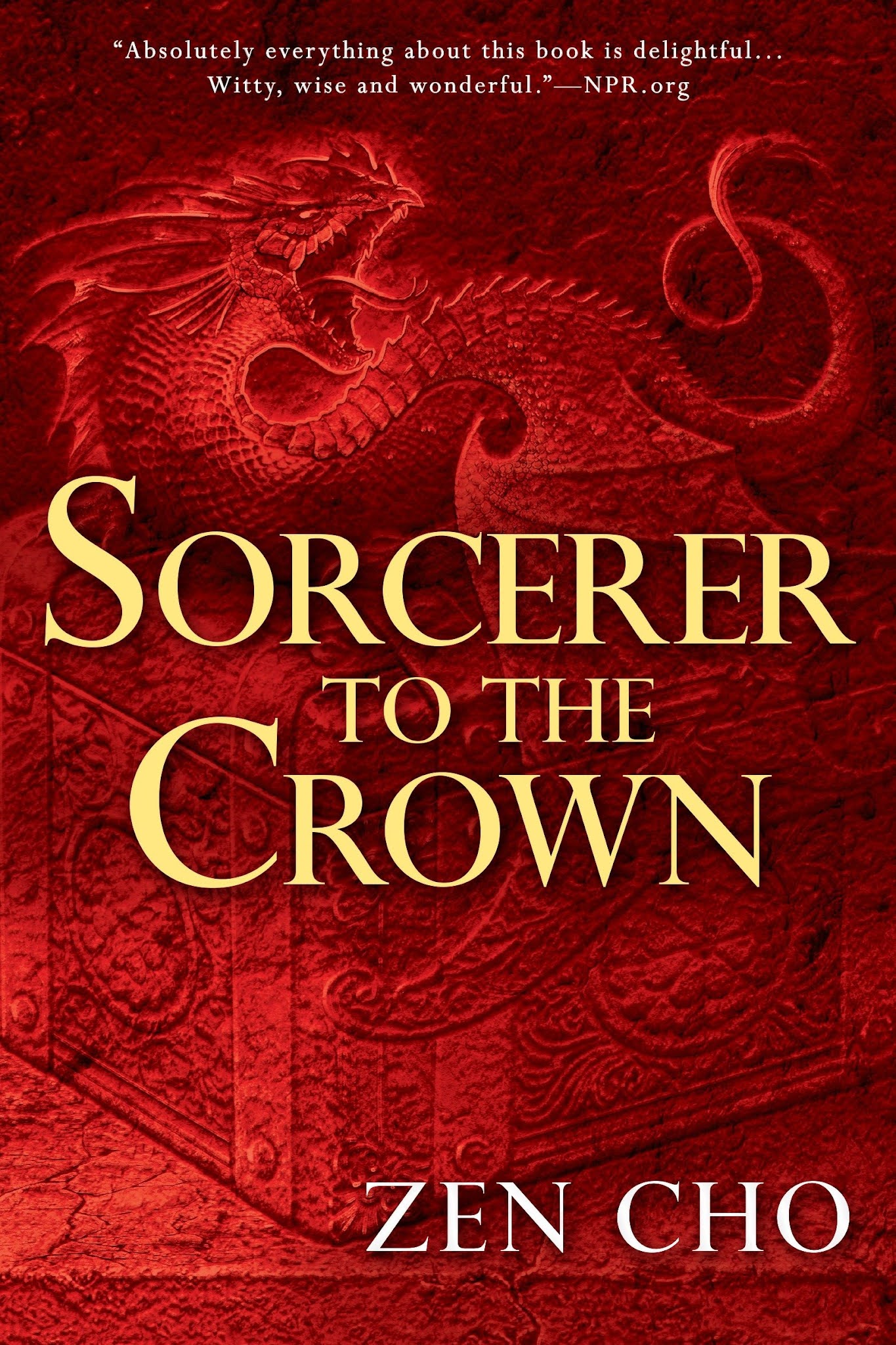
Review: Sorcerer to the Crown, by Zen Cho

Sorcerer to the Crown, by Zen Cho

a review by Rich Horton


This was Zen Cho's first novel, published in 2015. Cho is a Malaysian writer, based in the UK, where she works as a lawyer. She caught my attention with some fine short fiction, and when this novel appeared, advertised as a Regency romance with magic, I was intrigued -- because I like Regencies, and I like magic. And the book was well-reviewed ... but I remain obstinately behind on my novel reading. However, in 2021, I have made a focused attempt to catch up on novels I've missed in the past several years, particularly novels by women; and I have been using my (new) Audible account to help. Sorcerer to the Crown, then, is the latest such novel I've listened too (the 12th, beginning at the end of last year with Piranesi.) It is read by Jenny Sterlin, very nicely. (As is traditional, I will mention the pronunciation I learned from it: "geas" is pronounced "gesh" (roughly), instead of "jee-us" as I had always read it.)

[Note -- I may misspell some names, not having the printed book to consult.]

The novel opens with Zacharias Wythe, a young black boy, demonstrating his magical abilities before a meeting of the Society of Unnatural Philosophers, sponsored by his master (and eventually adoptive father) Sir Stephen Wythe, who is Sorcerer to the Crown -- that is, the leader of English magicians. At least, of the acknowledged English magicians -- mostly gentlemen, and all men. Zacharias is a curiosity, because of his color. As for women, they are deemed too weak to perform powerful magic, though it is discreetly accepted that many women use household magics to help with cooking and cleaning, etc. But with Sir Stephen's influence, Zacharias is trained in magic, and becomes very accomplished. And then, some 20 years later, Sir Stephen dies suddenly -- and Zacharias inherits his staff, which makes him the new Sorcerer to the Crown. But his position is delicate -- many English magicians are offended by the thought that a lowborn former slave is now their leader. He is even covertly accused of having murdered Sir Stephen. And he is privately subject to a mysterious and painful malady -- in addition to the fact that the ghost of Sir Stephen continues to give him advice. And finally, this is a time of crisis for English magic -- its supply is diminishing, evidently because of some dispute with the King and Queen of Faerie. Moreover, the Sultan of Jondarbyke is demanding magical help from England, to deal with a plague of vampiresses on his island -- and England may not have the magical ability to do so.


Zacharias has few allies -- his stepmother, Lady Wythe, is one; and he has a couple of supporters in the Society, an older magician named Damerel, and a younger, rather foolish but quite pleasant man named Rollo. It is Rollo who prevails on Zacharias to give a lecture at a magical school for "gentlewitches" -- a school which aims to teach young women to suppress their magical abilities. One of the women at the school is Prunella Gentleman, who was sort of adopted by the school's headmistress after her father committed suicide. Prunella never knew her mother, though her looks make it clear that her mother hailed from India. This of course makes Prunella an outcast too, and she has been doing chores at the school, including teaching, in exchange for her keep. She is also, we quickly learn, an extremely accomplished magician -- as, indeed, are several other young women at the school, despite the efforts of the headmistress. On the day of Zacharias' visit, Prunella is set to cleaning the attic (in part of keep her out of Zacharias' way) -- and there she discovers an old valise that must have been her father's, containing (as she eventually realizes) several magical treasures, in particular seven eggs that might hatch familiars. As such they are incredibly valuable, especially as Faerie has cut off the supply of familiars to England.

Well, Zacharias' visit is something of a disaster, as some of the girls, instead of showing their docile suppression of their magical gifts, get into a fight, complete with hurled spells. Prunella gets quite unfairly blamed, and decides it is time for her to leave. And Zacharias is struck by the realization that it is really foolish for England to ignore the magical abilities of their women, and he hatches a scheme to force the Society to accept women as "magiciennes". At the same time he finds himself burdened with Prunella, who has decided that she will go to London, and that the best way to get there is to hitch a ride with Zacharias.

Things keep bubbling from there ... there are sorcerous assassination attempts against Zacharias ... there are visits from one of the witches of Jondarbyke (a delightful character!) ... one of the more powerful magicians in England mounts an attempt to dislodge Zacharias from his position, aided by his wife, who is more than she seems ... Prunella hatches some of her familiars, with the result that she is de facto the most powerful magician in England ... and, of course, Zacharias and Prunella, against their first inclinations, get closer and closer (I mean, this is a romance!)

Some of this, it seemed to me, is too much of a muchness. The ending, though in many ways satisfying, is kind of a mad jumble. Some plot strands more or less fizzle, though some are quite effectively resolved. There are a couple of out and out surprises, which both delighted me and rather tired me. There are some cliches, most notably the one in which the main character is  a) inordinately beautiful; and b) the greatest sorcerer in the land. (The other main character is of course very handsome, and one of the greatest sorcerers in the land.)

The novel deals fairly effectively with the issue of race, which obviously greatly affects the social positions of both main characters -- yet even there at times I thought things not quite convincing. All in all, I'd call it a classic exemplar of a first novel -- a writer in love with her characters and concept, having a great deal of fun (which is transmitted to the reader) but not quite in control.

I don't want to understate things -- I really enjoyed this novel, even if I felt it didn't quite work completely. But how many novels do? Sorcerer to the Crown is a lot of fun, with characters it's nice to spend time with, and that you'll readily root for. The language is pretty solid -- a decent pastiche of early 18th century prose. There is certainly room for a sequel (and, indeed, one appeared in 2019, The True Queen.) Recommended.

Saturday, November 6, 2021

Review: Tropic of Kansas, by Christopher Brown

Tropic of Kansas, by Christopher Brown

a review by Rich Horton


Christopher Brown's 2017 novel Tropic of Kansas was the latest novel our book group (run by Mark Tiedemann) discussed -- last Wednesday! I actually bought a copy back in 2017, and never got around to reading it. Due to the condition of my basement, I couldn't find my copy, so I went ahead and bought the Kindle version -- and then the Audible version as well. The cool thing is, that both Kindle and Audible versions allow you to jump ahead to wherever you got in the other version. Anyway, some disclaimers here -- I come to this review both a) knowing the author (a bit, not extensively), and b) having just discussed the book with him (and several fellow book club members.) Just so you know!

Before I get to the book per se, maybe I should mention what I thought about the audiobook. First -- it only taught me one new pronunciation, and actually I learned this same thing from the last audiobook I heard (Machine, by Elizabeth Bear): some people (mostly British I guess) actually pronounce "solder" as if there is an "l" in the word. Who would do that?! All Americans know it's pronounced "sodder", but I guess that's kind of a bad word to the English (by analogy with "sodding".) (Also, in Machine I learned that the English pronounce "methane" "meeeethane", which is just weird, sorry.) Tropic of Kansas is read by Josh Bloomberg and Bahni Turpin. The two readers split the book based on the two POV characters -- Bloomberg reads the chapters featuring the male character, Sig; and Turpin reads the chapters featuring the female character, Tania. (Both read the final chapter all the way through, separately -- it features both characters.) Both narrators do a good job.

The 30,000 foot view of this novel is simple: in the near future (actually an alternate near future, the Jonbar point being, apparently, the successful assassination attempt on Reagan) the US is in terrible decline, ecologically, economically, and especially politically. President Mack is a fairly open fascist who, after serving a couple of terms, staged what seems a straightforward coup against his successors. His government is fantastically corrupt, and has enemies' lists that it eagerly acts upon, and all that. The book is essentially about a grassroots revolution against him, leading to ... but I'll let the book tell you that.

On the ground, though, the book is about its two main characters, who are radically different from each other (even though they are sort of step-siblings.) We are introduced to Sig as a young teenager, essentially feral, scrambling to steal some food from a Canadian home. Years later, he is still in Canada, still essentially feral, but is being deported to the US. Tania, by contrast, is a lawyer in Washington, D. C., working for the government, in a division that investigates corruption. This isn't what she might have expected growing up poor in Minneapolis, and her mother considers her to be something of a sellout, but she, and her very privileged white friend Odile, seem to feel that they are doing what they can to ameliorate a nasty political situation. But one day the two of them visit the White House, following what has been called a suicide bombing attempt by the former Vice President, Maxine Price, who (they say) tried to blow up the President in revenge for his role in removing her and the previous President from office. Tania sees the President -- who escaped the blast, only losing an arm -- and can't resist yelling at him. And quickly she and Odile are arrested.

Both of them have just enough pull not to be charged, but Tania's mother is also in prison, and Tania is pressured into a deal. In exchange for her mother's release, she must take on a difficult assignment in the "Tropic of Kansas" -- the name for the ecologically and economically blasted Midwest -- essentially, the Mississippi River valley (its whole length) and points West. Her division has been tracked with rooting out a dangerous criminal who has escaped from detention in northern Minnesota. This is, of course, Sig. And (in something of an implausible coincidence), she knows Sig. For he used to live with her family in his preteen years, when his mother -- a radical -- wasn't able to care for him. And Tania, a few years older than him, was his primary babysitter. We get some flashbacks, both their back stories, and especially the story of Sig's mother's death, and how Sig reacted (a policeman ended up dead, and Sig had to run to Canada.)

So that sets up the main action. And what follows is, in a series of alternating chapters, the story of Sig making his way from Northern Minnesota south, through Iowa, St. Louis, and Texas, and eventually to New Orleans, the center of the resistance. Meanwhile, in the other chapters, we follow Tania, as she is always a step or two behind Sig, but is slowly learning about the resistance, and especially their strange, secret, illegal computer network. Inevitably, the more Tania learns, the more she is convinced to change sides; and as for Sig, his passage is more a series of heroic attempts at small (or sometimes larger) acts of violence aimed at thwarting the government and its ruling cabal of corporations, and also setting free some of his friends. 

The structure of the novel is striking -- very short chapters, alternating viewpoints. It gives the book tremendous propulsive momentum. Much of Tania's (more interior, both figuratively and literally) chapters are devoted to understanding this society, and learning about the alternate political structure she eventually hopes to promote. Sig's chapters are exterior -- partly because he is all surface. We learn little about his inner feelings -- one noticeable feature is that he has a few brief relationships with women, and it never seems something he wants, though presumably he's happy enough with them. They just sort of happen. And they're not the point. The point, really, of the Sig sections is action, and they are very exciting, turning on a set of increasingly extravagant, and generally very violent, confrontations. Sig levels up again and again, becoming a sort of superhero, at the same time generally ending up seriously injured, captured, imprisoned only to escape, and at best only about 80% successful in each effort.

The resolution came for me as a bit of a mixed bag. There's a certain degree of anti-climax, and of rushedness, to the conclusion. But at the same time, it's pretty honest in its mixed nature. The book is willing to admit that revolution comes with terrible costs, to both sides; and also that while it may achieve some of its goals, it rarely achieves them all; and may also have unexpected and negative consequences. 

All this said, I really liked the book. It's terrifically exciting, Very fast moving. Politically fascinating (even if you don't agree at all times -- indeed, you almost never should agree wholly in a case like this, and as I mentioned, this book is willing, at least to a degree, to interrogate its politics, to admit skepticism.) The main characters are both very well depicted (despite the eventual near-superhero qualities of Sig), and both, despite severe faults, end up being people we really root for. 

And, for a fillip -- here's what Chris Brown said about the origin of this novel. He wrote a story for a festschrift about Robert Howard -- stories riffing on Howard's themes and characters. Brown's story essentially reimagined Conan as a soldier in the Iraq War. ("The Bunker of the Tikriti", as by Chris Nakashima-Brown, in Cross Plains Universe.) As he later considered making this story a novel, it obviously required massive change -- complete reimagining -- but it is truly interesting, and illuminating, to see Sig as modern day vision of what a Conan character might really be.