Thursday, March 12, 2020

Old Children's SF Book: Trapped in Space. by Jack Williamson

Old Children's Book: Trapped in Space. by Jack Williamson

a review by Rich Horton

Here's another old children's SF book. by a real legend of SF. Jack Williamson (1908-2006) published stories in 9 decades -- his first in 1928, his last 80 years later. He was popular from the first, and published major work in essentially all those decades, including a Science Fiction Hall of Fame story, "With Folded Hands" (1947), that still holds up even now; and a Nebula and Hugo winner as late as 2000. But in a funny way he was also always just slightly out of the mainstream of SF -- never listed with the likes of Asimov, Clarke, Heinlein, and Bradbury as truly one of the greats; often somewhat forgotten. Part of this is merit, I think -- I thought his 2000 story "The Ultimate Earth", definitely not worthy of its awards. But part may reflect gaps in his production (he spent some time doing continuity for a comic strip, and lots of time teaching.)

(cover by Robert Amundsen)
As far as I know Williamson only wrote this one "juvenile". It was published by Doubleday in 1968, and reissued by Scholastic in 1970. I encountered several Scholastic SF books over the years (Silverberg's Revolt on Alpha C, Turner's Stranger from the Depths, Del Rey's The Runaway Robot (actually by Paul Fairman), and Key's The Forgotten Door)), but I had no idea Williamson had written one. I got this book at an antique mall.

So -- it's really not very good. One of the keys to writing a good YA book is to avoid the appearance of "writing down" to your presumed audience. Williamson fails utterly in that area -- the book is over simple, and full of somewhat pandering explanation. But more than that, the plot is kind of weak, too, and the science isn't all that great (though he at least tries.)

Jeff Stone is a young man, just graduating from pilot training at the Space School. His older brother Ben graduated two years before, and went on a mission to a new star system. (Apparently these missions have a 30% fatality rate!) Ben seems to be lost as well, and there is going to be a rescue mission. Rather implausibly, Jeff is chosen. He'll accompany a fellow recent graduate, plus a girl, Lupe Flor, who was raised by hive-mind aliens after her parents crashed on their planet, and Lupe's alien friend.

They head off to the planet Topaz, 1000 light years away. There's a certain amount of (actually tolerable) guff about how the FTL drive works -- artificially reducing mass (which really doesn't make any sense but whatevery). When they get to Topaz, they are immediately attacked ... and they also hear a message from Ben.

The main issue, really, is how to make contact with the aliens of this system, who seem to want to shoot first and ask questions never. And then to figure out what happened to Ben. Not surprisingly, Lupe's alien friend turns out to be vital.

The actual theme here, if laid on a bit heavy, is just fine -- the notion that all aliens, no matter how weird, even aliens who live in empty space, are fellow beings that we should be friends with. And in fact the novel's skeleton, advancing that notion, is just fine. The problem is the creaky rescue plot, and the annoyingly condescending writing style. Definitely a very minor entry in the Williamson oeuvre.

Saturday, March 7, 2020

Birthday Review: Engaging the Enemy, by Elizabeth Moon

Engaging the Enemy, by Elizabeth Moon

a review by Rich Horton

Engaging the Enemy is the third in Moon's current series collectively called Vatta's War. I really liked Moon's first Mil-SF series, the Heris Serrano/Esmay Suiza books that eventually ran to 7 volumes. And I am really enjoying this series as well. That said, this book is pretty clearly a middle book, a chapter in a serial.

Ky Vatta is one of a few survivors of the successful interstellar trading company Vatta Transports. The bulk of that company was murdered in a coordinated attack by pirates in league with the government of their home planet, Slotter Key. Now it is clear that the pirates are attempting to control all of human space: they have destroyed much of the ansible network that connects various systems (all of which independent countries, basically), and they have taken over at least a couple star systems. Ky has managed to escape a couple of attempts on her life, and to defeat the pirates in a couple of small encounters. She has captured one pirate ship, the Fair Kaleen, which was captained by the slimy Osman Vatta, a cousin who was booted out of the family due to his nasty ways. Ky has also linked up with her beautiful cousin Stella, another survivor, and she assigns Stella to be captain of her original ship. And it wouldn't be a Moon space opera without Aunts in Space[tm], so back on Slotter Key, Aunt Grace, who is assumed to be a half-mad old bat, is working against the corrupt parts of the Slotter Key government.

The bulk of this book concerns Ky's attempts to organize resistance to the pirates, mainly by recruiting other privateers (Ky has a letter of marque from Slotter Key) to join her in forming an impromptu space navy. She is hindered in this by stupid governments who think the pirates will leave them alone if they just ignore things, and too by the individual crotchets and bloody-mindedness of the privateers. Stella is mad at her for various reasons as well, and then she runs into an old captain for Vatta who shockingly claims that she must be an imposter -- possibly a daughter of Osman Vatta who is impersonating the real Ky Vatta. The resolution to this last thread is a nice twist on what we expect. The other thread about the privateer navy leads to a nice concluding space battle. And back on Slotter Key Grace has made some progress in her attempts to root out the bad guys in local government and to begin rebuilding Vatta's position on planet.

I liked it because I like these books and this story and I root for Ky and Stella and Grace. That said this isn't the place to start -- begin at the beginning, with Trading in Danger. This latest book is mostly setting things in place for future books, which I imagine will involve bigger and better space battles, and interesting revelations about the bad guys (who are as usual for Moon pretty evull).

Hugo Nominations Post


Hugo Nomination Thoughts, 2020

Here’s my annual look at potential Hugo nominees. This will be short – not much discussion, and mostly about the short fiction.

First, my obligatory “Philosophy” disclaimer – though I participate with a lot of enjoyment in Hugo nomination and voting every year, I am philosophically convinced that there is no such thing as the “best” story – “best” piece of art, period. This doesn’t mean I don’t think some art is better than other art – I absolutely do think that. But I think that at the top, there is no way to draw fine distinctions, to insist on rankings. Different stories do different things, all worthwhile. I can readily change my own mind about which stories I prefer – it might depend on how important to me that “thing” they do is (and of course most stories do multiple different things!) – it might depend on my mood that day – it might depend on something new I’ve read that makes me think differently about a certain subject. And one more thing – I claim no special authority of my own. I have my own tastes, and indeed my own prejudices. So too does everyone else. I have blind spots, and I have things that affect me more profoundly than they might affect others. I’ve also read a lot of SF – and that changes my reactions to stories as well – and not in a way that need be considered privileged.

Short Fiction

Novella

I’ve not read as many of this year’s novellas as I should, so I don’t think this is really terribly representative. But here’s a list of novellas I really did like:

“New Atlantis”, by Lavie Tidhar (F&SF, May-June)
Desdemona and the Deep, by C. S. E. Cooney (Tor.com Publishing)
The Menace from Farside, by Ian McDonald (Tor.com Publishing)
“The Savannah Problem”, by Adam-Troy Castro (Analog, January-February)
Perihelion Summer, by Greg Egan (Tor.com Publishing)
“Glass Cannon”, by Yoon Ha Lee (Hexarchate Stories)
Alice Payne Arrives, Kate Heartfield (Tor.com Publishing)
“Waterlines”, by Suzanne Palmer (Asimov’s, July-August)
“How Sere Looked for a Pair of Boots”, by Alexander Jablokov (Asimov’s, January-February)

The novella that got the most buzz this year, This is How You Lose the Time War, by Amal El-Mohtar and Max Gladstone, though well-written, just didn’t ignite for me. And there are other novellas that I ought to read but haven’t gotten too.

Novelette

The top candidates for my ballot are: (and the order below is not my final order!)

"The Girl Who Did Not Know Fear", Kelly Link (Tin House, Summer)
"The Ocean Between the Leaves", Ray Nayler (Asimov’s, July-August)
"At the Fall", Alec Nevala-Lee (Analog, May-June)
"Cloud Born", by Gregory Feeley (Clarkesworld, November)
"Anosognosia", John Crowley (And Go Like This)
"Secret Stories of Doors", Sofia Rhei (Everything is Made of Letters)
"A Country Called Winter", Theodora Goss (Snow White Learns Witchcraft)
“Contagion’s Eve at the House Noctambulus”, Rich Larson (F&SF, March-April)
“Ink, and Breath, and Spring”, by Frances Rowat (LCRW, November)

Short Story

Here are the stories I’m strongly considering:

                “Green Glass: A Love Story”, E. Lily Yu (If This Goes On)
                “Mighty are the Meek and the Myriad”, Cassandra Khaw (F&SF, July-August)
                “Shucked”, by Sam J. Miller (F&SF, Nov-Dec)
                “The Visible Frontier”, by Grace Seybold (Clarkesworld, July)
                “The Death of Fire Station 10”, by Ray Nayler (Lightspeed, October)
                “Tick Tock”, Xia Jia (Clarkesworld, May)
                “A Catalog of Storms”, Fran Wilde (Uncanny, January-February)
                “Vis Delendi”, Marie Brennan (Uncanny, March-April)
                “The Fine Print”, Chinelo Onwualu (New Suns)
                "Cloud", Michael Swanwick (Asimov's, November-December)


Best Novel

Every year I mention that I haven’t read a lot of novels. More so than ever this year! There are only a couple that I got too, and I’ll mention them while acknowledging that there are tons more great novels out there. But, anyway, I was quite impressed by A Memory Called Empire, by Arkady Martine; and by The Future of Another Timeline, by Annalee Newitz.

Fan Categories

In the remaining categories (as, really, with all the categories except short fiction) I do want to emphasize what may be obvious – these are people and things that I personally enjoyed, but I know there’s a lot of excellent work I’ve missed. I’ll be nominating things that impressed me, but I’ll be glad to check out the stuff other people nominate.

Best Fan Writer

I’ll reiterate my admiration for John Boston and John O’Neill. John Boston’s most publicly available recent stuff is at Galactic Journey, where he reviews issues of Amazing from 55 years ago, month by month. (It will be noted, perhaps, that I also review issues of Amazing from the same period, at Black Gate.) John’s work there is linked by this tag: http://galacticjourney.org/tag/john-boston/.
As for John O’Neill, of course his central contribution is as editor of Black Gate, for which he writes a great deal of the content, often about, “vintage” books he’s found on Ebay or at conventions, and also about upcoming fantasy books.

Another Black Gate writer, and fan writer in general, who did great work last year was Steven Silver, particularly his “Golden Age Reviews”.

I should also mention Charles Payseur, a very worthy Fan Writer nominee the last two years, whose Quick Sip reviews of short fiction should not be missed.

And as for myself, I too am a fan writer (at least my blog writing and my stuff for Black Gate qualifies, if perhaps not my work for Locus, which I guess is now officially professional). I was pretty proud of my writing last year. I would note in particular my reviews of old magazines at Black Gate, particularly Amazing and Fantastic in the Cele Goldsmith Lalli era, and my various reviews of Ace Doubles (and other SF) at my blog Strange at Ecbatan (rrhorton.blogspot.com) (and often linked from Black Gate.) The other thing I did this year at my blog was a set of “Golden Age Reviews” of my own, inspired by Steven’s series, in which I covered the works that won awards in 1973, the year I turned 13.

Best Fanzine

As I did last year, I plan to nominate Black Gate, Galactic Journey, and Rocket Stack Rank for the Best Fanzine Hugo. I’m particularly partial in this context to Black Gate, primarily of course because I have been a contributor since the print days (issue #2 and most of the subsequent issues). Black Gate is notable for publishing a lot of content on a very wide variety of topics, from promoting new book releases to publishing occasional original and reprinted fiction to reviewing old issues of Galaxy (Matthew Wuertz) and Amazing/Fantastic/etc. (me) to intriguing posts about travel and architecture by Sean MacLachlan. Rocket Stack Rank and Galactic Journey are a bit more tightly focused: the former primarily reviews and rates short fiction, as well as assembling statistics about other reviewers (myself included) and their reactions to the stories; while the latter, as I mentioned above, is reviewing old SF magazines from 55 years past.

Finally, I’ll mention the other SF-oriented site I read and enjoy regularly – File 770 (http://file770.com/ ), which is (deservedly) very well known, having been nominated for the Best Fanzine Hugo numerous times and having won some as well.

Astounding Award

The newly renamed award for Best New WriterThis is given to the best writer whose first professional publication in the SF or Fantasy field appeared in the past two years (2018 or 2019). The best lists now are at Rocket Stack Rank (for short fiction) and the Astounding Award site itself (for novels.)

I went through those lists and came up with the following writers who have done something that impressed me:

Rammel Chan
Allison Mulvihill
P. H. Lee
Corey Flintoff
Bryan Camp
S. Woodson
Louis Evans


Sunday, March 1, 2020

Birthday Review: Declare, by Tim Powers

I would say this Birthday Review is belated, but I imagine Tim Powers is used to his birthday being celebrated a day late, as he was born on Leap Day. This is what I wrote about Declare back in 2001 -- it's one of my favorite of his novels, though I still consider The Anubis Gates, one of my favorite novels ever, as his best.

Declare, by Tim Powers

a review by Rich Horton

Tim Powers' Declare was my vacation reading this year [2001], which isn't really great for a book because I don't do that much reading on vacation -- too much time in the car, or at touristy spots, and besides, hotel rooms are typically not well set up for comfy reading. So it took me a while to finish -- possibly not the best thing for a book. Still, I liked it.

It opens with a brief scene featuring a British Intelligence Captain driving a Jeep down Mt. Ararat in 1948, fleeing the deaths of several of his comrades. Then we switch to 1963, and we meet Andrew Hale, who, we learn soon enough, was that Captain in 1948. He's a lecturer in English at a University, but his past in Intelligence has caught up with him. He's told by secret means to meet with his mysterious supervisor/recruiter at the shady, unofficial, branch of the British Intelligence that he has been a member of, and he learns that he is being provided with a rather uncomfortably cover -- he's being charged with treason and murder, which will make his flight to Kuwait and subsequent offer of his services to the Soviets more credible. The real reason for all this is that in 1948 his mission was to foil whatever the Soviets were trying on Mt. Ararat -- but while he managed to foul up their plans, they also fouled up his plans, in part due to the treachery of Kim Philby, so that the potential for the Soviets to achieve what they want remains -- and now, in 1963, they are ready to try again.

From there the story proceeds on multiple timelines. We learn in flashbacks of Hale's past -- his mysterious birth in Palestine, his Catholic upbringing by a single mother in the English countryside, his recruitment into a curious side branch of British Intelligence and his first assignment -- to let himself be recruited as a Soviet agent, to work in Nazi-occupied Paris in 1941. In Paris his partner agent is a beautiful young Spaniard named Elena Ceniza-Bendiga,and she and Andrew fall in love, but she makes clear that her first allegiance is to international communism. So when the Nazis find them out, and they escape and are ordered to Moscow, presumably to be killed as blown agents, he ducks out on her and returns to England, where he learns, more or less, what's really going on. There follow episodes in Berlin in 1945, where Hale meets Elena again, as well as Kim Philby, the highly placed spy who Hale has always disliked and mistrusted.  The three meet again on Ararat in 1948, when Hale learns conclusively that Philby is a traitor, and also becomes convinced that Elena has learned to hate him.

A parallel path follows Hale's adventures in the Middle East in 1963, as he manages to get recruited by the Soviets for theor new attempt at -- I won't say what -- on Mr. Ararat. This involves trips to mysterious cities in the desert, meetings with curious entities, and another meeting with Elena and with Kim Philby, who has finally been exposed publically as a spy, and who is looking for escape -- either to France or Russia. Finally, as we have known, the strange operation called Declare will be resolved, one way or another, on the slopes of Mt. Ararat, near a curious long buried wooden object -- perhaps a ship.

The book is always intriguing, and full of clever supernatural ideas. The central supernatural entities here are djinni -- which Powers links to fallen angels. He ties this in with the true stories of Kim Philby and his father, and with T. E. Lawrence, and with some mysterious cities in the Arabian Desert, and with meteorites, and spies, and Catholicism. I found this all well-imagined, and consistent and comprehensible in a way that, for example, the ghosts in Expiration Date never managed to be for me. There is also the love story between Elena and Andrew, which is well-told and very well resolved, but which didn't fully work for me, as the emotional element of it never quite came to life for me. I think the other slight weakness in the novel is a certain implausibility in some of the spy stuff -- basically, it seemed to me that Hale's cover would never have held up as well as it did -- the Russians would have got just a bit skittish, and shot him out of hand. Not that I'd know. Powers also manages to work in some of his other recurring themes -- poker, and the injured hero, for two. It's a very solid effort, just a whisker short of being exceptional, and it takes a place in my pantheon of Powers' books at the second level -- below my favorite, The Anubis Gates, but ranged somewhere with The Stress of Her Regard and On Stranger Tides as among the next best.

Saturday, February 29, 2020

Birthday Review: The Bell at Sealey Head, by Patricia A. McKillip

Patricia McKillip's 18th birthday is today -- which of course means she has just turned 72. In her honor, I'm reposting a review I did of her 2008 novel The Bell at Sealey Head for Fantasy Magazine. I note that I compared her regularity of production back then to Van Morrison -- but since that book she's only published two more novels, in 2010 and 2016, alas.

[Coda: Patricia McKillip died on May 6, 2022. A wonderful writer! Rest in peace, and thanks for all the pleasure you gave us!]


The Bell at Sealey Head by Patricia A. McKillip (Ace, 978-0-441-01756-0, $14, tpb, 279 pages) September 2009 (originally published September 2008).

A review by Rich Horton

(Cover by Kinuko Y. Craft)
I think of Patricia Mc Killip a little like I think of Van Morrison in music. Which is really not a terribly useful comparison, because I don’t mean it to apply to their mutual styles … rather, I mean to say that McKillip is one of those writers who reliably issues a novel every year or two, always enjoyable work. In the same way I look for a new Van Morrison album every year or two, and they are always enjoyable. Now it can also be said the McKillip’s novels, as with Morrison’s latter period works, are fairly small scale affairs, and while they show a certain range and a willingness to try different things, they aren’t groundbreaking masterpieces, either. (But as McKillip has the Riddle Master books early in her career, and the utterly gorgeous Winter Rose somewhat later, so Morrison has Astral Weeks and Veedon Fleece. Though here the comparison rather breaks down, because fine as The Riddle Master of Hed is, it’s no Astral Weeks. Which is hardly an insult – Astral Weeks being arguably the greatest album ever to come out of the pop/rock idiom.)

But I’m getting a bit silly and off track. As I implied, the latter day McKillip novels are not earthshaking. But they are still lovely, and sweet, and involving. Sometimes there are no villains at all, and even when there is a villain (as with The Bell at Sealey Head) he’s not very much the focus (and he has at least one redeeming quality).

The Bell at Sealey Head features three viewpoint characters. Judd Cauley is the innkeeper for the Inn at Sealey Head, a place that’s seen better times. His aged father is blind, and Judd barely keeps the Inn going while caring for this father and coping with his old retainers, particular the cook, who is quite awful. Meanwhile Gwyneth Blair is the bookish daughter of Sealey Head’s leading merchant. Her mother is dead, so she keeps tabs on her younger siblings – adolescent twins and a toddler – with the not always welcome help of her Aunt, while spending what spare time she has writing stories. And Emma is a maid at Aislinn House, the seat of the dying Lady Eglantyne. Emma’s mother is a wood witch named Hester. But Emma’s real secret is Ysabo, a young woman she sees through various doors in the house. Ysabo seems to live in an alternate Aislinn House, occupied by her mother and grandmother and a crowd of knights, all obsessed by rigid ritual.

We quickly learn that Judd is sweet on Gwyneth, and that Gwyneth returns his affection, though neither really knows how the other feels. Gwyneth’s Aunt is determined to match her with Raven Sproule, the local gentry, and Raven’s sister Daria is also in favor of the match. Emma’s household awaits the arrival of Lady Eglantyne’s heir, Miranda Beryl. And Ysabo is being forced into marriage with one of the knights, whose name she doesn’t even know. Then Judd gets a rare guest – Ridley Dow, a young scholar from the big city (Landringham), who is interested in magic, and in particular in the mysterious bell that rings at Sealey Head every sunset. Legend has it the bell was on a ship that sunk off the Head, but Ridley has other ideas, ideas that involve Aislinn House. And now Miranda Beryl is finally coming to her Aunt’s house, with a pile of idle Landringham friends, many of whom will stay at the Inn, which means Judd need a real cook …

And so the real action begins. Which I don’t propose to further summarize. Of course we will learn Ysabo’s secret, and that of her version of Aislinn House. And we get to read Gwyneth’s newest story, which concerns the Bell. And the lives of Gwyneth and Judd and Raven and Daria and Emma and Ysabo and Miranda and Ridley all change, mostly for the better …

So what do we have? A very sweetly enjoyable book. A pleasure to read through and through. Not to oversell it – it’s nothing earthshaking, it’s nothing really terribly new, it won’t convince people who haven’t much cared for McKillip’s work to date to convert, any more than, say, Hymns to the Silence likely caused any huge swell of support for Van Morrison. But not to undersell it – as ever with McKillip, the prose is elegant, limpid, lovely – if not as astonishing as in for example the incomparable Winter Rose; the characters if perhaps mostly just a bit domesticated remain quite real; and there are some nice fantastical ideas, particularly the otherworldly Aislinn House and its strangled routine.

Friday, February 21, 2020

Birthday Review: Claremont Tales II (plus more short stories), by Richard A. Lupoff

Today is Dick Lupoff's 85th birthday. Lupoff is a science fiction and mystery writer of considerable accomplishment, a winner of a Hugo (with his wife Pat) for his great fanzine Xero, and an expert on such subjects as comics, pulps, and Edgar Rice Burroughs (among many more things.) I reviewed a wonderful anthology of work from Xero here: Review of The Best of Xero.

Below is a reproduction of a review I did of his short story collection Claremont Tales II (originally at SF Site), as well as a couple more reviews I did of his short stories, one in a retro review of the 1970s Cosmos, and another Locus review of Weird Tales.

Claremont Tales II, by Richard A. Lupoff

a review by Rich Horton

Add caption
Veteran SF and Mystery writer Richard A. Lupoff is back with a second retrospective collection of his best short fiction. Last year, Golden Gryphon published Claremont Tales, and now we see Claremont Tales II. This collects several fairly early stories (1969 through 1978), and some recent stories (including a brand new story for this book).

Immediately noticeable is Lupoff's versatility. Included are some straight SF, some supernatural horror (two stories, at least, fairly directly influenced by Lovecraft), and some straight mystery stories, as well as some amalgams of all of the above. Always noticeable, too, is Lupoff's assured storyteller's touch, his engaging voice, and his ability to alter that voice in service of his aims, most notably here in "The Adventure of the Boulevard Assassin", a Sherlock Holmes story written in the style of Jack Kerouac. (Back in the 70s, Lupoff attracted some notice with a series of SF stories pastiching various author's styles, all written as by "Ova Hamlet".)

The above-mentioned Holmes piece, a very sly divertissement, is one of the more impressive entries here. I also quite liked "Jubilee", an Alternate History of a Roman Empire where Julius Caesar survived his assassination attempt. And despite my general lack of sympathy for Lovecraft, I was rather taken with the two Lovecraftian pieces in Claremont Tales II, "The Devil's Hop Yard" and "The Turret". The new story in this book is "Green Ice", a sequel to an earlier story called "Black Mist". This is an SF mystery, in which Japanese-Martian detective Ino Hajime is called in to investigate the activities of a descendant cult to Aum Shinrikyo (the Japanese cult which perpetrated a poison gas attack on a subway a few years past) on the Jovian moon Europa. It's an intriguing, rather mystical, story, which perhaps leaps a bit too quickly to its conclusion, but which is a good read nonetheless. "31.12.99" is an evocative and moving story of the new millennium. "News from New Providence" is a somewhat mordant account of the Duke and Duchess of Windsor investigating a murder in the Bahamas. "Whatever Happened to Nick Neptune?" is a very enjoyable story of a very special pulp magazine. And so on -- top to bottom this is an extremely enjoyable collection.

Somewhat shamefacedly I must confess to having mostly lost track of Mr. Lupoff's career in recent years. I had been quite impressed with his novella from Again, Dangerous Visions, "With the Bentfin Boomer Boys on Little Old New Alabama"; and I quite enjoyed the Ova Hamlet pastiches. I also took notice of "Black Mist" and "31.12.99" in their recent appearances. But I have missed the rest of his work recently -- apparently including a linked series of mystery novels. (A related short story is included here.) This book is evidence that he remains a forceful and worthwhile writer -- check it out.

Cosmos, September 1977

Lupoff's "The Child's Story" is a far future story, about a group of very different (from each other) posthumans, returning to Earth for a visit -- with rather different motives. It's not a bad attempt at portraying posthumanity.

Locus, September 2006

My favorite from Weird Tales for August-September, however, is a moving semi-autobiographical story by Richard Lupoff, “Fourth Avenue Interlude”, about a boy in love with books who helps out in an old New York City bookstore, and the wonderful discovery he makes – but the wonderful discovery isn’t the point: or only to the extent that what he really discovers is the pleasures of all sorts of stories.

Tuesday, February 18, 2020

Review: Holy Fire, by Bruce Sterling

James Wallace Harris writes the excellent blog Auxiliary Memory, in which he discusses many different things, including such subjects close to my heart as SF (and short SF), and also forgotten popular fiction. One of his interests is a writer named Lady Dorothy Mills, who wrote popular travel books and novels mostly in the 1920s. James has a webpage about Mills: Lady Dorothy Mills , and recently posted about her on his blog. Here's a post he wrote for the site Book Riot about Mills, as reprinted on his blog: The Resurrection of Lady Dorothy Mills, in which he mentions her 1926 SF novel Phoenix, which he compared in theme to Bruce Sterling's Holy Fire. He wondered if anyone in his circle had read the latter -- and of course I had, and I knew I'd reviewed it, and I realized I'd never reposted my review after my old webpage went away.

So here is that review, from way back in 1996, one of the earliest book reviews I posted. (And next, try to find a copy of Phoenix -- which might not be easy! Though it should be in the public domain next year.)

Holy Fire, by Bruce Sterling

Bantam Spectra, October 1996, $22.95 US

ISBN: 0553099582

a review by Rich Horton

Holy Fire is a pretty impressive novel. Sterling really packs ideas onto the page! He furnishes his setting with detail after telling detail: there is a much greater sense, seems to me, that the future being depicted is really in the future, and not just now + a few changes, as in so many SF books. And the details are cleverly backgrounded: offhandedly mentioned here, revealed by a turn of phrase there, implied by a description...(Also, he does stop and lecture on occasion: but the lectures are interesting, not distracting, and important to his story.) Anyway, the way Sterling does this stuff is great fun (in his short fiction too), and he's pretty good at little jokes on the one hand, and telling aphorisms on the other hand.

Holy Fire is set 100 years in the future, and the main character is a woman born in 2001 (a symbolic date, I'm sure; as the fact that the book opens with the death of her former lover, born in 1999, is symbolic too). This woman, Mia Ziemann, after attending her lover's "funeral", and receiving a mysterious "gift" from him (the password to his questionably legal Memory Palace) (a MacGuffin if there ever was one!) undergoes a crisis of sorts and decides that it is time to cash in her chips, as it were, and undergo the radical life-extension treatment which she has been planning. She comes out of the treatment a young woman in appearance, and a different person in attitude, and with a different name (Maya). As a result, she runs off (illegally) to Europe, trying to live the life of the late-21st century young people (it seems). The rest of the book follows her somewhat rambling adventures with a variety of Europeans, young and old, as well as eventually getting around to the meaning of the MacGuff -- er, I mean, Memory Palace.

The book is very strong on the description and rationale for the culture and economics of a future dominated by medical treatment, life-extension methods, and (as a result of the previous two), old people. Sterling knows that if people live a long time, society will be very different, and he does a good job showing us one way it might be different. His views of both young (say, up to 60 or so) and old (up to 120 or more at the time of the book) people are very well done. Part of the book is an attempt to get at what the difference between a society of very-long-lived people (like up to 150 years or so), and a society of near-immortals (up to 1500 years or more) might be: and here he waves his hand at some neat ideas but kind of fails to really convince.

Throughout it is readable, interesting, and funny. The resolution is solid, though as I have suggested, he waves at a more "transcendental" ending, and doesn't really succeed there. But Maya's story is honest and convincing, though Maya as a character is a little harder to believe. She seems to be whatever the plot needs her to be at certain times: this is partly explainable by the very real physical and psychological changes she must be undergoing: but at times it seems rather arbitrary.


Sunday, February 16, 2020

Birthday Review: Feersum Endjinn, by Iain M. Banks

Today would have been Iain Banks' 66th birthday. Sadly, he died 7 years ago. He was one of the most interesting and enjoyable SF writers, and also a fine writer of contemporary fiction. Here's a review I did of one of his earlier novels, a non-Culture novel, but very much SF. I wrote this way back in 1996.

Feersum Endjinn by Iain M. Banks

Bantam Spectra, 1995 (originally published in 1994 in the UK)
ISBN: 0-553-37459-1

a review by Rich Horton

Iain M. Banks has been publishing SF novels for the past several years, as well as publishing mainstream novels (with horror and/or slipstream SF facets) as by Iain Banks. He has received considerable praise in both genres, but for one reason or another, I have yet to read one of his books until now.

Banks` SF has mostly been set in a far future dominated by the "Culture", a galactic scale group of races, including humans, who apparently inhabit huge starships. Feersum Endjinn, his latest book, isn't part of this future. At the time of the action (which occurs over a couple of days, or several decades, depending on how you measure it), the Earth of the very far future is inhabited by the descendants of those who stayed when most humans traveled to the stars in the "Diaspora". Earth is dominated by an aristocratic class, based in a huge castle, so large that the highest tower extends into space, and the King`s residence, a large "palace", is contained within a chandelier of the greater castle. Ordinary humans are allowed 8 normal lifespans (copies apparently made of their brains` contents at the time of death), after which they are allowed 8 additional "lives" in a sort of virtual reality maintained in the global computer net, after which their personality becomes a component of the AI complex which "is" the net (or "crypt" as Banks cleverly calls it.) At the time of the action, Earth is threatened both by the Encroachment, a dust cloud which will swallow the Sun in a few centuries, and by a virus which is infecting the Crypt. Possible solutions to these problems were left by the humans of the Diaspora, but the means of access to these solutions has been forgotten.

The story is told in four threads, following four main characters: a mysterious, nameless woman, who is soon revealed as a messenger from the Crypt; the King`s Chief Scientist, Hortis Gadfium, who is part of a conspiracy which has been trying to discover the hidden solution to the problem of the Encroachment; an aristocrat and loyal general of the King`s, Alandre Sessine, who is on the point of discovering that the King and his advisors are obstructing progress towards solving the problem of the Encroachment, apparently because such progress is a threat to the status quo, and who is assassinated multiple times, both in real life and post-death virtual reality, for his pains; and finally, Bascule, a young, innocent "teller", that is, one who communicates with the Crypt as part of his job, who is also "recruited" by the Crypt to help find the solution to the encroachment problem.

These four threads are soon seen to be quests which will converge on each other. Much time is spent exploring both the physical and virtual reality of this far future Earth. The resolution is logical and satisfying, and the last line of the book is marvelous.

The strength of this book is the colorful presentation of a truly strange future world. I also found the "Virtual Reality" of the Crypt internally convincing, in a way I often don`t (i.e. I could never really believe in William Gibson`s visions of Cyberspace.) That isn`t to say that Banks has provided rock solid scientific rationales for the elements of this future world: far from it, but he makes us happily suspend disbelief in a lot of unlikely things, partly simply by setting the story so far in the future. In addition, Banks is an excellent and audacious writer. The Bascule sections of the novel are told in a compressed prose, abbreviating words phonetically in Bascule's (I am told) south England accent (like feersum endjinn for fearsome engine), also using numbers and symbols. This is initially difficult to follow, but I picked up on it pretty quickly, and I thought it was vital to providing Bascule an individual voice.

In summary, I loved this book. It is over the top, but in a good way, and Banks makes it all work.

Wednesday, February 12, 2020

Birthday Review: The Pickup Artist, and short stories, by Terry Bisson

Today is Terry Bisson's birthday. In his honor, here's a review from my old SFF Net group of his novel The Pickup Artist, plus several reviews I've done of his short fiction for my Locus column.

Review of The Pickup Artist

Terry Bisson's new novel, The Pickup Artist, is an interesting, odd, novel that reminded me strongly of Jonathan Lethem, particularly, for some reason, Amnesia Moon.  At the opening it seems almost a straightforward commentary by SFnal means on a theme reminiscent of Fahrenheit 451 (though at core very different), but by the end it has become a road novel through a very strange next century America. 

The title character is Hank Shapiro, who works for the government confiscating works of art which have been "deleted".  It has been determined that contemporary artists are unfairly at a disadvantage in "competition" with the weight of all the works of literature, painting, acting, etc. from the past, and each month, a randomly selected set of authors, musicians, movies, painters and so on is "deleted", and all their works are supposed to be destroyed.  Shapiro and his fellow "pickup artists" travel to people's homes who are reported to own copies of deleted videos, records, and books, and confiscated the works (while compensating the owners). 

Hank's dog is dying, and his mother is dead, and his father, who named him for the legendary country singer Hank Williams, left long ago.  The combined effects of all these lead him to a criminal act -- when he confiscates a Hank Williams record he decides to try to find a record player on which to listen to it -- just once -- before turning it in.  Before long he's involved with a long-pregnant librarian named Henry, and with a series of identical Indians named Bob, and he's breaking into a veterinary hospital to rescue his dog from euthanasia, and his Hank Williams record has been stolen, possibly by one of the Alexandrians (Library version) who apparently try to rescue deleted artwork.  So Hank and Henry and the corpse of Indian Bob and the dying dog start to chase the record across the country, through flea markets and abandoned casinos and abandoned highways to the independent city state of Vegas.

Alternating short chapters tell the history of the move for "deletion", which began with terrorist destruction of paintings at museums, and continued with the support of a mysterious figure who seems to be Bill Gates (as well as SFWA!) and an aging actress and a trial of the accidental killers of a number of people at a museum.

The telling of this story is continually interesting, and the characters are quirky and involving if not quite ever real.  The plot is discursive and really doesn't go much of anywhere, and the social background is interesting but not coherent.  Much gives off the sense of being made of as it goes along.  What seems to be the central argument, concerning the morality of this "deletion" and perhaps the "anxiety of influence" or something, is never really engaged, but the book is still about something -- about death, I think, and perhaps about art as a release from a dead life.  I don't get the sense of a completed argument, or even, really, a completed book -- but an interesting effort in both areas.

Review of SF Age, September 1998

the latest SF Age, September, is a fine issue.  It has a neat Terry Bisson story, "First Fire", which plays clever hommage to one of the most famous SF stories of all time (I won't say which, as that would be a spoiler)

Locus, October 2003

Terry Bisson's "Almost Home" tells of a boy in a small town, and his closest friends, an athletic kid named Bug, and a sickly girl named Toute. The boy discerns the outline of an aeroplane among the fencing and buildings of an abandoned racetrack, and in magical fashion the three kids bring it to life, and fly ... well, somewhere else: things in this world are stranger than at first they seem. Sweet and moving, but also quite spooky.

Terry Bisson also has a worthy novella at Sci Fiction in September. "Greetings" is the story of two 70ish men, close friends, long-time radicals, who have just received notice that they are scheduled for euthanasia. They refuse the option of a communal death and decide to commit suicide in the company of their wives, and a government observer, of course. But things don't go quite as planned ... Bisson's social future as presented is creepy, but the story doesn't seem much concerned with arguing the pros or cons of government-mandated euthanasia -- though the story does ask us to think about it. The heart of the story is in the characters, though, and in the ironic working out of events.

Locus, February 2006

With the February F&SF Terry Bisson’s long novella “Planet of Mystery” is concluded. This is a rather strange story set on a decidedly implausible Venus. (Oddly, and probably not very sensibly, I was reminded of the Ace Double To Venus! To Venus!, by “David Grinnell” (Donald A. Wollheim).) A pair of astronauts from a combined U.S./Chinese mission reach Venus, and to their shock crash land in a shallow lake. The air is breathable, and the temperature tolerable. Soon they encounter centaurs and beautiful Amazon women. The mission commander decides that he is hallucinating, and only contact with the orbiter keeps him sane – he thinks. But the strangeness multiplies – before long a flying saucer is in the picture … It’s just a very weird story, maybe in the end a bit too weird, too disconnected, to really satisfy. But I did enjoy myself.

Locus, August 2006

A few stories in the August F&SF are purely comic, and nicely so. In Terry Bisson’s “Billy and the Spacemen”, homicidal little Billy saves the world from invasion.

Locus, October 2006

Interzone for August has a fine mathematical fantasia from Rudy Rucker and Terry Bisson, “2 + 2 = 5”, in which a mathematician proves that there are holes in the number system; and another story about numbers,

Locus, October 2008

I also liked Terry Bisson’s “Private Eye”, in which a man who is a host for people who log on to look through his eyes meets a woman with a similar secret of her own. Bisson quite sweetly charts the public and private progress of their relationship.

Friday, February 7, 2020

Birthday Review: Stories of Sam J. Miller

Sam J. Miller is certainly one of the most exciting writers to appear in the field this past decade. Today is his birthday, so here's a collection of my reviews of his work from Locus.

Locus, February 2014

I was woefully neglectful of Electric Velocipede this year, and alas I must report that John Klima has decided to close the 'zine down after 27 issues, print and online. This was one of the most successful small 'zines in the field, winner of a 2009 Hugo for Best Fanzine. The final issue, Winter 2013, features “The Beasts We Want to Be”, by Sam J. Miller, a strong SF horror story set in an alternate post-Revolution Russia, told by a “Broken” soldier, who has been conditioned in a “Pavlov's Box” to serve the goals of the Revolution, as he commandeers the artwork of an aristocratic family, then finds himself drawn to save a woman of that family from reconditioning, and then to save a painting of her husband. Very dark stuff.

Locus, September 2016

Sam J. Miller’s “Things With Beards” (Clarkesworld, June) riffs on a rather scarier story about a form of alien contact, a story that has been successfully riffed on before, in both movies and an excellent recent Peter Watts tale. So the title tells you which story, right? And hints at what Miller is doing, quite ambitiously, as his protagonist, back from the Antarctic, a somewhat closeted gay man in the early ‘80s, at the onset of the AIDS crisis, also engages with a protest movement against police violence, and wonders what is happening to him when he forgets hours at a time. It’s interesting to see Miller using the metaphor of a shape-changing alien monster so bravely –  a worthwhile new take on a classic.

Locus, December 2017

Tor.com’s two October originals are both pretty strong stories. “The Future of Hunger in the Age of Programmable Matter” by Sam J. Miller is told in two sections by Otto, a gay man in near future New York, who lives with his boyfriend Trevor, who rescued him from drug addiction and who keeps him (so to speak) straight. At a party Otto falls in lust with a friend’s brother, Aarav, as the guests discuss what they are doing with programmable matter. The second part is set not too long later, in a much-changed world – it seems that programmable matter has run amok and destroyed much of the world. Trevor is dead, and Otto is in a refugee camp. There he encounters Aarav again, now blinded, and he contemplates how to deal with him – after their encounter, which it turns out went horribly wrong for Otto, but does that matter now? The story is absolutely convincing in portraying Otto, and his relationship with Trevor and his abortive connection with Aarav – but the SF side, the programmable matter and the disaster it causes, seems thin and unconvincing.

Locus, July 2018

Sam J. Miller makes his first appearance in Analog with a moving story, “My Base Pair”, about Thatch, who is trying to reconnect with his long-lost childhood friend, Kenji. Kenji is a “hacksperm”: born with the stolen genes of a celebrity (Tom Cruise), and in an environment where vicious prejudice against such children is rife, he has disappeared. Thatch has become an investigator into the criminal aspects of that practice, perhaps not realizing how his work might actually increase the oppression the innocent children of stolen genetic material face. He has tracked down an illegal fight between another “cruise” and someone he hopes is Kenji, and he tries to finagle information about Kenji’s location from this other man. The story intertwines Thatch’s memories of his childhood times with his friend, and his more recent painful memories of an affair with a journalist investigation the whole issue. It’s very strong on the personal aspects of Thatch’s life, and very interesting on some of the scientific and social ramifications of the “hacksperm” tech, but perhaps doesn’t quite convince on the truly vicious legal and societal reaction to the (innocent) children.

Locus, November 2019

Sam J. Miller’s “Shucked” (F&SF, November-December) is a first-rate horror story. Adney and her boyfriend Teek are on vacation in Italy, and she’s wondering if their relationship is real besides the sex. Then a somewhat creepy older men approaches them with an offer – he’ll pay her for an hour of Teek’s time. Somehow Adney convinces herself to accept the offer – Teek apparently doesn’t mind … but this can’t end well, can it? This is an example of a writer using a fairly familiar idea (which I won’t spoil) so artfully that it becomes newly effective. Strong work.

Birthday Review: The Sweetheart Season, by Karen Joy Fowler

Today is Karen Joy Fowler's birthday. Last year I presented a summary of my reviews of her short fiction; so this year I'm resurrecting a review I did back in 1997 (I think one of the very first reviews I did for widish consumption) of her lovely second novel.

The Sweetheart Season, by Karen Joy Fowler
Henry Holt, 1996
$23.00
ISBN 0-8050-4737-9

Karen Joy Fowler's first novel, Sarah Canary, is a marvel, an amazing, original novel about aliens, of all sorts, in the 1870's American West. It is extraordinarily assured, the best first novel I've read in a long time - indeed, in my opinion, at least arguably the best SF first novel of the nineties. Obviously, I have eagerly anticipated Fowler's second novel, which has now appeared: The Sweetheart Season.

Categorization of Fowler's work in a generic sense has always been difficult: perhaps a better word would be pointless. That said, most of her stories, for me, read best as SF or fabulations, but she is clearly enough a writer who appeals to non-SF readers as well. Sarah Canary is readable as a "mainstream" novel, though I think it is best read as SF; in John Clute's words, it is a First Contact story. The Sweetheart Season, by contrast, seems clearly a "mainstream" novel to me, though one could define certain of the events of the story as fantastical if one insisted.

The story concerns a small town in northern Minnesota, Magrit, home to a grain mill and an associated cereal business. It is set in 1947. The viewpoint character is Irini Doyle, though the story is told in the "voice" of her daughter, retelling Irini's story from a present day perspective. Irini lives with her alcoholic father (her mother is dead), who is a research chemist at the cereal company. Irini works in the Research Kitchen of the cereal company. The other characters are her co-workers (all women) in the Kitchen, as well as the company founder, his wife, and his grandson, and a few other local women.

The main action of the novel revolves somewhat loosely around a promotional scheme of the founder: the girls at the company form a baseball team, which barnstorms through Minnesota and Wisconsin, purportedly demonstrating the nutritive benefits of the company's cereal by their success. Several other narrative threads are woven into the story: the writing of a continuing promotional kitchen/life advice column by the fictional Maggie Collins, a sort of Betty Crocker-type spokesperson for the cereal company; the antagonism between the former residents of Upper Magrit (submerged to make the mill) and Lower Magrit (where everyone now lives); the involvement of the mill owner's wife with Gandhi and the Indian independence movement; the efforts of the local women to find love and husbands in a town left nearly male-free by the war; and a mysterious (young, male) visitor to Magrit. All of these threads are well-integrated with the novel's theme, as I read it: essentially: the nascent "Women's Liberation" movement, though that over-simplifies: but the focus on the "Kitchen", yet in the context of women who are all working, and playing a nominally male sport, combined with the ironic voice of the present day narrator, and the ironic-in-this-context quotes from Maggie Collins' women's magazine advice column, quite nicely merge to make simple, true, statements about the position of women in 1947, and in our time.

The female characters are very well drawn, and almost invariably engaging. A couple of the male characters come off as ciphers, but the portraits of Irini's father, and of old Henry Collins, the mill owner, are very good. Fowler's prose is clean and elegant. Her narrative voice is a delight: ironic, affectionate, knowing, often very funny. One brief quote, from one of Maggie Collins' advice columns, meant to be read in the context of the decision to form a baseball team: "Polls have recently confirmed what has long been suspected; most men do not want brainy women. Stewardesses have turned out to be that occupation blessed most often with marriage. The key elements appear to be uniforms and travel."

I wouldn't rank The Sweetheart Season quite as highly as Sarah Canary. At times the usually wonderfully controlled ironic voice turns a little shrill. At times she drives home a point unnecessarily: it is sufficient to show us the evidence, or to leave an ironic statement alone for the reader to interpret. Also, I was completely unable to believe the resolution of one of the plot threads. However, the book as a whole is thoroughly enjoyable, and says a lot of worthwhile things about the place of women in our society, especially about how (and, I suppose, why) it changed in the years during and after World War II.

Thursday, February 6, 2020

Forgotten SF Collection: Now Then!, by John Brunner

As I've mentioned many times before, I quite enjoy early John Brunner. So, for this "Forgotten Books" outing, I thought I'd resurrect what I wrote about a fairly early Brunner collection of novellas. On the whole, it must be said, these are minor Brunner.

(Cover by Hector Garrido)
Now Then! is a John Brunner collection from 1965. It includes three unrelated novellas: "Some Lapse of Time" (24,000 words, from Science Fantasy #57, February 1963), "Imprint of Chaos" (17,500 words, from Science Fantasy #42, August 1960), and "Thou Good and Faithful" (19,000 words in this version, originally published as by John Loxsmith in Astounding, March 1953 -- the original version was a bit shorter at about 17,000 words).

"Some Lapse of Time" is a dour anti-Nuclear War story. A doctor discovers a dying tramp. The tramp turns out to have an unusual deficiency disease, and to be unidentifiable, and to speak an unknown language that might be related to English. The doctor begins to have terrible dreams as well. It turns out that the tramp has been sent back in time from a post-Holocaust world -- but will anyone believe this?

"Imprint of Chaos" is the first to be published of the "Traveler in Black" stories. I haven't read these stories, which appear to be rather popular. [I read them later.] This story involves the Traveler, who has many names, but one nature, traveling around his world giving people what they want. In this fashion he resists chaos. This story is somewhat episodic, but the bulk of it concerns an man who wanders into the Traveler's world from our world, and who is treated by the inhabitants of a certain city as a god (you see, they hadn't any gods, and they had decided they wanted one ...). I've got to say I found this pretty minor stuff -- I hope the other Traveler stories are better. [They are.]

"Thou Good and Faithful" was Brunner's first story for a major magazine, and for some reason he published it as by "John Loxsmith". Within a year it had been anthologized as by "K. Houston Brunner", the form of his name Brunner used most often in those days. For this collection, Brunner (as was his wont) revised the story, expanding it slightly from 17,000 to 19,000 words. It is a typical Brunner revision -- no change in plot, no added scenes, just a general reworking of the prose. The story concerns an exploring ship in a crowded galaxy that comes to a potentially perfect world. Beautiful climate, and no intelligent natives. But some robots are discovered -- who made them? Over time, the mystery is solved (well, not so much solved as the robots eventually just tell them what's up). The story is overlong -- it probably should have been about 10,000 words. It does have a fairly interesting theme concerning the ultimate destiny of intelligence.

Tuesday, February 4, 2020

Birthday Review: Stories of Kenneth Schneyer

Yesterday was Ken Schneyer's birthday. I felt like Ken deserved a birthday review, but I confess my Locus archive missed a couple of worthwhile stories, so I added a couple of new capsule reviews.

Locus, June 2010

And Kenneth Schneyer, in “Liza’s Home” (Greatest Uncommon Denominator, Winter 2010), coils time paradoxes nicely in a story of a woman racked by guilt who invents a time machine.

Locus, August 2012

At Beneath Ceaseless Skies for May 31 I enjoyed Kenneth Schneyer's “Serkers and Sleep”. Serkers are victims of the bite of serks, which leads to paranoia and madness, and superhuman strength, such that serkers are likely to kill many of those closest to them. The only recourse is to kill them early, before the madness overtakes them. This notion is briefly sketched, and the future course of the story is clear when we meet our protagonist, an adolescent with a female friend who loves to swim in the lake, where the serks live … The resolution turns movingly on a local legend, and a magical book.

Clockword Phoenix 4, 2013

Kenneth Schneyer's "Selected Program Notes from the Retrospective Exhibition of Theresa Rosenberg Latimer" is an interesting story told via the notes to an exhibition of the title painter's work. It's set in the future -- Latimer is said to have lived from 1963-2023. The paintings and notes tell the story of much of Latimer's life -- her time in college, her up and down relationship with her lover and later wife, her fraught relationship with her parents -- as well as referencing a few dark incidents from the wider world: an industrial fire, a notorious case of child abuse. The notes try to tease out all kinds of symbolism as the reader realizes that what is being described are ghosts (and hints about the painter's personal life.) [This story made the Nebula shortlist.]

Lightspeed, November 2015

"The Plausibility of Dragons", by Kenneth Schneyer, follows the Moorish scholar Malik and the woman warrior Fara as travel through medieval Europe in search of the dragon they think killed Fara's sister. Malik isn't sure he believes in dragons, but he finds it even stranger that as they get closer to rumors of dragons they also find people who think he's a demon because of his dark skin, and that Fara is a witch, because no woman would wield a sword. The story turns intriguingly into a meditation on the nature of reality and the importance of belief in each other.

Lightspeed, July 2016

Kenneth Schneyer has a distinct interest in the stories we tell, as evidenced by his previous Lightspeed story, "The Plausibility of Dragons". "Some Pebbles in the Palm" is about the many lives of a fairly ordinary person, suggesting that he (or his choices) really didn't affect the world much. Then suggesting that maybe nobody's life affects the world much. Then reminding us that this is a story, leading to a neat stinger of an ending.

Locus, January 2018

I also liked Kenneth Schneyer’s “Keepsakes” (Analog, 11-12/17). The title refers to personality recordings, that their owners can call up and converse with, to help them remember their past. One question is – does this interaction change the keepsakes? Another question: what if a keepsake remembers something the later person doesn’t? And what if that memory hints at a crime? The protagonists are Doru and Afzal, who were lovers long ago, before Doru broke things off. He’s an expert on the Keepsake technology, and Afzal is a lawyer, and Afzal’s latest case involves a young woman whose Keepsake suggests her father may have killed her mother. There is a legal story here – can Keepsakes be witnesses? – but also an involving personal story, about Doru and Afzal and their history – and their Keepsakes.

Thursday, January 30, 2020

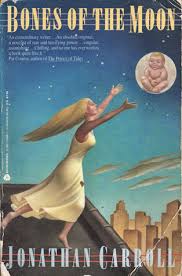
Birthday Reviews: Bones of the Moon (plus some short stories), by Jonathan Carroll

Jonathan Carroll's birthday was a few days ago, but I didn't have a chance to post this short selection of reviews until today. Carroll is a really intriguing writer, and I have generally loved his short fiction, but struggled just a bit with the novels I've read. (I say struggled, and that's true, but I still enjoy and am fascinated by them.) I need to read some more of his novels, anyway. Here is a quick look I did for my old blog at Bones of the Moon, plus a few short things I've written for Locus about his shorter work.

Blog review of Bones of the Moon

Bones of the Moon is a novel by Jonathan Carroll.  Carroll is one of Glen Engel-Cox' favorite writers, and as it happened I had picked up a copy of this book for a song some years ago, at one of those roving remainder stores.  I have read some stories by Carroll before ("Friend's Best Man", "Uh-Oh City" and "Alone Alarm"), and I had been intrigued by his quite unusual imagination: almost whimsical, but darker and wilder.  He is a fine writer, too, but based on the sample of his work I've seen, an indifferent plotter.

The above comments apply pretty well to this book, anway.  Either that or I'm seriously missing the point. The story is the first person narration of Cullen James, a young New Yorker who lives upstairs from a serial killer. This revelation is made on the first page, and serves to imbue what otherwise seems to be a sunny novel with a sense of dread. Cullen is married to an ex-basketball player named Danny James (who, like Danny Ferry, played in Italy (coincidence, I'm sure)): she quickly narrates their long friendship/courtship, the precipitating event of which is her difficulty coping with an abortion after a loveless relationship. These early chapters are a pure and believable love story. But, pregnant with a child by Danny, she begins to have sequential dreams of an odd fantasy world, populated by toys from her childhood, and accompanied by her first child, obviously the aborted baby. Eventually they begin a quest to find the five "Bones of the Moon". At the same time she befriends another neighbor, a gay man, and through this friend she meets a strange filmmaker, who becomes obsessed with Cullen. Some of her fantasy world becomes entwined with the real world, in difficult to understand but disturbing ways. 

The resolution is shocking, and a bit ambiguous. It's not quite unearned, but it still seemed, oh, slightly forced, to me.  I freely admit that I didn't "get" all of it, though I'm not sure that it is all supposed to make coherent sense.

The strong points are the fine writing, and the wonderful, wild, imagination. As I say, I felt a bit let down by the plotting. The characters were extremely well drawn, and individual, but perhaps not quite real: or should I say, not people I quite recognize. I except Danny James here, who is extremely well-drawn and real (but who disappears to some extent towards the end). All these caveats aside, the book has some real power, and some real and effective weirdness.

Sympathy for the Devil review from Fantasy Magazine

Sympathy for the Devil also includes excellent recent work, especially Jonathan Carroll’s “The Heidelberg Cylinder”, a distinctly offbeat story about the dead returning because Hell is running low on space.

Locus, August 2011

The very big “little magazine” Conjunctions has a history of being hospitable to the fantastic, and again we see this is number 56, called “Terra Incognita: The Voyage Issue”. Names familiar to genre readers include Peter Straub, James Morrow, and Jonathan Carroll (and by all means read the stories by writers from outside the genre too!). My favorite was “East of Furious”, by Jonathan Carroll. It’s about the platonic relationship between Beatrice Oakum and her divorce lawyer, Mills. Eventually Beatrice convinces Mills to tell her the story of one of his previous cases, involving a modern alchemist and her Russian husband. The story – and its eventual intersection with that of Mills and Beatrice – is twisty and clever and witty and ultimately rather dark. Lovely work.

Locus, January 2017

There’s some nice stuff in November at Tor.com as well. “The Loud Table”, by Jonathan Carroll, opens with four older men who regularly sit and gab at a coffee shop. They’re morning the loss of their fifth, who just died of cancer. And of course they discuss their own maladies, including the one so many of us fear, Alzheimer’s. (I assume by us I mean all of us but I’m 57, so perhaps I just mean us old men!) One of the men discusses his memory loss – which makes him fear the disease, of course. For example, this one beautiful girlfriend … And the narrator makes him an offer … I’ll let Carroll reveal the sting. It’s a modest story, but enjoyable and expertly told.

Sunday, January 26, 2020

Birthday Review: Stories of Yoon Ha Lee

I can't believe I haven't done a summary post on Yoon Ha Lee's short fiction. I found his shorter work intriguing from the very first story, "The Hundredth Question" in F&SF in 1999. He has a wider reputation now, after the tremendous success of his Machineries of Empiretrilogy. But as I hope this shows, he was writing striking work at shorter lengths throughout, and getting better and better. I've reprinted several of his stories in my Best of the Year volumes. Particular favorites include "Flower, Mercy, Needle, Chain", and the remarkable "Iseul's Lexicon", from his first story collection, Conservation of Shadows. Not included here is my review of his latest collection, Hexarchate Stories, all set in the Machineries of Empire universe, because that review appears in the current (January 2020) Locus.

Locus, June 2002

And Yoon Ha Lee's "The Black Abacus" (F&SF, June) is a fascinating attempt at describing a war conducted in quantum space through the eyes of a spaceship captain and her (traitorous?) associate and lover. I don't think the story quite works, but the attempt is intriguing indeed.

Locus, January 2009

And Yoon Ha Lee’s “Architectural Constants” (BCS, 10/23) is an evocative and original story of a constantly changing city, its changes controlled by a mysterious “spider”, and of the librarian and the sentinel whose destinies collide with the latest alterations.

Locus, March 2009

Yoon Ha Lee, in “The Unstrung Zither” (F&SF, March), seems to be trying something quite interesting. The story is apparently SF. An established planet trying to reestablish (by war) sovereignty over five colony planets. Five child assassins, one from each colony, have been captured. Xiao Ling Yun, a musician, is charged with using her musical ability to learn how to defeat them. The atmosphere is distinctively fantastical – largely I think because everything in the story is metaphor. Or perhaps not – perhaps what seems metaphor is real in this future, or alternate world? At any rate, all this is odd and interesting. And Ling Yun’s character is very well shown. That said, I felt the story didn’t quite work – but was a highly worthwhile failure – in that the plot’s dependence on quite implausible actions by the Phoenix General naggingly undermined my suspension of disbelief.

Review of Federations, Locus, May 2009

Yoon Ha Lee’s most notable feature, it seems to me (though Lee has displayed plenty of range) is the ability to imbue quite overtly space operatic stories with a nearly fantastical sort of color, and with a considerable feeling of intimacy. “Swanwatch” is another such (compare, for example, to “The Unstrung Zither”, from the March F&SF). A young woman is exiled to a distant space station for a trivial crime, and her new duty is to observe the “art form” of suicides who spiral into the nearby black hole. The story’s resolution isn’t quite what first seems offered, refreshingly.

Locus, September 2009

Yoon Ha Lee is never less than interesting – in “The Bones of Giants” (F&SF, August-September) a man searching for revenge against the evil necromancer who killed his mother allies himself with a chance-encountered young woman. On the surface a fairly conventional fantasy, but well executed, and with an effective closing revelation.

Locus, May 2010

At April’s Clarkesworld both stories are striking. Yoon Ha Lee’s “Between Two Dragons” is a war story, about a hero admiral who falls afoul of political machinations during a war, and is imprisoned, only to be released when the exigencies of war require his services. Which description of course doesn’t describe what’s really going on – this is a future war, between multiple star systems, and the admiral’s imprisonment involves also some mind alteration … but at heart it remains simple, a question of loyalty, and where loyalty belongs. Lee continues in his SF to use the language of fantasy to get at his themes: always quite interestingly.

Locus, September 2010

Yoon Ha Lee is reliably original and exotic again with “The Territoralist” (BCS, July 15). Guard Captain Jaris leads a crew to a territory that has “gone rogue” to set things right. The journey is fraught with strange omens, strange attacks, strange weapons – and in the end treachery, nicely foreshadowed. So I liked the story, though on final analysis I didn’t quite get a firm enough sense of groundedness to love it.

Locus, October 2010

Fantasy’s companion, Lightspeed, features a striking short Yoon Ha Lee story in September, “Flower, Mercy, Needle, Chain”, in which an assassin with a mysterious gun is approached by a potential client – but her mission and her gun are not what they once were. In its brief space the story spans great time, many universes, and we learn the assassin’s history, and the gun’s nature, both fascinating and unexpected.

Locus, December 2010

Yoon Ha Lee’s “The Winged City” (Giganotosaurus, December) is another striking and ambitious – but perhaps not quite successful – fantasy. Lee seems to try as hard as any writer to make worlds truly strange, and so with this story, about an apparently flying city, facing drought, that wages war on its neighbors for water and luxuries. This strategy seems about to fail, as one of the generals pushes for her clay man to accompany her to the next war. The sense of oddness, of dislocation, is palpable and effective, but the story qua story, in the end, slipped from my grasp. So – a worthy effort, but, for me, not a hit.

Locus, March 2011

It seems to me, thinking about Yoon Ha Lee’s increasingly impressive array of stories, that Lee's central theme is war, and that Lee treats this theme in strikingly original and varied ways. “Ghostweight” (Clarkesworld, January) is his latest war story, as striking and wrenching as any of them. Lisse is a deserter from the an interstellar Imperium’s army, and with the help of a ghost attached to her, she takes over an abandoned war kite, determined to take revenge on the people who destroyed much of her planet and killed her parents. Her cause seems just – is just – but can she truly be effective? And will her violence breed more violence, turn her into something she never wanted to be? And what of the ghost’s motivations? These are familiar questions, no doubt, but ever important ones, and well asked here, and twistily resolved, in another of Lee’s very different SFnal worlds – described with the feel of fantasy, with ghosts and origami and kites, but at core true interplanetary SF.

Locus, October 2013

Also at the August Lightspeed, Yoon Ha Lee is aggressively strange as ever in “The Knight of Chains, the Deuce of Stars”. It concerns “the exile Niristez … in a ship of ice and iron and armageddon engines” (for me, Lee's imagery usually hovers just to the good side of overwrought). Niristez has come to “a black spire upon a world whose only sun is a million starships wrecked into a mass grave” to play a game with the Warden of the tower – perhaps hoping to keep her promise to end an endless interstellar war, perhaps hoping to prolong the war. Games are central here, and cards, and strategy and tactics, and, as so often with Lee, ways of describing future war (and thus perhaps conflict in general) in new and effective ways.

Locus, February 2014

The best piece in the January Clarkesworld, however, is Yoon Ha Lee's “Wine”, one of Lee's grimmer stories, set on the planet Nasteng as it comes under attack by representatives of the wider universe, apparently interested in the secret of their “wine”. The ruling Council of Five hire mercenaries to resist the attack, and they ask a terrible price. The nature of that price, and the Council, and the wine, is the subject of the story, as learned by Loi Ruharn, a General and the lowborn lover of the one of the Councilors. Dark stuff indeed.

(Cover by Sherin Nicole)
Lee is justifiably one of the most celebrated newer writers in our field, though, even while celebrated, Lee is not as well known as deserved for a simple, common, reason: no novels. (Though I think a couple may be in the pipeline.) Indeed, Conservation of Shadows is Lee's first full-length book. (Another very creditable collection could be assembled from stories not in this one, mind you.) It's an exceptional collection, with such tremendous stories as “Flower, Mercy, Needle, Chain” and “Ghostweight”. There's also an original novella, the longest story I think I've seen from Lee, “Iseul's Lexicon”, which I think is one of the stories of the year. Iseul is a spy for Chindalla, a nation half of which has been conquered by Yegedin, in a world where humans some centuries before freed themselves from the cruel domination of magicians called the Genial Ones. What little magic is still done is based on that of the Genial Ones, with charms written in their language. Iseul, a poet and linguist, is a natural magician of sorts, and her mission, to investigate the house of a Yegedin magician, seems a natural. When she encounters a Genial One in the house, the implication that the Yegedin have allied with a survivor of humans' old oppressors leads to an desperate race to stop the Yegedin from using this new power to conquer the rest of her country. The plot, put that way, is conventional enough, though well-handled. The power is in the telling, at times as (grimly) funny as anything I've seen from Lee, delightfully imaginative in the handling of the magic system, original, moving, realistic in its look at a middle-aged ex-poet caught up in war. Simply exceptional work.

Locus, May 2014

Yoon Ha Lee is one of the masters at merging SF and Fantasy – though to me it seems Lee often uses imagery from Fantasy to come to grips with the strangeness of the universe, and of deep time, and of intergalactic distances. “The Bonedrake's Penance” (BCS, March 2014) concerns a human girl raised by a Bonedrake, a weapon who has renounced war to curate a museum of sorts, devoted in part to the memories of past wars. As the girl grows up, she eventually comes to participate in the Bonedrake's interaction with visitors, and she must learn the reasons behind her “mother”'s devotion to absolute neutrality, even at the cost of peace.

Locus, May 2016

from the March 3 issue of BCS, Yoon Ha Lee’s “Foxfire, Foxfire” is a strong story in which the fantasy element is the main character: a fox who wants to become human – by killing 100 people, and inheriting their knowledge and characteristics. The SF part is her prospective 100th victim: the pilot of a cataphract, a huge robot being used in a battle. And the story itself finds a way to be different and moving and to invoke real sacrifice. Strong work.

Locus, August 2016

The aftermath of war – or, again, the way being a soldier changes one – also drives “Shadows Weave”, by Yoon Ha Lee. Tamalat is a warrior and Brio was an engineer who served with her. Brio has lost his shadow, perhaps as a way to escape the darkness of his fighting history, but it hasn’t turned out well, and Tamalat is acting as a shadow of sorts for him, and is trying to find a way to restore his true shadow. So they have come to a remote monastery, to learn how to sew a shadow back on … A bit of a convoluted setup, and perhaps not entirely convincing, but I liked the characters and the unexpectedly sweet ending. (“Sweet” not being a word one uses often in connection to a Yoon Ha Lee story.)

Locus, April 2017

Yoon Ha Lee’s “Extracurricular Activities”, from Tor.com in February, is perhaps more traditionally plotted, and with a more conventional tone, than much of Lee’s work. By which I mean to imply that it is perhaps less challenging – but I should say as well that it is a lot of fun. It’s set, I believe, in the same universe as his first novel, Ninefox Gambit (and as “The Chameleon’s Gloves”, mentioned below). Shuos Jedao is an undercover operative for the Heptarchate, assigned to infiltrate a space station controlled by another polity (the Gwa Reality), and to rescue the crew of a merchanter ship that had really been heptarchate spies, including Zhei Meng, a classmate of his at Shuos Academy. Jedao, posing himself as a crewman on another merchanter, executes the mission – with plenty of panache and a certain unconventional approach. It’s funny and clever, and Jedao is an engaging character, especially in his relationships – with his mother, his various commanders, flashbacks to his time at the academy and his friendship with Meng, and with a potential lover among his new crew. One of Lee’s intense and complex social and cosmological universes, presumably established in other stories, makes an effective background for a fine caper piece, with enough of a dark edge to ground it.

There’s plenty more really cool stuff in Cosmic Powers … another Kel story from Yoon Ha Lee, “The Chameleon’s Gloves”, in which an “haptic chameleon”, banished in disgrace from the Kel, is offered a chance at reinstatement if they help recover a super weapon from an apostate General;

Locus, April 2018

My favorite from the the February 1 issue of Beneath Ceaseless Skies was “The Starship and the Temple Cat”, by Yoon Ha Lee, which really does mix out and out fantasy with SF. (Unlike Lee’s novels, which I read as being pure SF in a milieu describable to us only in a way that seems like Fantasy.) The cat is a ghost, in its spectral sense the only survivor of a space station destroyed by a Galactic warlord’s forces. The starship is one of the fleet that destroyed the space station, and it has returned out of something like guilt after the death of its Captain. And somehow the two meet, and through poetry and music, find a way to resist the warlord’s forces.