Tuesday, October 8, 2024

Old Bestseller Review: Miss Granby's Secret; or, The Bastard of Pinsk, by Eleanor Farjeon

Review: Miss Granby's Secret; or, The Bastard of Pinsk, by Eleanor Farjeon

a review by Rich Horton

This is the latest in the Furrowed Middlebrow series of reprints of worthwhile books by British women authors of roughly the the first half of the 20th Century, curated by Scott Thompson (of the excellent Furrowed Middlebrow blog) and published by Dean Street Press. The series was interrupted by the unexpected death of Dean Street's publisher, Rupert Heath, in 2023; but Rupert's sister Victoria Eade has taken over, and a new Furrowed Middlebrow book has at last appeared.

Eleanor Farjeon (1881-1965) was a very popular children's author with a career stretching from the turn of the century to about 1959, and including children's stories, biographies, poetry, at least one libretto for an opera by her composer brother Harry Farjeon, memoirs, and a few novels for adults. Scott Thompason chose for reprint the novel at hand, Miss Granby's Secret; or, The Bastard of Pinsk. Though it was reasonably well-received on its release in 1940, it seemed to have been all but forgotten and had been out of print for years. (Scott suggests that her other adult novels are less successful.) Her best known children's novels seem to be a pair about a troubadour: Martin Pippin in the Apple Orchard (1921) and Martin Pippin in the Daisy Field (1937). She is also remembered for writing the lyrics to the hymn "Morning Has Broken", and there is a children's book award named for her. For all that, I had only a vague memory of encountering her name, and I'd never read any of her books.

This novel is curiously structured, as, essentially, a novel within a novel. Pamela Lang, the narrator of the frame, is the great-niece of Adelaide Granby, who had been a very popular writer of salacious romances over the latter half of the 19th Century. Aunt Addie, as Pamela calls her, is dying, in 1912, at the age of 79. She has written 49 novels and confesses that she wanted to write a 50th, but didn't get to finish it. Pamela is bequeathed her papers (and some money -- Miss Granby's novels have made her very wealthy and, as a spinster, she is very generous with bequests to a variety of people.) With the help of some letters and Miss Granby's diary, she learns that at the age of 16, Adelaide had fallen in love with a boy of about her age who was helping her with penmanship and her father with his book catalogue. Her father intends her to marry someone of a more appropriate class -- but Addie rebels, and continues dallying with the boy, Stanislaw, until her father catches them in flagrante delicto, as it were. Stanislaw is banished, but Addie refuses to marry anyone, and stays faithful to Stanislaw her entire life; turning her romantic energies to her novels.

Another thing found in Aunt Addie's papers is her first novel -- written when she was 16, not long after her love affair. Naturally, Pamela reads it, and this novel is reproduced in full in this book. It's the story of three beautiful daughters of a wicked great uncle, triplets, who have been raised in seclusion. At the age of 16 they notice a handsome young man riding by their great uncle's estate on a magnificent horse, and they attract his attention. As such things go, one day he falls from his horse and they must bring him in to their house and nurse him. Naturally, they all three fall in love with him, and he with each of them. But things are complicated by their dragonish governess, whose back story we learn -- a career as a courtesan to many men, beginning with the triplets' wicked great uncle. And of course their handsome visitor -- named Stanislaw -- turns out to have a mysterious past, and a beautiful sister who has herself been compromised, leaving her with a young child. And then enter the three boorish men their uncle has decided will be their husbands -- in order to get him out of debt ... 

It's rather intricately plotted, involving hints of incest, polyamory, hidden marriages, bastards, sinister servants, and more. It's also preceded by a set of definitions, revealing that the author, Adelaide Granby, didn't really know the meaning of terms like bastard and lecher, nor did she have any hint of the facts of life.

All this is funny for a while, but I confess it drags a bit over time. The novel does resolve, in an absurd but satisfying enough fashion. Pamela Lang, in 1912, decides it is too silly for publication -- Aunt Addie's desired Golden Jubilee novel will, after all, never see print. Fast forward a couple of decades -- Pamela, a young Fabian in 1912, has taken advantage of the new opportunities open to women and become a dentist. Some chance encounters remind her of Aunt Addie's past -- especially the revelation of the real identity of her lover Stanislaw, and the discovery of a lost part of her Aunt's diary. And in the end we learn just a bit more of her Aunt's romantic past, and of what really happened between her and Stanislaw. All this ties in with Pamela's life choices, and with those of some of the women she encounters -- her own maid, and a nurse (one of Addie's bequestees) who cares for Addie's old lover as he is dying -- and the story, rather movingly, becomes a sort of meditation on the changing fortunes of women over the previous several decades.

It's not a wholly successful novel, to my mind. The conceit is wonderful, and the eventual working out is effective, but the novel within a novel wears out its welcome and some of the jokes become a bit over-labored. Still, it's a fine book, and it's pleasant to see it back in print. 

Saturday, October 5, 2024

Review: Invisible Things, by Mat Johnson

Review: Invisible Things, by Mat Johnson

by Rich Horton

Invisible Things is a 2022 novel from Mat Johnson. It was published by the One World imprint of Random House, and as far as I can tell marketed to the mainstream. But it's a true quill SF novel, though certainly one directly addressing contemporary social issues, with a sharp satirical slant -- so one that I would think does appeal to non SF readers. (Johnson's first novel, Pym (2011) is also SF, an odd sequel of sorts to Poe's The Narrative of Arthur Gordon Pym.) The question is -- did the SF world notice this novel? And will SF readers read it the same way?

I don't recall a lot of coverage of Invisible Things in SF sources, but I could easily have missed it. Will SF readers like it? I think they should, and many will, but it does raise thoughts about SF reading protocols and SF readers' expectation. The book is about a trip to Jupiter's moon Europa, and an impossible city that is found there: a domed city (or county), with what must be artificial gravity (and other super high tech), in which live a million or so people in an environment and social system strongly resembling a contemporary American city. This poses questions: who made the city? how is it maintained? where do the residents come from? why does it exist? SF readers, I think, will want answers to all those questions -- and the book does provide some answers, but not all of them. SF readers may also have plot expectations that will mostly (though not entirely) be frustrated. Having said that, I was reminded, to one degree or another, of some of Philip K. Dick's novels (particularly Time Out of Joint) and even of Frederik Pohl's great novella "The Gold at the Starbow's End" -- so this does fit a template of some successful SF. And there is no question that Johnson knows SF, and takes it seriously, and while the book can't be called rigorously "hard" SF, it is as plausible as it needs to be, giving just the right level of detail. I should add, lest the following seem labored, that above all this novel is funny -- funny with a determined satirical point, but funny it is.

The story primarily follows two viewpoint characters. One is Nalini Jackson, a Black post-doc in Applied Sociology, who is accompanying the crew of the Delany, a spaceship exploring the Jupiter system. Her goal is to study the relational dynamics of the crew, to see how they are affected by a long trip in confined quarters. But her job (already fraught) is upended when they discover the anomalous city on Europa, and then are suddenly transported to the city, called New Roanoake, with apparently no choice but to stay there for the rest of their lives. The other main character is Chase Eubanks, a limousine driver in New Mexico, who has become part of the Allies of Alien Abductees after his wife mysteriously disappeared a few years before. He works for a rich old man who suddenly takes an interest in his alien abduction obsession -- and Chase learns that NASA has investigated the disappearance of the Delany crew with unmanned spacecraft, and has managed to get detailed photographs of the interior of the dome on Europa -- and one of the residents of the city is Chase's lost wife, Ada Hibiscus Sanchez. Soon Harry, Chase, a UN representative, and an Admiral working for NASA are on their way to Europa, in a ship called the Ursula, planning to learn more about this mysterious city, and to rescue the astronauts, and hopefully also some of the presumably abducted residents. 

In New Roanoake, Nalini and her fellows are struggling to adapt to their fates. Nalini is planning to use her sociological skills to analyze the society of New Roanoake, which seems only too closely to mirror contemporary American society, with its class and racial issues, and also with a lot of the same technology (and the same chain restaurants!) The other Black member of the crew, Dwayne Causwell, has joined a revolutionary party, the Party of the People. The captain of the Delany, Bob Seaford, has insinuated himself into the power structure of the city, which is dominated by the Founders' Party, which seems primarily focused on retain the privileges of people born in the city instead of abducted from Earth -- or "collected" as the locals prefer to call it -- including the descendants of Virginia Dare and other people presumably abducted from the original Lost Colony, Roanoake. Nalini's sometime lover, Ahmed, is just going along to get along, finding a job working for a TV station. And Ada Sanchez, now calling herself Hibiscus, is making ends meet as a typical lower class resident.

The arrival of the Ursula threatens to wholly upset New Roanoake. Admiral Ethel Dodson announces her intention to set up a facility to manufacture more spaceships to take the residents of the city home. The UN representative talks about exchanging technology with the city -- especially the tech involved in maintaining it. And Chase -- Chase just wants to find Ada (Hibiscus.) But we soon realize that there are very strange things going on -- Invisible Things, which it is taboo to mention, that occasionally snatch people and either disappear them or prominently mess with them. The resolution turns on the collision of the plans and desires of a whole range of people: Chase's desire to be with Hibiscus, Hibiscus' relative happiness with New Roanoake, Bob and his fellows in the Founders' Party desire to hold on to power and privilege by any means, Dwayne's need to see justice in the city, Nalini and Ethel's desire to go home to Earth, and the various conflicting and sometimes contradictory urges of the entire population of New Roanoake. Not to mention whatever unknowable desires the Invisible Things may or may not have.

As I said above, this book is very very funny. It is so in a satirical way, and no character is spared the knife. And, yes, the satire is in service of pointed commentary on our society, on voting rights, economic privilege, other class divisions, media, and human nature. The main characters -- Chase and Nalini -- are depicted deeply and convincingly. Most of the rest are a bit flatter, and give the impression of existing to make a point more than to be real -- but that's a feature of a lot of satire. And some of these characters are a delight -- such as Deputy Vice Party Chairman Brett Cole, generally only to be addressed by his full title.

Recommended.

Tuesday, October 1, 2024

Review: Miss Pickerell and the Geiger Counter, by Ellen MacGregor

Review: Miss Pickerell and the Geiger Counter, by Ellen MacGregor

by Rich Horton

One of the juvenile SF-adjacent writers I missed during my formative years was Ellen MacGregor. She was the originator of the Miss Pickerell series of books, involving an elderly spinster having adventures, occasionally involving clearly science fictional concepts, as with the first of the series, Miss Pickerell Goes to Mars. These were evidently important to a number of readers as a gateway to SF -- Harry Turtledove is apparently one example. But I never saw them.

Ellen MacGregor was a librarian. born in Washington state in 1906. She got her Bachelor's degree from the University of Washington in 1926, and got her Masters from the University of California at Berkeley. She had librarian and research positions in multiple places -- Hawaii, Key West, and the Chicago area, which seems to have been her primary residence. She didn't start writing fiction until 1946. Her first book, Tommy and the Telephone, appeared in 1947. The first Miss Pickerell book, Miss Pickerell Goes to Mars, began as a short story, "Swept Her Into Space", published in Liberty in 1950, but appeared in book form in 1951. Two more Miss Pickerell books came out in 1953, but MacGregor died, only 47, in 1954. She had finished Miss Pickerell Goes to the Arctic and it appeared later in 1954. Three more non-Pickerell novels, presumably found in her papers, appeared in the next three years. A decade or so after her death, her publisher engaged Dora Pantell to write more books about Miss Pickerell, beginning with Miss Pickerell on the Moon in 1965. Pantell wrote a total of 13 Miss Pickerell books, the last appearing in 1986. The first 11 of these were published as by "Ellen MacGregor and Dora Pantell", and the last two by Dora Pantell "in the spirit of Ellen MacGregor", but it seems likely to me that all of these books were entirely written by Pantell, except just possibly for the first one or two. 

Miss Pickerell and the Geiger Counter is a very short book, around 13,000 words. It is illustrated nicely by Paul Galdone. In this book, Miss Pickerell and her nephews, and of course her cow, are headed to the state capitol for the state fair, and for the boys to see an Atomic Energy exhibit. Miss Pickerell will take her cow to a veterinarian for a routine checkup. Alas, however, the steamboat captain kicks her off the boat because of the cow, but not before mentioning that people are prospecting for uranium in the area. 

Miss Pickerell lets the boys continue to the exhibit, while she hopes to catch the train with her cow. But stuff intervenes -- her cow is kidnapped, the local sheriff gets the measles and insists on deputizing Miss Pickerell and assigning her the job of looking for the uranium, and Miss Pickerell misses her train. But she does recover her cow, and find out the truth behind the uranium search, and also learns what the sheriff really wants to do with his life. And the boys are fine, too!

It's not bad, but not special. Still, I think I'd have enjoyed it if I found it when I was 10 or so. Also very notable is the didactic side -- MacGregor definitely seemed to think her job was to educate young reader in science, and there are a lot of mini-lectures, about geology and radioactivity and such. I can't really recommend these books for adult readers, but they are amusing enough, and Miss Pickerell is a nice character.

Sunday, September 29, 2024

Resurrected Review: King's Shield, by Sherwood Smith

Back in 2009 I wrote this shortish review of Sherwood Smith's novel King's Shield, the third in four novels from DAW about a man named Inda. These are part of a very extended series of series, if you will -- stories set in the same fantasy world, over millennia. Some of these are YA -- of which my favorite are a diptych called Crown Duel and Court Duel; and some are aimed at an adult audience, of which my favorite is the opening book in this series, called simply Inda. They are all enjoyable novels -- traditional secondary world fantasy, I suppose, but expertly done, and lots of fun.

King's Shield, the third novel in the Inda series, is essentially the story of the invasion of the seagoing Venn (they are Norselike, and indeed I believe explicitly descended from Norsemen who happened into the world of this book) into Iasca Leror, the home of Inda, and a generally warlike culture but not one much given to either magic use or sea travel. Inda has learned of the coming invasion and has returned home after years in exile during which he became known as a pirate though in fact he was instead a scourge of pirates. Inda's return is a gamble -- he could technically be imprisoned for breaking his exile -- but in fact his enemies have been ousted from the throne, and the new King is his childhood friend, Evred. Soon Evred makes Inda his warleader, and they plan resistance to the Venn invasion. And the story then tells how they fight off the Venn.

That doesn't in a sense seem like much story for a very long book (it's about 250,000 words). And indeed the book starts slowly -- but it gathers momentum and is very exciting and involving by the end. Part of this is simply that the action is shown in considerable detail, and from several points of view -- not just Inda's, but also Evred's, and a couple of Venn, and a couple of Inda's friends from his pirate days, and Evred's wife, and some other key women, and a band of children ... And besides that the action is complicated and involved. Indeed, though the battles are important, and the outcome of the war is important, the book is really most closely focussed on the characters. On Evred's hopeless attraction to the thoroughly heterosexual Inda. On Inda's friend Tau's search for a purpose in his life. On Inda's betrothed Tdor's reaction to Inda's Venn lover. And so on ... 

The book also examines the role of duty and loyalty in advancing a war good people know to be unjust. The use and misuse of magic in war is an issue. I've enjoyed this series immensely. That said, I think I would rank King's Shield only third of the three books to date -- partly this is due to its middle-bookness, and to the previous book featuring some really critical developments (such as Evred's ascent to the throne) that this book has little chance of topping. Also, as the series gets longer, there seems a temptation to linger on side issues -- to keep us up to date with characters we know -- so that for example this book features several essentially unnecessary chapters dealing with Inda's former shipmates, who are still sailing -- these are not uninteresting, and may prove important in the next book, but they have nothing to do with this book's plot. But for all that, the main point is that the Inda books continue to be some of the most fun fantasy reading I've had in years.


Wednesday, September 25, 2024

Review: The Practice, the Horizon, and the Chain, by Sofia Samatar

Review: The Practice, the Horizon, and the Chain, by Sofia Samatar

by Rich Horton

This is a new novella, perhaps 23,000 words, from Sofia Samatar. It should go without saying that anything by Samatar is in the must-read category. This book certainly is. It's strange, dark, depressing but hopeful. Excellent work.

The story centers two characters, one a teenaged boy who has grown up in the Hold of a mining spaceship, the other a professor of the "Older Knowledge" at a school in the more privileged levels of that spaceship. We learn over time that the ship is part of a fleet of ships, in which live what seem to be the survivors of a ruined Earth. They maintain themselves by mining necessary material from what seem to be asteroids. 

The boy has some artistic talent, which brings him to the attention of the professor, who has him freed from the Hold, and from the chain that the people in the Hold always wear. She is the daughter of a man who was also brought up from the Hold to be educated, during a brief period when scholarships were offered to some Hold denizens. The professor has fought to reestablish the scholarships, and the boy is the first attempt at making this work.

The boy has a hard time adjusting to life on this new level. In particular, he misses a friend of his, called the Prophet, who preaches a religion (with Christian echoes) to the people down there. He has dreams, even visions, especially of some of the people in the Hold who were killed due to the negligence and cruelty of the Ship's leaders. The professor, too, has difficulty. She has to spend time helping the boy catch up with his studies, which affects her own work. And it becomes clear that her status in her school, in her whole society, is fraught, due, clearly, to her father's origins. And, too, we realize that she, and the boy, and other people in her orbit, called the Ankleted, are in a sense in chains as well -- an electronic device around their ankles, which helps them communicate with others, turns out to have additional uses.

The book, then, slowly reveals a truly awful and hypocritical society. The professor's treatment by her colleagues, at the same time a satirical depiction of academic politics and a searing depiction of class prejudices, is dreadful. The boy is treated as a sort of pet, though his innocence allows him to overcome this in the way the professor really can't. The story finally turns on the boy's realization of some unexpected abilities, and a reunion with the the Prophet, and an attempt to rescue the Prophet's daughter. The Practice, the Horizon, and the Chain, is presented as SF, but it's more a sort of parable, and a dark commentary on class and power hierarchies in our world. It's an effective and powerful story.

Sunday, September 22, 2024

Review: The Ministry of Time, by Kaliane Bradley

Review: The Ministry of Time, by Kaliane Bradley

by Rich Horton

The Ministry of Time is Kaliane Bradley's first novel, though she has published a number of short stories, including the winner of the 2022 V. S. Pritchett Prize. As the title hints -- with its resemblance to John Brunner's Society of Time, or Jack Williamson's Legion of Time -- the novel is unabashed SF, and it is a time travel/alternate history story. It seems perhaps in conversation with stories like those mentioned above, or like Poul Anderson's Time Patrol series, or Fritz Leiber's Spiders and Snakes. I don't know if Kaliane Bradley is particularly an SF fan, though apparently she's a fan of Terry Pratchett, but she does use this trope expertly and effectively.

The narrator (who is, perhaps significantly, never named) has just taken a job for the Ministry of Time as a "bridge". Her assignment is to help a person who has been rescued from the past (someone who is known to die, so that taking them to the future won't change history) adjust to the present day. (The novel seems set just slightly in our future -- maybe!) Her assignment is Graham Gore, who was a member of the doomed Franklin Expedition which attempted to find a Northwest Passage from the Atlantic to the Pacific. The expedition set out in 1845, and became stuck in the ice in Northern Canada. By 1848 all crewmen of the two ships of the expedition had perished. Gore was "rescued" by the Ministry in 1847.

The other time travelers -- or ex-pats, as they are formally called -- are Thomas Cardingham (died in the Battle of Naseby in 1645), Margaret Kemble (died in the Plague in London in 1665), Anne Spencer (died in the French Revolution in 1793), and Arthur Reginald-Smyth (died in the Battle of the Somme in 1916.) These are all fictional, I think, though Google tells me there was a somewhat noted landscape painter named Arthur Reginald Smith who was a near contemporary of this character (about ten years older), though while the painter did serve in the Great War (in the Artists Rifles Regiment! -- I had not heard of that,) he survived the War, dying in somewhat mysterious circumstances (drowning) in 1934. The time travelers call each other by their dates of recovery -- typically just Forty-five, Sixty-five, Ninety-Three, Forty-Seven, and Sixteen.

The first part of the novel is focused on the narrator introducing Gore to the 21st Century -- and in addition we see the other time travelers and their bridges. Much of this is funny, with Gore's stiff upper lip and general Victorian nature battling to understand this new century. The other two time travelers we get to know best are Margaret and Arthur, who are both gay. Margaret adapts enthusiastically to the freedoms of this time, and particularly enjoys movies, while Arthur struggles with PTSD, and with his (as he realizes) hopeless crush on Gore. Thomas Cardingham is a disagreeable person, particularly sexist and otherwise violently disapproving of 21st Century morés -- I'm not sure if he was a Cavalier or Roundhead, though perhaps the former as he has long hair and, after all, the Royalist side lost decisively at Naseby. And Anne Spencer, rescued from the Terror*, wholly resists adaptation to this future.

We also learn a lot about the narrator -- she's the daughter of a Cambodian woman who barely escaped the Khmer Rouge, and an English man. Her biracial status, and her family history, are significant, and it's significant that her mother, like the time travelers, is an expat. (Bradley, I should note, is also Cambodian-English.) And in short interludes between chapters, we get a direct narrative of the desperate lives of the crew of the Franklin Expedition over the two years and more they are stranded, with some key insights into Gore's character.

But we begin to realize that there are strange things happening, of which the narrator is mostly unaware. There's the picture Gore (an accomplished artist) draws of a weird machine he sees. There's Quentin, the narrator's "handler", who is convinced there is something rotten in the Ministry. And Arthur's bridge, Simellia, a Black woman, is much more radically inclined than the narrator, and she too raises doubts. Time travel seems to have some weird effects, such as the expats suddenly not showing up on scanning equipment. The leader of the project, a sinister-seeming woman named Adela, is constantly changing in appearance. And what about this unusual person, the "Brigadier", who seems to be lurking round the edges?

The plot develops in expected ways -- the narrator and Gore falling in love, most obviously -- but also in some very unexpected ways. If at first it reads like a convenient use of the time travel device to tell a love story, and a story about the experience of expatriates (either in time or space), with some cli fi mixed in, by the end it's all of those things plus a book that gloriously and whole-hearted buys into the strangeness and paradoxes of time travel. There is a wild twist at the end, which I only guessed half of in advance. The love story is beautifully handled. The depiction of near future life is fraught and believable. The examination of the expat experience, the depiction of the horrors of the Franklin Expedition, and the intricate plot are very well done. There are some truly wrenching -- tragic -- happenings, which hit home. It's well written -- Bradley in particular has a way with striking images and metaphors. I did have some quibbles -- time travel stories are always weird when the paradoxes are acknowledged, but some of the effects of this version of time travel seemed contrived to me. Some of the political business (and busyness) towards the end felt flat to me (and a bit "tick the boxes" obligatory.) I'm not sure I quite bought a couple of characters' transformations, and some of the motivations driving the climax didn't quite work. That said, in the end I loved the novel, and the very end is a honest and very moving indeed. The book made me laugh, made me think, made me go wow! -- and brought me to tears.

I've complained a bit about what seems a great many first novels winning major SF awards recently** Having said that, I won't be surprised in The Ministry of Time wins major awards, and as of now it's my choice as best SF novel of 2024 (noting that there are plenty I haven't read.)

*The Terror, of course, is also the name of one of the ships of the Franklin Expedition, so in a sense Gore was also rescued from the Terror, though he was First Lieutenant of the other ship, the Erebus.

**I suppose I should survey the history of the awards and see how often in the past first novels have won Hugos -- the first two Hugos for Best Novel, after all, went to first novels (The Demolished Man and "They'd Rather Be Right"), and other still acclaimed first novels such as "... And Call Me Conrad"/This Immortal, A Canticle for Leibowitz, Neuromancer and Jonathan Strange & Mr Norrell have won. (OK -- I have taken a look! Only three first novels in the past 11 years have won (Ancillary Justice, A Memory Called Empire, and Some Desperate Glory.) Six first novels in the first 60 years won. So possibly the rate is a bit high recently, but for a relatively small sample size it's really not that strange.)

Thursday, September 19, 2024

Review: How to Rule an Empire and Get Away With It, by K. J. Parker

Review: How to Rule an Empire and Get Away With It, by K. J. Parker

by Rich Horton

K. J. Parker's stories are known for their romantic cynicism, their fascination with how things work (mechanically and politically), for depictions of war, for an abiding almost hopeless view of relations between men and women, and for their dark humor. Most of his stories are set in a vaguely Byzantine world, with no pretensions to consistency between stories, sometimes with magic and sometimes without. K. J. Parker, of course, is a pseudonym for Tom Holt, who also write rather lighter comic fantasies under that name, and brilliant historical fiction as by Thomas Holt. I will especially recommend, as I always try to, Thomas Holt's novel The Walled Orchard, first published under the Tom Holt name in two volumes as Goat Song (1989) and The Walled Orchard (1990) -- this is about the Sicilian Expedition, a drastically failed military campaign by Athens in the fifth century BCE. It is, I think, one of the very best historical novels of the past half century, blackly funny, ultimately tragic, and really moving -- about a Greek playwright, his horrible marriage to a woman he loves and hates, and his terrible experiences in Sicily.

A few years ago I read Parker's novel Sixteen Ways to Defend a Walled City (2019), in which the capitol city of an Empire is besieged by an army of what they think of as barbarians. The novel was in many ways one of Parker's stories about How Things Work, and it brilliantly depicted an engineer leading the effort to foil every effort of the besiegers to breach the walls of the city. All those details were fascinating. And the character story was effective is well, and nicely mordant.

How to Rule an Empire and Get Away With It, from 2020, is the sequel. The siege has settled into a stalemate. Notker, our narrator, is an actor, impressionist, and playwright. He's also the son of a gang enforcer -- the City has two primary gangs, or Themes, the Blue and the Green, bitter rivals. And the city's leader, Lysimachus, a man regarded as a hero for saving the city (though we all know the real hero was the engineer in Sixteen Ways) has been killed. Mention is made of some popular plays, with names like The Prisoner of Beloisia and The Man in the Bronze Mask. Not to mention that one of Notker's most popular impressions was of Lysimachus. Any reader can see where this is going. 

So, yes, Notker is maneuvered into assuming Lysimachus' position, and impersonating him. In the process he must get himself a mistress, to keep up appearances, especially as Lysimachus' sexuality was in doubt ... and he chooses Hodda, an actress and impresario with whom he is in love, though she is basically indifferent to him, despite them having a previous relationship. (There's an echo here of The Walled Orchard, with a playwright involved in an unsuccessful relationship.)

This sets up the situation for the rest of the novel -- Notker/Lysimachus takes control, and eventually truly takes the reins, leading several efforts to keep the invaders at bay, and in the process unifying the Blue and Green gangs, and making other improvements in the City's organization, as well as harrying the enemy. Plague threatens as well. Meanwhile Hodda desperately wants them to escape to safety, and Notker assures her that that's the plan, but only when it's feasible. There is some of Parker's beloved engineering, mostly involving attempts to stop the besiegers from breaking through a seam of granite and getting to the city walls to undermine them. It's clear Notker -- now crowned Emperor Lysimachus II -- is tempted by power, but he realizes that power leads to abuse of power and atrocities. And he comes up with a plan to sort of have his cake and eat it too ...

It's enjoyable enough, but nowhere near Parker at his best. The engineering bits are OK but not as absorbing as he can be. The relationship between Notker and Hodda just doesn't have the emotional heft some of the other doomed quasi-romances in Parker's novels attain. The darkly comic tone is well maintained, but it's not as funny as he can be. The ending falls just a tad flat, though as this is a middle novel of a trilogy that's not entirely unusual. (The third novel, A Practical Guide to Conquering the World, appeared in 2022.)

Monday, September 16, 2024

Review: Raise High the Roof Beam, Carpenters; and Seymour, an Introduction, by J. D. Salinger

Review: Raise High the Roof Beam, Carpenters; and Seymour, an Introduction, by J. D. Salinger

by Rich Horton

I read J. D. Salinger's most famous novel -- only novel, really -- The Catcher in the Rye, back in high school -- the right time. I liked it, and at more or less the same time, I read Nine Stories, and I thought that was pretty good too. But I didn't read his third book, Franny and Zooey, until just a few years ago. I thought that book was fine but not brilliant. I kind of knew I'd eventually read his only other book -- the one at hand -- though I'd gathered the impression that his fiction was somewhat linearly declining in quality. So when I found a copy of RH&S (as I'll abbreviate it) for a dollar at an estate sale, I figure, why not?

Like Franny and Zooey, this book comprises a shorter story plus a novella or short novel. In this instance, "Raise High the Roof Beam, Carpenters" is the shorter one, at some 22,000 words; while "Seymour, an Introduction" is the longer, some 29,000 words. The stories appeared first in the New Yorker, in 1955 and 1959, respectively. (All of Salinger's work except for The Catcher in the Rye appeared there after "A Perfect Day for Bananafish" in 1948 -- the New Yorker gave him a contract in which they had right of first refusal for any fiction -- for a price, I assume.) Both these books, plus three of the stories in Nine Stories ("A Perfect Day for Bananafish", "Uncle Wiggily in Connecticut", and "Down at the Dinghy") concern the Glass family -- seven children (two of them dead) of two vaudevillians. Salinger's last published story, "Hapworth 16, 1924", which occupied nearly the entirety of the New Yorker for June 19, 1965, is also about the Glasses, and by repute, Salinger wrote additional stories and novels about them after he stopped publishing.

This is, I think it's fair to say, a problem. Salinger's obsession, the Glass family, is wearing. In particular, the eldest child, Seymour, becomes an improbable object of devotion -- an absurdly precocious boy, a saint, really. And the last two published stories are similarly long pieces curated (or written) by the second Glass child, Buddy, but wholly about Seymour. The thing is, Seymour committed suicide in the very first, and best, Glass story, "A Perfect Day for Bananafish". Salinger's development of the Glass mythos ended up requiring his stand-in, Buddy, to claim, in "Seymour, an Introduction", that in "A Perfect Day for Bananafish" (supposedly, in this context, written by Buddy) was not really about Seymour but about Buddy. 

(A couple words about the titles of these stories and the book -- the proper punctuation is not clear. I have rendered the titles in the form I think most sensible.)

So, the stories themselves. "Raise High the Roof Beam, Carpenters", is about Seymour's wedding day, in 1942. It is told by Buddy, two years Seymour's junior. For reasons -- wartime reasons, mostly -- Buddy is the only Glass who can make it to the wedding, though he had to get leave from his army camp to do so. But the wedding doesn't come off -- Seymour has seemingly left Muriel, his fiancée, at the altar. Buddy ends up in a car with members of the bride's family, heading to what will be a gloomy quasi-reception. The story follows Buddy's endurance of the protests of the Matron of Honor and her husband, and a certain Mrs. Silsburn, about the caddish behavior of Seymour. His only ally is a dwarfish elderly deaf-mute. The drive is interrupted by a parade, and in the end Buddy invites them all to his and Seymour's nearby apartment (abandoned to their sister Boo-Boo when they join the military), and makes them drinks while finding Seymour's diary. It turns out that Seymour funked the wedding because he was "too happy" -- and that he and Muriel ended up eloping. 

This is actually a decent, if overlong, story. Salinger's eye (and ear) for amusing details is fully present. The story is more about Buddy than about Seymour, which is fine. It's a nice presentation of a fraught wedding at a difficult time -- the early months of America's entry into the Second World War. (Salinger served on the European front, was there on D-Day and the Battle of the Bulge, was present at Dachau shortly after its liberation, and was cleary and understandably severely affected by this.) The title, by the way, is from a fragment of Sappho: "Raise high the roof beam, carpenters. Like Ares comes the bridegroom, taller far than a tall man."

"Seymour, an Introduction" is Buddy's attempt, in 1959, to describe his beloved elder brother to the world, on the occasion of the prospective publication of Seymour's poems. (Seymour, besides being remarkably talented at everything else except for some sports at which he is very bad but in a very special way, is supposed to be a great poet -- in Buddy's estimation, clearly the greatest poet of the 20th Century, working in a form called "double haiku" -- sometimes in Japanese, sometimes in English, presumably occasionally in Latin or Sanskrit or Proto-Indo-European.) This introduction is incredibly discursive, and is as much about Buddy as it is about Seymour. We learn a fair amount about their shared childhood, and a lot about Buddy's state of mind and health as he is writing this. (He is a teacher at a women's college in far upstate New York.) And we do learn about Seymour. Not much about his poems, which are never quoted, just described, but a lot about his physiognomy, and about his early life with Buddy. 

The thing is, there is some good stuff here. But it's to a great extent buried in the endless, self-indulgent, divagations; and it's to a great extent weakened by the glorification and sanctification of Seymour. (Yes, I suppose his name is meaningful too!) The Seymour we saw in "A Perfect Day for Bananafish" is an affecting character -- clearly damaged by his experience in a terrible war, clearly unhappy in his marriage (though I think the portrayal of Muriel, in retrospect, seems unfair.) The later revisionist approach to his life and fate is, well -- self-indulgent. I understand that "Hapworth 16, 1924" is mostly a long letter from the seven year old Seymour, written at camp, in which we learn of his lust for a much older married woman, and of his admiration for the likes of Anna Karenina. Hmmmm. 

(I was intrigued to see references to Betsey Trotwood and the donkeys, and to Anna Karenina's being painted in Italy, in this story -- references that would have meant nothing to me had I not read both David Copperfield and Anna K in the past year or so.)

So -- a lesser story in this case. Still, I'm happy enough to have read this book. I don't know that I'll attempt "Hapworth 16, 1924", though I guess I'll get to it sooner or later, mostly later. And I must confess I have little optimism about the supposedly voluminous material Salinger left behind at his death -- surely it means something that his heirs have not seen fit to publish it.


Wednesday, September 11, 2024

Resurrected Review: The Cutting Edge, by Penelope Gilliatt

I decided for eccentric reasons -- and because the latest novel I read (The Ministry of Time, by Kaliane Bradley) deserves a more thoughtful treatment -- to post a very short review I did of a fairly obscure novel, that I read a couple decades ago. I chose this novel because Joachim Boaz just acquired Penelope Gilliatt's SF novel, One by One. (I had not known she'd written any SF!)

Resurrected Review: The Cutting Edge, by Penelope Gilliatt

by Rich Horton

Penelope Gilliatt was an English novelist, short story writer and screenwriter (Sunday Bloody Sunday) who was also well known at the film critic for the New Yorker whose columns alternated with those of Pauline Kael. She was married to the famous playwright John Osborne. I got her 1979 novel The Cutting Edge for a quarter when my local library deaccessioned it -- I bought it because I recalled her name from the New Yorker, and because it looked interesting, and because how wrong can you go for a quarter?

And in fact it is a pretty enjoyable novel. It's the story of two eccentric sons of an eccentric English professor. The elder son is eventually named Peregrine, the younger Benedick (I say eventually because the professor initially called them Brother A and Brother B). They grow up, and Benedick gets married, and for a while live together in the ancestral house, along with Benedick's wife, and the Professor, and his second wife, and the boy's half-brothers, and their nurse ... then Benedick's wife, Joanna, leaves him. Which precipitates the main action of the novel.

The two end up in Istanbul. Peregrine is a writer and a Benedick a musician, but neither makes much money. When Peregrine gets in trouble for an affair with a 14 year old, he's off to Italy and then Paris, meanwhile becoming somewhat famous in England for his criticisms of his country, which come apparently from an old-fashioned (as in Samuel Johnson old-fashioned) Tory sensibility. Meanwhile Benedick is writing music with some success, missing his wife, and missing his brother even more perhaps. A series of brittlely funny short chapters detail their, er, peregrinations, leading inevitably to Joanna showing up in Paris and shacking up with Peregrine.

And that's pretty much it. It's a short novel (perhaps 40,000 words) and a fast read, and funny in rather brittle fashion (as I said). It's populated by briefly and effectively sketched eccentrics who wander into and out of the brothers' life. The whole thing is nice if minor work.

Monday, September 9, 2024

Review: A Mourning Coat, by Alex Jeffers

Review: A Mourning Coat, by Alex Jeffers

by Rich Horton


Alex Jeffers first came to my attention wtih two stories in the Robert Silverberg/Karen Haber anthology Universe 2, from 1992: "(from) The Bridge", and "The Fire, The Fire". I didn't realize it then, but I had seen stories from him more than a decade earlier, beginning with "Mask", from New Dimensions 6, edited by Silverberg, through "The Celebrants", from Universe 12, edited by Silverberg with Marta Randall. There's a reason I didn't make that connection -- these stories were published as by Donnan Call Jeffers, Jr. (Alex's birth name) and Peter Santiago C. Indeed, Jeffers' first 8 SF stories were published in anthologies edited by Robert Silverberg, which ought to remind us that Silverberg's contribution to the field as editor, not just writer, has been profound. (Though to be sure Silverberg's co-editors, Randall and Haber, deserve credit too.) 

But this isn't about Robert Silverberg! It's about Alex Jeffers. I loved those stories in Universe, and his name stuck with me, and I was delighted when I saw more stories from him some 15 years later: "Firooz and his Brother" in F&SF in 2008 (and reprinted in my Best of the Year anthology) and "Jannicke's Cat" in M-Brane in 2009. Christopher Fletcher, editor and publisher of M-Brane (and a fellow St. Louisan) also published a short novel by Jeffers in 2011, The New People. (Which I reviewed here.) Jeffers has also published two non-fantastical novels, Safe as Houses (1995) and Do You Remember Tulum (2009), as well as a couple more novels, Deprivation; or, Benedetto furioso: An Oneiromancy (2013) and That Door is a Mischief (2014), as well as a Lambda Award winning erotic novella, The Padisah's Son and the Fox (1996, expanded 2013). And as to the name -- yes, Alex is the grandson of the great American poet Robinson Jeffers.

Jeffers has continued to publish delightful stories, including some set in a fantastical world called Kandadal's World. I reprinted one of these ("The Tale of the Ive-Ojan-Akhar’s Death") in my Best of the Year volume. A Mourning Coat is likewise set in that world. (It's a world about which you can say "in" not "on".)

Therre, the narrator, is mourning his father's death. He had been his caretaker for five years, as his father descended into a cranky senility. And so his feelings are complicated -- this made his life terribly difficult (for one thing he broke up with his long time lover to devote his full attention to his Dada.) And his family history was tricky too -- his father, a famous actor, moved from the mainland, Kyrland, to the large island Yf for his career, taking Therre with him, but abandoning Therre's mother and older sister, who wished to stay home. Therre has grown up to be a highly respected costume designer for the movies, and that career, too, has been put on hold as he cares for his Dada. But for all that, Therre truly loved his father.

There are to be two ceremonies -- a private one for Therre and close friends, and a more public one for his father's industry connections. Therre makes a special, rather flamboyant, mourning coat for these ceremonies. And, somewhat unexpectedly, this creates a sensation -- his career as a designer is definitely back on. But is this what he wants?

There are significant personal elements -- his ex-lover, now married, accompanies him to the private ceremony, and though their sexual relationship is not on anymore, they can still be friends -- and she, a lawyer, will represent him in a case brought by his father's former lover, contesting the will. Add to that a mild rekindling of Therre's relationship with his sister, and most importantly, the prospect of a new lover -- an actor he had worked with on an eventually abortive film project before his father's illness. 

In many ways, recounting this plot, it seems like the stakes here are small. And perhaps they are -- but then how small are the stakes when we are mourning a parent? or starting a new relationship? No, Therre's choices aren't going to change the world -- but they will change his life in ways that matter. And recovering from grief is also emotionally vital to anyone -- and Jeffers' depiction of Therre's grief is beautiful and convincing. 

I haven't discussed the prose, which is graceful and beautiful. Nor have I discussed the context -- this world, and the magic, the gods, which are de-emphasized here because Yf has no gods -- but magic still plays a significant role here. And we see too the history -- recounted in part by describing movie projects for Therre and his father. There is a real sense of reality, of deep time, of history as it is remembered. This is truly a lovely story, and I hope it gets the attention it deserves.

I'll add, quickly, details of the publication. This edition is from dave ring's imprint Neon Hemlock. It's a pretty book, with nice cover (by Jeff Kristian) and interior illustrations (by Matthew Spencer.) It's available at www.neonhemlock.com. 

Friday, September 6, 2024

Review: Cold Welcome, by Elizabeth Moon

Review: Cold Welcome, by Elizabeth Moon

by Rich Horton

I really enjoyed Elizabeth Moon's Aunts in Space*, er, Familias Regnant Space Opera series, 7 books published between 1993 and 2000; and I also loved her Vatta's War books, five more Mil SF/Space Opera stories published from 2003 to 2008. (Ky Vatta's universe is not the same as that of Heris Serrano and Esmay Suiza, but it does feature one formidable (Great) Aunt.) So I was quite glad, back in 2017, to see that she was publishing sequels to the Vatta's War books -- Cold Welcome in 2017 and Into the Fire in 2018. I didn't read the books right away -- too much other stuff on my plate -- but my wife (not an SF reader) did tackle Cold Welcome. And now I finally have gotten around to it.

Ky Vatta, after the events of the Vatta's War books, has been named the Admiral of the Space Defense Force, a multi-planet peacekeeping organization. And now she is returning to her home planet, Slotter Key, for some ceremonial reasons, and also to clean up the ownership status of the Vatta family business. Her redoubtable great aunt Grace is the Rector of Defense for Slotter Key, her cousin Stella is the primary leader of the Vatta businesses, though she's now based on another planet (Cascadia), her sometime lover Rafe, a criminal who has gone more or less straight as the head of ISC, is also off planet. And pretty much as soon as she enters Slotter Key's atmosphere, her shuttle is shot down over the far southern seas of the planet, as winter approaches.

Ky and the 20 or so survivors manage to survive ditching into the ocean, and to get into a couple of rafts. Ky, with the able help of a veteran Master Sergeant Marek, and with the less able presence of her Cascadian personal assistant Jen Bentik, organizes things to eventually bring them to shore on the deserted continent of Miksland, abandoned as a terraforming failure. Her job is to find a way to survive for a few months until the weather makes it possible for a rescue mission to get to them; and at the same time chivvy the other survivors into becoming a disciplined team, and dealing with the malcontents and a potential traitor.

Meanwhile Grace Vatta and Stella and Rafe and other mobilize to deal with making sure a rescue effort is mounted, to find out who is responsible for the attack on the shuttle, and to give what help is possible to Ky, which is precious little except for one bit of magic secret tech that Ky and Rafe share. (This tech was introduced in the previous series.) There are bad guys on Slotter Key, and on other planets. There is political maneuvering, such as people who want Ky declared dead so they can assume her powerful position. And there are some mysteries -- the continent of Miksland isn't quite what it seems, and there are unexamined secrets about the history of Slotter Key, such as who terraformed it and why and where are they, that only now start to come to light. 

The novel is just lots of fun. Elizabeth Moon is a first rate adventure writer, and I found it gripping throughout. She also makes the political intrigues, well, intriguing. The bad guys, mind you, are really evil, to the extent we see them. And Ky has some superpowers (or it comes off that way) and a lot of luck. But that comes with the territory for this sort of book. I also found the ending just a bit disappointing, though I think this is largely because room was being made for the sequel. In particular, some of the new questions the books raises -- particularly the mystery of the terraformers -- are dangled in front of us but never addressed. That will come later in the series, I trust! 

*Full credit should be given to James Davis Nicoll for coining the term "Aunts in Space".

Tuesday, September 3, 2024

Impressions of Anna Karenina by Leo Tolstoy

Impressions of Anna Karenina by Leo Tolstoy

an essay by Rich Horton

I can't call this a "review" -- reviews are pointless for a classic a century and a half old. Calling it an essay is probably overblown, but there you are. Just think of this as my impressions. I'll be rambling a bit -- a lot! -- and I'll repeat myself. Apologies! 

Anna Karenina was serialized between 1875 and 1877, and first published in book form in 1878. Tolstoy considered it his first true novel -- note that War and Peace appeared in 1869! Those two novels, of course, are considered among the two greatest novels of all time. William Faulkner famously answered, when asked to name the three best novels, "Anna Karenina, Anna Karenina, Anna Karenina". Tolstoy (1828-1910) wrote many other stories, and works like The Death of Ivan Ilyich, The Kreutzer Sonata, and Hadji Murat are also very highly regarded. He was also a profoundly influential thinker -- a radical Christian, a pacifist, a vegetarian (nearly a vegan). He was nominated for the Nobel Prize in both Literature and Peace multiple times, and it seems a crime he never received it, though to be fair it was early days for the award. For all that, I had not read him, at all, and I knew I ought to. And it became clear that Anna Karenina was likely a novel I would have great sympathy with.

I'm not going to worry too much about spoilers -- I knew the (very minimal) basics when I started and I imagine most readers do. And it's not a plotty novel, though there is a plot, and a resolution, probably guessable from about 100 pages in. But I also won't go into details. The novel opens with the famous line "All happy families are alike, each unhappy family is unhappy in its own way." That's from the en vogue contemporary translation, by Richard Pevear and Larissa Volokhonsky, which is the one I (mostly) read. The first American translation, from 1887, by Nathan Haskell Dole, reads "All happy families resemble each other, every unhappy family is unhappy in its own way." Constance Garnett's long standard translation renders the first line: "Happy families are all alike, every unhappy fmaily is unhappy in its own way." Rosemary Bartlett's long popular translation of the line is the same as P&V's. I'm not sure the point I'm making -- there isn't that much difference here, and there seems to have been a fairly reasonable convergence. I think the line is a nice aphorism, and profoundly wrong, as is even illustrated in the novel. Most assuredly the Karenin family (Anna and her husband Alexei and their son Seryozha) is unhappy; and differently so than the Oblonskys -- Stiva and Dolly and their several children; and differently so than the arrangement Anna and her lover Vronsky and their all but ignored young daughter Annie end up in. But the happy families portrayed (Levin and Kitty and their daughter, and that of Kitty's parents, the Shcherbatskys, and the glimpses we see of one or two muzhik families) are also differently happy.

Well, no matter. What is the novel about? Well, it's a long novel -- some 800 pages, about 350,000 words -- so it's about a lot of things. Of course it's about marriage and adultery, but it's also about farming, and about war, and about religion (and philosophy in general), and about economics, and about the difference between life in Russia and life in Europe; and, in a large way, about how to live a life, and whether the life we live is the result of our choices, or of fate. There are a great many characters: some important: Anna Arkadyevna Karenina, her husband Alexei Alexandrovich Karenin, her brother Stepan Arkadyich "Stiva" Oblonsky, his wife Dolly (Darya Alexandrovna), her sister Kitty (Katernina Alexandrovna) Scherbatsky, Kitty's eventual husband Konstantin Dmitrich Levin, and Anna's lover Alexei Vronsky. And there is a host of lesser characters, some critical, such as Levin's brothers Nikolai and Sergei, or Anna's son, and some minor but beautifully portrayed, such as the lawyer Karenin approaches about a divorce. 

The plot is arranged basically in two threads. One concerns Anna Karenina, unhappily married but a loving mother and an admired society wife, who meets Alexei Vronsky, who had been courting Anna's sister-in-law Kitty Shcherbatsky, and falls head over heels for Anna. Vronsky at first sees her as yet another diversion -- much as Kitty was, though Kitty thought he was serious and on those grounds refused Konstantin Levin when he proposed. (Some people suggest that Anna "stole" Vronsky from Kitty, but it's clear that Vronsky had no intention of marrying Kitty, and that he would have made her a dreadful husband (he's a cad, for one thing, though a charming and superficially accomplished one.)) Anna and Vronsky's affair becomes quite serious -- very much to Vronsky's discomfort -- and a child results, leading to separation from Karenin (but no divorce, a critical point) and to social exile, and for a time real exile to Italy. I won't say how this ends though I suppose most know -- certainly not happily. The second thread concerns Levin, who retreats to his farm after Kitty's rejection, and works on his book about farming, and tries to make the farm a success while treating his workers fairly (who are, after the freeing of the serfs which occurred about a decade earlier, tenant farmers.) But he doesn't forget Kitty, and after a time, and a bit of a crisis in Kitty's life, they realize they should be together -- and they get married and have a child, and all the while Levin -- a happy man, wholly in love -- continues to philosophize about the meaming of life, and about why he, an unbeliever, was brought to prayer during Kitty's labor, and so on.

The bald elements of this plot are pretty basic, but there is so much more to this novel -- the devil is in the details. The characterization is remarkable (with, as I suggest, the exception of that of Anna.) There are wonderful brief bits -- Levin at a friend's house, convinced that the friend's wife wishes him to marry her sister, and thus convinced that this pretty sister is wearing a particularly low cut dress just to ensnare him, and yet unable to keep his eyes from her bosom, for just one example. Levin's inner life throughout is utterly convincing to me, and really interesting despite (or because of) the digressions into farming techniques, or agonizing about suicide despite his happiness. (To be sure, Levin is a pretty obvious stand in for Tolstoy, which perhaps made Tolstoy's job easier.)

On the other hand, we see Vronsky's dilettantish approach to practically everything -- his early career in the military, his later stab at painting, his attempt to set up as a country landowner, his horses. He is intelligent and educated, but not truly dedicated, and it's clear that he can be pretty good at things but never really good. And, honestly, that's more or less true of his relationship with Anna. (We presume he's at least good in bed (or on the couch!), though to be honest, after Karenin, maybe anyone would suffice.) I see some readers viewing him as a romantic figure, or even a victim of Anna's, which is absurd. He's a cad -- his purposeful dallying with Kitty with no attention of marriage is the early indication, but we see it throughout -- his hard ways with his workers, his impatience with Anna, his need for her to have a child even after she nearly died bearing their daughter, and his basic mediocrity (in Nabokov's term.) 

As for the question of the place of women, and of wives, in this society -- of course Anna is herself a key figure, but Dolly Oblonsky is maybe the less dramatic but more convincing example. The novel opens with her threatening to leave her husband because he's having an affair with the governess, and (ironically) it is Anna who convinces her to stay. But Dolly is much put upon -- despite his vow to reform, Stiva continues dalliances with dancers and actresses and such (while spending money that puts the household finances in serious jeopardy) while Dolly keeps having children, takes the lead in raising them of course, worries about her declining looks, worries about money ... And then there's a remarkable long passage when she wishes she could have done what Anna did, wishes she had never had children, rages against the place of women in this world -- and ends up realizing she doesn't have an alternative. 

I could go on -- Kitty too is nicely captured, Karenin is a truly pathetic figure, almost one we sympathize with but a mean and  small-minded man, Levin's brothers, especially the academic Sergei, are precisely depicted, Kitty's almost holy friend Varenka, in a small somewhat sad role is believable, Stiva's bonhomie and charm along with his sheer fecklessness is just spot on. 

And then Anna. I've said I don't believe Tolstoy got her inner life. For me, it was easy to believe that her life with Karenin was miserable, and that her love for her son was real. But I was never wholly convinced by her seemingly obsessive love for Vronsky. And what we see -- a fair amount -- of her thought, of her inner turmoil, just didn't ring quite true. She is shown to be a brilliant woman -- at least the intellectual equal and, really, the superior, of both the men in her life. She writes a book! She is ready to help with Karenin with his government duties, but he (20 years her elder) shuts her out -- and later she studies to learn the things Vronsky is interested in -- and he too, without seeming to realize it, shuts her out. Hey, she reads English novels -- early in the book we see her reading a novel that is obviously, if not actually, meant to be by Anthony Trollope. All this I am happy to believe, but it never translates into understanding her disastrous affair. You could say she had bad taste in men, but it's clear that her scheming mother forced Karenin to propose, without any thought of Anna's personal happiness; and once in a loveless marriage her options were limited. 

It's not fair to criticize other's takes on the book too much, but I will say I read one blogger who read the novel in 1000 word chunks, one per day, so the book took a year. Which is fine, mind you. Her take on the novel was basically that she hated it, and that she advocated that you should just read what you like, don't beat yourself up if you haven't read a classic novel like Anna Karenina. Well, that's fine too, even if I think her reading was way off. But if you're going to say "read what you like", and then turn around and make it clear that if what you like is SF or Fantasy, well, you're a worthless stupid reader (perhaps I exaggerate her take, but it sure seemed like that's what she thought) then maybe I won't take you too seriously.

Anyway -- bottom line -- Anna Karenina is a beautiful novel, an absorbing novel. It's worth reading, it's worth understanding, it's worth arguing with. Tolstoy was an intriguing thinker -- but that doesn't mean he was always right! Ranking great novels is a silly endeavor -- all middle range novels are pleasant in a similar way, but all great novels are great in their own way, one might say. Still -- this is close to the top! Does it top, say, Middlemarch in my mind? Maybe not. But it's in the conversation!

Friday, August 30, 2024

Review: Across a Billion Years, by Robert Silverberg

Review: Across a Billion Years, by Robert Silverberg

a review by Rich Horton

I am making my way through Robert Silverberg's early ouevre, and I've realized that in a way this stretches all the way to about 1970. What I mean is, Silverberg to some extent abandoned the SF field in the early 1960s, partly because of a collapse in the magazine markets, and he turned to popular science, and to some pseudonymous work in other genres. Some of his earlier work kept appearing in book form until about 1965, but more ambitious short fiction started showing up in 1963 with stuff like "To See the Invisible Man" and "The Pain Peddlers". His first novels that I would called "middle period" came out in 1967. But a few outliers showed up as well -- I think all really YA (perhaps excepting Regan's Planet.) These are The Gate of Worlds (1967), Across a Billion Years (1969) and the diptych Regan's Planet (1964) and World's Fair 1992 (1970). One might also add Time of the Great Freeze (1964) and Conquerors From the Darkness (1965). For my own reasons I think of these as more akin to his early work, largely because, though very professionally executed, these novels just don't seem to have the ambition of his middle period work. But perhaps that's unfair -- perhaps the only real difference is market -- YA versus adult. (And I will say that I greatly enjoyed Time of the Great Freeze and The Gate of Worlds when I read them at age 11 or so, from my junior high library.)  

I believe I also read Across a Billion Years at the same time, but I really hardly remembered it. So I bought a copy, and read it anew. The first thing I'll say is that I call it YA, but it's possible it wasn't really marketed as such. There is a fair amount of reference to sex in the book (including a near rape scene) if nothing explicit. But it features a young protagonist who acts his age, and needs to grow throughout the novel. And it was published by The Dial Press, not Silverberg's usual publisher. And, I have to say, though I thought it a decent read, it clearly doesn't stand with the great work Silverberg did in this period -- work like Thorns, Dying Inside, Downward to the Earth, A Time of Changes, Nightwings, and more.

The novel is narrated by Tom Rice, a newly hatched extraterrestrial archaeologist, who is recording his experiences on a new expedition in order to send them to his sister Lorie. We quickly realize that Lorie is severely disabled -- confined to a hospital bed. But she is also a telepath, and part of the network of "TPs" that allow faster than light communication in this future. For, in 2375 A. D., Earth and a few alien races form a loosely united polity, and in joint expeditions, they explore relics on other planets. They are mostly interested in the High Ones, a very powerful alien civilization that left traces on numerous planets, roughly a billion years ago. But the High Ones seem to have been gone for 800,000,000 years or so.

Tom's group includes three professors, and eight junior members, mostly humans but with a few aliens mixed in, and one pulchritudinous android (depicted with Tom on the paperback cover above, as they make their great discovery.) They are exploring High Ones deposits on Higby V. Much of the early part of the book includes a bit of background on the High Ones, and what they've left behind, and a lot of description of the odd natures of the alien members, and of Tom's obsession with sex. (As well as his exceedingly uncharitable evaluations of the non-human members of the expedition, all of whom, he is at first convinced, are there just to check diversity boxes.) Tom is aware, of course, that the beautiful android is not programmed to be interested in sex, but soon he's intrigued by the one human woman in their group, Jan, who is about his age. But Jan seems more interested in an older man on the team; and there is another man who is very creepily interested in Jan as well. Which leads to an attempted rape -- with Tom showing little concern about it (he even trots out the old "you can't be raped if you aren't at some level willing" canard.) To be somewhat fair, this is all presented as Tom being an insensitive and rather juvenile jerk, and he does do some growing up. But it's all quite awkward -- I don't know how it played in 1970 but it's kind of disgusting now.

As for the SFnal aspects -- they make a great discovery (with Tom at the center, though really more for random reasons) -- a High Ones artifact that shows detail views of life in ancient High Ones cities, and of a robot left on an asteroid. The team decides to find the robot, which leads to more discoveries, and another trip across the galaxy ... with an ending hinting at transcendence ...

None of this is really original, or, truth be told, all that fascinating. But it is well told, so I read it with interest throughout. But a lot of it is four finger exercises -- enjoyable but never new, with perhaps one exception. The depiction of Tom's relationship with his sister, and his slow understanding of her inner life, is effective and quite moving. 

As to what we learn about the High Ones -- similar ideas are very common in SF. (Andre Norton's Forerunners, for just one example of very many.) And to be honest they work OK as a mystery -- but the mystery revealed almost never works. Silverberg's solution here is -- not bad. It's not amazing, but it's believable and not a cheat. 

In summary -- a minor work by a major writer. Readable, but not really important.

Tuesday, August 27, 2024

Review: Behold the Ape, by James Morrow

Review: Behold the Ape, by James Morrow

a review by Rich Horton

Behold the Ape is the latest book from James Morrow, one of the SF field's great satirists. Yet to say "satirist" shortchanges his range: he does sharp SF speculation, straight humor, moving and dramatic fantasy ... but, yeah, he's a pretty funny writer, and usually with a wickedly sharp edge. This book is published by Kevin J. Anderson and Rebecca Moesta's WordFire Press, and it's a lovely object, illustrated with a number of cartoons published about Charles Darwin when The Origin of Species first appeared, and also about the Scopes trial.

In this novella the main character is Sonya Orlov, a young woman who has become a queen of low-budget horror films. She's making a good money, she loves her work, and she has a pleasant relationship with a screenwriter, Homer. Her brother Vasily is a lot less stable, however, and now he's a sort of self-taught surgeon. She's supported him financially, and now he wants some more direct help. For his latest surgical effort was to transplant a human brain into the skull of a gorilla. More specifically, he's transplanted the left hemissphere of Charles Darwin's preserved brain into a gorilla named Zorlag. But he's having regrets after finding that Zorlag is being forced to work as a sideshow exhibit run by a fanatical opponent of the teaching evolution. Long story short -- Sonya, Vasily, and company manage to kidnap Zorlag, steal the other half of Darwin's brain and finish the full brain transplant, and voila! -- Darwin is resurrected in an ape's body, and of course he's horrified at the anti-scientific messages he was forced to promulgate.

The story continues with Sonya and Darwin collaborating on a series of Ape Woman movies, with the two of them playing both halves of a Jekyll and Hyde ape character -- combining scientific messages about evolution with lurid horror plots; thus making great use of both Sonya and Darwin's talents. But their fundamentalist opponents are not ready to give up, and they continue to threaten the Ape Woman franchise. When Sonya pivots to a movie based on Wells' Island of Dr. Moreau, just as Pearl Harbor is on the horizon, the stage (or screen!) is set for a wild climax.

The story is a good deal of fun, between jokes at the expense of Scopes Trial era protesters, affectionate hommage to '30s horror movies and other pre-Code delights, and implausible biological hybridization. It's not as satirically potent as Morrow's Bible Stories for Adults, or novels like Towing Jehovah -- the targets are sort of fish in a barrel -- but it's enjoyable, funny, sweet, and sometimes quite moving. 

Saturday, August 24, 2024

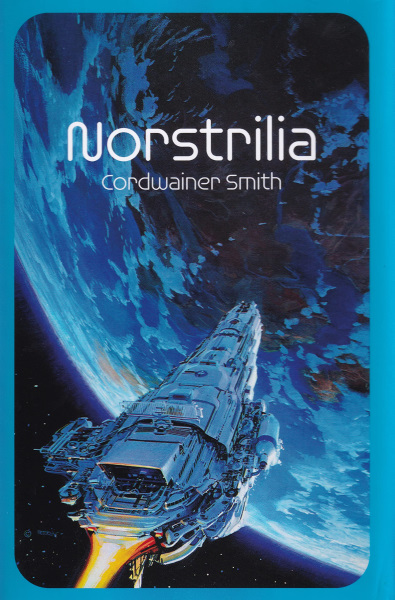
Review: Norstrilia, by Cordwainer Smith

Review: Norstrilia, by Cordwainer Smith

by Rich Horton

I last read Cordwainer Smith's only novel, Norstrilia, when it was first released in its "full" form, back in 1975, so almost 50 years ago. And I must confess, I remembered almost nothing -- Rod McBan from Old North Australia (Norstrilia), C'Mell, stroon ... that's about it. I had intended to reread it for a long time, and, happily, my book club chose it as one of our readings this year. Which finally got me off the schneid.

I went ahead and bought the NESFA Press edition, which is by a wide margin the best one to get. This version takes the 1975 Ballantine text, and adds some material from both the novella length magazine publications ("The Boy Who Bought Old Earth" and "The Store of Heart's Desire") and the two short novels expanded from those (The Planet Buyer and The Underpeople), in the process smoothing over some discontinuities introduced during the complicated road to publication. This edition also includes an introduction by Alan Elms, and an appendix giving the alternate texts from the other versions, and detailing the way in which the various texts were stitched together. There is also a 2006 Baen collection called We the Underpeople, which comprised the three key stories related to Norstrilia ("Mother Hitton's Littul Kittons", "Alpha Ralpha Boulevard", and "The Ballad of Lost C'Mell"), the novella "The Dead Lady of Clown Town", and Norstrilia itself. I do not know what text the Baen edition uses.

I'll discuss the textual variations between the various versions in more detail later, but first let's get to the novel itself. John J. Pierce put together a speculative timeline for Smith's Instrumentality of Mankind future history. Pierce places Norstrilia at right about the most critical period of Instrumentality history: The Rediscovery of Man. It's part of a cluster of five stories set in about 16,000 A. D. (I use the abbreviation A. D. advisedly -- Smith was a committed (if somewhat heterodox) Christian, and the Instrumentality stories ultimately had quite overt Christian themes -- noticeable in Norstrilia if muted, but more explicit later.) These five stories are "Mother Hitton's Littul Kittons", "Alpha Ralpha Boulevard", "The Ballad of Lost C'Mell", Norstrilia, and "A Planet Named Shayol". Two of these ("Alpha Ralpha Boulevard" and "The Ballad of Lost C'Mell"), along with Smith's first story, "Scanners Live in Vain", are my three favorite Cordwainer Smith stories.

Roderick Frederick Ronald Arthur William McArthur McBan the 151st, hereafter called Rod, is the heir to a wealthy estate on the planet of Old North Australia, or Norstrilia. Norstrilia's wealth is derived from stroon -- the immortality drug that can only be produced there. As the novel opens, Rod is 16, or perhaps 64, as he has lived the first 16 years of his life four times, in the hopes that his congenital defect will be cured. This defect means he cannot "spiek" or "hier", which is to say telepathically communicate. Otherwise he's a pretty intelligent young man. And this is his fourth chance at the test which will determine if he lives or dies -- for on this somewhat inhospitable planet the population is rigorously controlled. It is thought that his handicap will doom him -- but his examination goes in an unexpected direction. However, there are still people who think he ought to be killed. The only solution seems to be to leave Norstrilia -- but those who leave cannot return. But with the help of an ancient computer, Rod finds a sort of loophole -- he plays games with his enormous wealth to buy the entire planet known as Manhome, or Old Earth.

His troubles are hardly over. Such wealth makes him even more of a target, on Norstrilia, on Old Earth, and in between. He does have allies, and they find a way to sneak him to Mars, and then, in the disguise of a C'Man, married to the beautiful girlygirl C'Mell, he gets to Earth, along with a number of robots disguised as him. And here on Old Earth, he will find his heart's desire, meet E'Telekeli, the most powerful of all the animal-derived "underpeople", escape multiple attempts on his life, get psychiatric treatment, live a long life with C'Mell, and finally realize his real destiny.

I don't really want to say more about the plot. There is at the same time a lot going on, but in an odd way not that much. Some of it seems a bit arbitrary, some doesn't quite convince, and some is fascinating. But still it all pretty much works. The novel isn't at a level with Smith's greatest works, but parts of it are. At time it reaches the incantatory heights Smith could achieve, and it hints throughout at a really important story -- the story of the Underpeople (which is also central to "The Ballad of Lost C'Mell", and which perhaps is ultimately key to the entire Instrumentality future history.) But Rod isn't an Underperson (though of course C'Mell and E'Telekeli are), so that story is kind of told in the margins. We like Rod, but he doesn't shake the universe, in a way. This is a good novel, and it's an important part of the future history created by one of the oddest and most powerful SF writers of all time. But to fully grok Cordwainer Smith, you need to read his short fiction -- and for doing so you will be richly rewarded.

I promised a bit more about the textual history of Norstrilia. It was written as a single novel, but Smith couldn't sell it in whole. He divided it roughly in half, and cut versions of each half were published in Frederik Pohl's magazines Galaxy and If. (Pohl was Smith's primary editor.) The two novellas were published in the April 1964 issue of Galaxy ("The Boy Who Bought Old Earth", about 38,300 words) and the May 1964 issue of If ("The Store of Heart's Desire", about 23,300 words.) Paperback editions of both novellas, expanded to short novel length, appeared from Pyramid: The Planet Buyer (1964, about 53,000 words) and The Underpeople (1968, about 42000 words). These books presumably restored cuts to Smith's original manuscript that had been made to fit the magazines' space restrictions, but also included additional material to make each book stand alone to some extent. Alan Elms' introduction implies that Smith's manuscript was about 75,000 words. The combined length of the novellas is almost 62,000 words. The Pyramid paperbacks come to about 95,000 words. The NESFA edition is about 89,000 words, based on an electronic count kindly supplied me by Jim Mann of NESFA, not counting the introduction or the appendices, and the Del Rey edition is about the same. I suspect my estimate for the Pyramid books is off just a bit, and the two books probably are similar to the complete Norstrilia, after accounting for the additional text added to each to smooth out the transition between the two volumes, set against a somewhat restored text from Smith's manuscripts (or so I assume) that is found only in the "complete" version. 

My suspicion is that Smith's original manuscript was about 90,000 words, and was cut significantly for the magazine publication, and mostly restored (plus some bridging material) for the first books. Alternately, Smith wrote a 75,000 word version first (as Elms suggests) but expanded it later to the final 90,000 words, hoping to sell it as two novels. (At Pyramid in particular, novels of 45,000 words or so were not uncommon.) It would be interesting to know for sure which of these two possibilities is true, and if so which parts were added later. It is worth noting that The Underpeople didn't appear from Pyramid until 1968, while The Planet Buyer came out in 1964, just a few months after the novellas. Smith died in 1966, so it is at least possible that he made some revisions after the first publication of The Planet Buyer.


Wednesday, August 21, 2024

Review: Hope-in-the-Mist, by Michael Swanwick; "Paris", by Hope Mirrlees

Hope-in-the-Mist, by Michael Swanwick; "Paris", by Hope Mirrlees

a review by Rich Horton

A couple of years ago, at a Kaffeeklatsch at Boskone I think, Michael Swanwick discussed (among many other things) Hope Mirrlees, and in particular her poem "Paris". I read Mirrlees' novel Lud-in-the-Mist a couple of decades ago and thought it wonderful, and so I was intrigued by "Paris", which Michael described in part as a modernist poem in the mode of "The Waste Land", and possibly an influence on that poem. (Mirrlees absolutely knew T. S. Eliot well, and it's very plausible that Eliot read "Paris" as he was composing "The Waste Land".) I also discovered that Swanwick had written a short biographical piece on Mirrlees, called Hope-in-the-Mist, and published in 2009 by Henry Wessells' always intriguing small press Temporary Culture. ("Paris", to be sure, was also published by an enterprising small press, Hogarth Press, run by Virginia and Leonard Woolf. So was "The Waste Land", by the way.) So I bought that book, and found a copy of "Paris" online (there are many.))

I finally got around to reading Hope-in-the-Mist. It's a nice looking book (as I expect from Temporary Culture.) There's a delightful foldout illustration by Charles Vess, an introduction by Neil Gaiman, useful endnotes, and "A Lexicon of Lud" -- an explanation of many of the terms used in Lud-in-the-Mist.

But the heart of the book of course is Michael Swanwick's mini-biography of Helen Hope Mirrlees, which is 60 pages long. She was born in 1887, and her family was quite wealthy. She attended Newnham College at Cambridge, and studied Classics. There she met Jane Harrison, a very important Classicist, almost 40 years her senior. They became very close, and in the years after Mirrlees left Newnham, she and Harrison began living together, on and off, mostly on, until Harrison's death in 1928. Swanwick considers the question of whether or not they were lovers, and wisely chooses to be agnostic. Certainly both women came fairly close to marrying men (Harrison at least three times); and there is plenty of evidence that for Harrison, financial reasons might have been sufficient to choose to live with a wealthy and sympatico friend. But we really cannot know one way or the other.

Swanwick's book engagingly follows Mirrlees' life, at first concentrating on her literary efforts, which in essence comprise four significant works: "Paris: a Poem" (1920), and three novels: Madeleine (1919), The Counterplot (1924), and Lud-in-the-Mist (1926). Apparently she was under contract for one more novel, but it's not clear how much of that she may have written. After Harrison's death she worked primarily on two biographies: one of Harrison, which she never finished; and one of Robert Bruce Cotton, of which only the first volume has ever been published. She also privately printed a couple of very short books of poems.

Swanwick is very interesting on Mirrlees' literary work. Madeleine doesn't sound like a novel worth reading, but I admit I'm intrigued by The Counterplot. The Cotton biography sounds excessive, and her late poems seem negligible. But Lud-in-the-Mist is wonderful -- and I really do need to reread it. And "Paris" -- well, I'll get to that in a bit.

Hope-in-the-Mist also discusses the rest of Mirrlees' very long life (she died in 1978 at the age of 91.) Lin Carter, when he reprinted Lud-in-the-Mist in 1970 in the Ballantine Adult Fantasy series, wasn't aware that she was still alive, though he apparently tried to locate her, but published the book anyway, as it was in the public domain in the US. And to be fair, this reprinting was vital to bringing Mirrlees' work back to attention. Mirrlees had moved back and forth between France and England, spending much of the war years in London with her mother -- and also with T. S. Eliot, who boarded with them (and wrote much of the Four Quartets there.) Later, Mirrlees moved to South Africa for a considerable time. 

She seems to have been in many ways a difficult person, but also intriguing. She was quite a beauty as a young woman, but it is repeatedly said that she "lost her looks" as she aged. Swanwick's book includes anecdotes and other testimony from friends and relatives, that present a portrait of an interesting and rather contrary individual. As noted, she largely stopped writing -- certainly stopped writing interesting stuff -- after Jane Harrison's death. Swanwick suggests, plausibly, that her relative financial security, due to her family's wealth, was a reason that she didn't have to write. At any rate, it's a loss for readers that she never wrote anything more after producing something as wonderful as Lud-in-the-Mist. But -- nobody owes us readers anything. Also central to Mirrlees' life was her conversion to Catholicism in the late '20s.

Now, to "Paris". I have read it through a few times. It is a long poem, at about 600 lines. And it is undeniably a work that will remind any reader of "The Waste Land". It is thoroughly plausible that it influenced Eliot, or at least that it sprang from the same wellsprings of inspiration. Which is not to say that it's about the same things, or that either poem is a copy of the other.

"Paris" is a fascinating read, definitely worth the time of any reader of poetry. There are arresting lines:

"Paris is a huge home-sick peasant,

He carries a thousand villages in his heart."


Or this passage, which struck me just now as I am reading Anna Karenina:

"Désouvrement

Apprehension; 

Vronsky and Anna

Starting up in separate beds in a cold sweat

Reading calamity in the same dream

Of a gigantic sinister mujik....

Whatever happens, some day it will look beautiful:

Clio is a great French painter,

She walks upon the waters and they are still.

Shadrach, Meshach, and Abednego stand motionless

and plastic mid the flames."

It's also full of typographical experiments, and experiments with noise. It's a poem that's trying to be special, and new, and often succeeds. I don't think it's the equal of "The Waste Land", but that doesn't really matter.