Birthday Review: Stories of Caitlin R. Kiernan
Today is Caitlin R. Kiernan's birthday, and I find I've never published a collection of my reviews of her short fiction. So here is one!
Blog review of Shadows Over Baker Street, November 2003
"The Drowned Geologist", by Caitlín R. Kiernan, also only peripherally features Holmes, mostly telling of an American geologist who encounters some mysterious old fossils on a visit to England.
Blog review of Gothic!, April 2005
I quite enjoyed Caitlin R. Kiernan's "The Dead and the Moonstruck", another "reversal" story, this one about a changeling raised by ghouls who must pass a rite of passage test to become fully accepted by her new family. The story doesn't really go anywhere though -- it is clearly a bit of backgrounding for a character in her latest novel. But I did enjoy it.
Locus, December 2008
The opening and closing stories in the fine, typically rather mannered, small magazine Not One of Us (now up to 40 issues!) impressed me. Caitlín R. Kiernan’s “Flotsam” is a brief intense depiction of the protagonist’s latest encounter with a seductive vampire of sorts – it’s essentially a prose poem, and as such not easy to pull off, but Kiernan’s writing is lovely and it works.
Review of Eclipse 4 (Locus, May 2011)
“Tidal Forces” by Caitlin R. Kiernan is very well-written, and the central characters are utterly real, but its central conceit, which is purposely just plain weird, came off simply too affected for me. I have no doubt Kiernan did exactly as she intended, and used the idea with eyes fully open – but it didn’t work. There’s still plenty to like in this story of a woman whose partner is afflicted with a black hole, quite literally, that begins to eat her substance away.
Review of Supernatural Noir (Locus, August 2011)
And finally Caitlín R. Kiernan’s “The Maltese Unicorn”, which is as stylishly noir as any story here, about a used bookstore owner who is friendly with a mysterious brothel owner, and thus ends up trying to track down a strange object – a dildo – for her, and ends up getting involved, to her distress, with a beautiful and untrustworthy woman mixed up in the whole business. I thought this the best story in the book, and the story that most perfectly, to my taste, matched the theme.
Review of Naked City (Locus, August 2011)
The American West, and mines, are also central to another strong Caitlín R. Kiernan story, “The Colliers’ Venus (1893)”, in which a museum curator investigates a captured woman – a woman found encased in rock, while dealing as well with his own abortive relationship.
Tuesday, May 26, 2020

Old Bestseller: Franny and Zooey, by J. D. Salinger
Franny and Zooey, by J. D. Salinger
a review by Rich Horton
 Franny and Zooey was J. D. Salinger's third book, published in 1961. The two previous books were his only novel (The Catcher in the Rye) and a story collection (Nine Stories.) The two parts of Franny and Zooey appeared in the New Yorker in 1955 and 1957.) It's a short book, and is usually described as comprising a short story ("Franny") and a novella ("Zooey".) In fact "Franny" is a longish short story at some 10,000 words by my rough count, and "Zooey" is a very long novella, perhaps 50,000 words. For that matter, the two pieces are intimately related, and if you ask me, they work together as a unified whole, and I think it makes a fair amount of sense to call the book a true novel.
This is the third Salinger book I've read. Like everyone else of my generation, I was assigned The Catcher in the Rye in high school, and like (it sometimes seems) only a few people, I rather liked it. I also read Nine Stories, and reread much of it just a few years ago. I think some of those stories are very fine. I could continue to the last book (Raise High the Roof Beam, Carpenters, and Seymour, an Introduction) but I am gathering that his work seemed to decline in quality as time went on, so perhaps I won't continue.
So I decided I'd read "Franny", because it's kind of short. And I read it through, liking it fine if not really loving it. It's the story of a few hours one weekend in which Franny comes up from her school (unspecified -- I thought it might be obvious to smarter readers but apparently it's not clear -- I'd have said maybe Vassar? maybe Mount Holyoke? but I don't know) to Harvard, where her boyfriend Lane goes, to attend the Harvard-Yale game. They go to a restaurant, and talk, and Franny is revealed as an interesting if a bit, well, immature young woman, while Lane is revealed as a prat (or "phony", Holden Caulfield would say.) Franny talks about books and her acting and about the odd book she's reading, The Way of the Pilgrim, about a man in Russia who is convinced that the way to spiritual truth is to continually recite a prayer: "Lord Jesus Christ have mercy on me". Franny doesn't eat and then gets sick. Lane mostly just gets mad that he's missing the game. By the end I was sure Franny was pregnant.
"Zooey" is set only a few days later, after Franny, in her delicate condition, has gone home to New York. It is basically organized around three communications between Zooey and his family -- first a long letter from his brother Buddy, next a long conversation in the bathroom with his mother, and then an even longer harangue (in a couple of parts) from Zooey to the distraught Franny. I kept waiting for the other shoe to drop about Franny's condition, but it never did, and eventually I realized Franny is NOT actually pregnant (though she probably was sleeping with the rather shallow Lane.) Instead she's having a spiritual crisis, based partly on her reaction to the book and its "prayer". Zooey, a TV actor, is unconvinced of the value of the book, and expresses some of his own philosophical notions, along with descriptions of his TV career, a couple of new scripts he's looking at, a potential movie he could appear in in France, and aspects of his family life. His and Franny's family, the Glasses, are Salinger's major fictional obsession -- the excellent story "A Perfect Day for Bananafish" features their older brother Seymour, who committed suicide. The children all appeared on a long-running radio show, which seems to have affected them in something like the way child actors are often depicted as being affected by early fame. Anyway, Zooey's ramblings (and really he does ramble) are sometimes interesting, somes just affected, to the point of occasional tedium. More to the point, he didn't really come to life for me, though Franny was a reasonably well done character.
I don't think this is a bad book, but it's not a great book either. It may be a book of its time ... probably it hit home a lot more directly in 1961 than now. I understand Salinger was quite upset that not just me but many readers assumed Franny was pregnant ... all I can say, it sure seemed like that's what we were expected to think. Salinger can (or could) write, but I think his prose was overrated at times ... it's original, has a real (though somewhat limited) voice, and certainly includes some sharp observation, but it never seemed quite striking to me, and sometimes just lost its way. Perhaps I write too much in awareness of where Salinger ended up ...
a review by Rich Horton
This is the third Salinger book I've read. Like everyone else of my generation, I was assigned The Catcher in the Rye in high school, and like (it sometimes seems) only a few people, I rather liked it. I also read Nine Stories, and reread much of it just a few years ago. I think some of those stories are very fine. I could continue to the last book (Raise High the Roof Beam, Carpenters, and Seymour, an Introduction) but I am gathering that his work seemed to decline in quality as time went on, so perhaps I won't continue.
So I decided I'd read "Franny", because it's kind of short. And I read it through, liking it fine if not really loving it. It's the story of a few hours one weekend in which Franny comes up from her school (unspecified -- I thought it might be obvious to smarter readers but apparently it's not clear -- I'd have said maybe Vassar? maybe Mount Holyoke? but I don't know) to Harvard, where her boyfriend Lane goes, to attend the Harvard-Yale game. They go to a restaurant, and talk, and Franny is revealed as an interesting if a bit, well, immature young woman, while Lane is revealed as a prat (or "phony", Holden Caulfield would say.) Franny talks about books and her acting and about the odd book she's reading, The Way of the Pilgrim, about a man in Russia who is convinced that the way to spiritual truth is to continually recite a prayer: "Lord Jesus Christ have mercy on me". Franny doesn't eat and then gets sick. Lane mostly just gets mad that he's missing the game. By the end I was sure Franny was pregnant.
"Zooey" is set only a few days later, after Franny, in her delicate condition, has gone home to New York. It is basically organized around three communications between Zooey and his family -- first a long letter from his brother Buddy, next a long conversation in the bathroom with his mother, and then an even longer harangue (in a couple of parts) from Zooey to the distraught Franny. I kept waiting for the other shoe to drop about Franny's condition, but it never did, and eventually I realized Franny is NOT actually pregnant (though she probably was sleeping with the rather shallow Lane.) Instead she's having a spiritual crisis, based partly on her reaction to the book and its "prayer". Zooey, a TV actor, is unconvinced of the value of the book, and expresses some of his own philosophical notions, along with descriptions of his TV career, a couple of new scripts he's looking at, a potential movie he could appear in in France, and aspects of his family life. His and Franny's family, the Glasses, are Salinger's major fictional obsession -- the excellent story "A Perfect Day for Bananafish" features their older brother Seymour, who committed suicide. The children all appeared on a long-running radio show, which seems to have affected them in something like the way child actors are often depicted as being affected by early fame. Anyway, Zooey's ramblings (and really he does ramble) are sometimes interesting, somes just affected, to the point of occasional tedium. More to the point, he didn't really come to life for me, though Franny was a reasonably well done character.
I don't think this is a bad book, but it's not a great book either. It may be a book of its time ... probably it hit home a lot more directly in 1961 than now. I understand Salinger was quite upset that not just me but many readers assumed Franny was pregnant ... all I can say, it sure seemed like that's what we were expected to think. Salinger can (or could) write, but I think his prose was overrated at times ... it's original, has a real (though somewhat limited) voice, and certainly includes some sharp observation, but it never seemed quite striking to me, and sometimes just lost its way. Perhaps I write too much in awareness of where Salinger ended up ...
Sunday, May 10, 2020
Birthday Review: The Sorcerer's House, by Gene Wolfe
Gene Wolfe would have turned 89 this past Thursday. Alas, he died last year. I am (belatedly) posting another one of my reviews in his honor. This is perhaps the best of his late novels, The Sorcerer's House, from 2010. This review originally appeared in Fantasy Magazine.
The Sorcerer’s House
By Gene Wolfe
Tor
$24.99 | hc | 302 pages
ISBN: 978-0-7653-2458-0
March 2010
A review by Rich Horton
 Gene Wolfe continues to publish interesting novels about every year. His new book is The Sorcerer’s House. It is a standalone novel, and, by Wolfe’s standards, a fairly simple one. It is also quite absorbing, a very nice read, and for all its relative “simplicity” stuffed with puzzles and with such Wolfean obsessions as twins, shapechanging, and virtue. And it is told in the familiar almost naïve first-person prose of many recent Wolfe novels.
The protagonist is Baxter Dunn, who has just been released from prison. We slowly gather that he went to jail for fraud, and that his victim, or one of his victims, was his identical twin brother, George. Most of the book is told in letters from Baxter to George, though Baxter also writes to George’s wife Millie, and to a friend he made in prison. And some of the letters here are addressed to Baxter.
Baxter comes to a quiet Midwestern town called Medicine Man. At first destitute, he comes by mysterious means into possession of a house called the Black House, which is rumored to be haunted. The house is quite odd – it is (of course) bigger on the inside than the outside, and its windows sometimes seem to look out on a landscape different that what one sees from the outside. And there are a variety of unusual characters attached to the house: another pair of good/bad twins, teenaged boys named Emlyn and Ieuan; a couple of weird butlers named Nicholas or Nick; a fox who sometimes seems to be a woman; and some magical implements.
Baxter also has encounters in the town, particular a series of variously interesting women: an attractive young widow, the older woman who revealed his inheritance to Baxter, a pert policewoman, etc. And the town is also menaced by a “Hellhound”. We are left to wonder what is really going on. Is Baxter really a criminal or did his brother betray him (perhaps because they both seem to love Millie)? Why did the mysterious Mr. Black leave his house to Baxter? From whence do all the odd creatures attracted to Baxter come – the fox woman, the werewolves, a vampire?
All this is familiar territory for Gene Wolfe’s readers. What may seem unusual is how relatively transparently it is all resolved. (Though the ending does leave a couple of open questions – I have my own answers, contradicting the plain narrative, but I’m by no means sure I’m right.) At any rate, it doesn’t quite achieve the depth of Wolfe’s very best work. But it avoids the frustration of a novel like, say, Castleview, at least to this reader, who knew there was something special going on beneath that book’s surface, but never quite figured it out. The Sorcerer’s House is, in the end, an entertainment, clever and satisfying – not great Wolfe, but good Wolfe, which is recommendation enough.
The Sorcerer’s House
By Gene Wolfe
Tor
$24.99 | hc | 302 pages
ISBN: 978-0-7653-2458-0
March 2010
A review by Rich Horton

The protagonist is Baxter Dunn, who has just been released from prison. We slowly gather that he went to jail for fraud, and that his victim, or one of his victims, was his identical twin brother, George. Most of the book is told in letters from Baxter to George, though Baxter also writes to George’s wife Millie, and to a friend he made in prison. And some of the letters here are addressed to Baxter.
Baxter comes to a quiet Midwestern town called Medicine Man. At first destitute, he comes by mysterious means into possession of a house called the Black House, which is rumored to be haunted. The house is quite odd – it is (of course) bigger on the inside than the outside, and its windows sometimes seem to look out on a landscape different that what one sees from the outside. And there are a variety of unusual characters attached to the house: another pair of good/bad twins, teenaged boys named Emlyn and Ieuan; a couple of weird butlers named Nicholas or Nick; a fox who sometimes seems to be a woman; and some magical implements.
Baxter also has encounters in the town, particular a series of variously interesting women: an attractive young widow, the older woman who revealed his inheritance to Baxter, a pert policewoman, etc. And the town is also menaced by a “Hellhound”. We are left to wonder what is really going on. Is Baxter really a criminal or did his brother betray him (perhaps because they both seem to love Millie)? Why did the mysterious Mr. Black leave his house to Baxter? From whence do all the odd creatures attracted to Baxter come – the fox woman, the werewolves, a vampire?
All this is familiar territory for Gene Wolfe’s readers. What may seem unusual is how relatively transparently it is all resolved. (Though the ending does leave a couple of open questions – I have my own answers, contradicting the plain narrative, but I’m by no means sure I’m right.) At any rate, it doesn’t quite achieve the depth of Wolfe’s very best work. But it avoids the frustration of a novel like, say, Castleview, at least to this reader, who knew there was something special going on beneath that book’s surface, but never quite figured it out. The Sorcerer’s House is, in the end, an entertainment, clever and satisfying – not great Wolfe, but good Wolfe, which is recommendation enough.
Monday, May 4, 2020
Birthday Review: Leviathan, by Scott Westerfeld
Here's a review in honor of Scott Westerfeld's birthday, today -- his very enjoyable Steampunk YA novel Leviathan.
Leviathan
by Scott Westerfeld
Simon Pulse
$19.99 | hc | 440 pages
ISBN: 978-1-4169-7173-3
October 2009
A review by Rich Horton
 Scott Westerfeld’s Leviathan is a thoroughly delightful Young Adult novel, the first in a series that is based on World War I, but in an alternate history. In this history Charles Darwin discovered the genetic basis for evolution, and how to manipulate it, and as a result the United Kingdom and its allies have a society based on biotechnology, such as the title airship, a huge beast (or colony of organisms) based on whale DNA and much more. By contrast the Germans and Austrians and their allies, called Clankers, use Steampunk flavored machinery: airplanes and zeppelins, but also great walking land war machines.
The novel is told through the point of view of two teens. Aleksandar is the son of the murdered Serbian Prince Franz Ferdinand and his lower-class wife, and as such is not eligible for the throne, but is still a threat to the powers that be. As the novel opens he is spirited away by a pair of loyal retainers, who fear that the people who arranged for Alek’s parents to be killed will be coming for him. They take a smallish “Walker” and head for Switzerland, fleeing the German army that should be on their side. Meanwhile Deryn Sharp, a girl who has grown up loving to fly the living balloons based on jellyfish genetics, has disguised herself as a boy and joined the Air Service. She ends up a midshipman on the whale-based Leviathan, which is ferrying a valuable but mysterious cargo from England to Turkey, just as war is breaking out.
As we might expect their paths cross … And, in reality, nothing is resolved in this book, no mysteries even unveiled. That will wait for subsequent books, which this reader anticpates eagerly.
The novel is in many ways a familiar YA construction: a hidden Prince, a disguised girl, both people who need to grow up and are being forced to do so in a dangerous situation. The book delights in part because both protagonists are nicely depicted and fun to follow and root for. It also delights in the depiction of the rival, unusual, technologies of the Darwinists and the Clankers. Westerfeld is very good with plausible invented words, and with plausible (to a sufficient degree, at least) inventions, particularly his biological inventions. (The Clanker tech, after all, though different to ours, is still by and large familiar.) There is plenty of exciting action as well. And an intriguing mystery – with the hint that the War may play out a bit differently than in our world – which hold the interest in this book and make subsequent books much to be looked forward to.
Leviathan
by Scott Westerfeld
Simon Pulse
$19.99 | hc | 440 pages
ISBN: 978-1-4169-7173-3
October 2009
A review by Rich Horton

The novel is told through the point of view of two teens. Aleksandar is the son of the murdered Serbian Prince Franz Ferdinand and his lower-class wife, and as such is not eligible for the throne, but is still a threat to the powers that be. As the novel opens he is spirited away by a pair of loyal retainers, who fear that the people who arranged for Alek’s parents to be killed will be coming for him. They take a smallish “Walker” and head for Switzerland, fleeing the German army that should be on their side. Meanwhile Deryn Sharp, a girl who has grown up loving to fly the living balloons based on jellyfish genetics, has disguised herself as a boy and joined the Air Service. She ends up a midshipman on the whale-based Leviathan, which is ferrying a valuable but mysterious cargo from England to Turkey, just as war is breaking out.
As we might expect their paths cross … And, in reality, nothing is resolved in this book, no mysteries even unveiled. That will wait for subsequent books, which this reader anticpates eagerly.
The novel is in many ways a familiar YA construction: a hidden Prince, a disguised girl, both people who need to grow up and are being forced to do so in a dangerous situation. The book delights in part because both protagonists are nicely depicted and fun to follow and root for. It also delights in the depiction of the rival, unusual, technologies of the Darwinists and the Clankers. Westerfeld is very good with plausible invented words, and with plausible (to a sufficient degree, at least) inventions, particularly his biological inventions. (The Clanker tech, after all, though different to ours, is still by and large familiar.) There is plenty of exciting action as well. And an intriguing mystery – with the hint that the War may play out a bit differently than in our world – which hold the interest in this book and make subsequent books much to be looked forward to.
Review: The Sky So Big and Black, by John Barnes
The Sky So Big and Black, by John Barnes
a review by Rich Horton
 This is John Barnes' new novel. It's set in the same future history as his novels Orbital Resonance, Kaleidoscope Century, and Candle. Like Orbital Resonance, it's nominally YA, and very Heinleinian, and very much "to please adults". It's something of a sequel to Orbital Resonance -- I don't remember that book that well, but I'm pretty sure the main character of the new book is a relative of the main character of the older book -- I think a niece. It's also heavily related to Candle, far as I can tell, in that a main plot element is the takeover of Earth by the "One True" meme -- something I deduce happened in Candle, though I'm not quite sure. (I haven't read Candle.) (I say "Future History" but it's really an odd variant -- a sort of Future Alternate History, in that it's set in a future that branches from a near past (at time of writing) history that never happened.)
I just wanted basically to say that I loved this book. As I mention, it's very much in the Heinlein Juvenile mode. There are passages that seem pure quill Heinlein. Here's the protagonist's father and her talking about education in the 20th Century:
"In fact what [20th C. students] got was either a specialty in some academic subject, like math or literature, or certification in some useful trade, like engineering or lying."
"They didn't have certification in lying!"
"Ha! The first place my grandpa taught was a program in something called "communications". Look up the curriculum sometime and tell me that's not a degree in lying!"
And there's plenty more in that vein, about personal responsibility and politics and human relationships.
But more than all that, it's just a good novel. Very well structured -- it's presented as a psychologist listening to a series of interviews he did with Teri-Mel Murray, a young woman on Mars who was working with her father as an "ecospector". It's clear from the start that something terrible happened, and indeed that the psychologist was forced to erase Teri-Mel's memory. It's also clear that he likes her a lot, and is really torn up by what has happened, and worried that he may have to treat her again, for some mysterious reason that takes a long time to become clear.
The interviews tell of Teri and her father travelling across the lightly terraformed planet to a "Gather" of the "rounditachis", people who live more or less in the open on Mars, working to help advance the terraforming. Teri is hoping that she will be certified a "Full Adult" at the Gather, and be free to marry her boyfriend. Her father wants her to go back to school for one more year, because he's not convinced that ecospecting will remain a good living. As they travel, they plan to make one more attempt at a big "scorehole". And Teri is starting to worry about her boyfriend.
All the above is cute stuff, and interleaved with neat SFnal details about the terraforming of Mars. In the background lurk details about the future history up to this point, especially the takeover of ecologically ravaged Earth by a "meme" called "One True", or "Resuna", which more or less has turned Earth's population into a hive mind. Also we learn bits and pieces about the psychologist's feelings, which give us hints about the disaster which has clearly occurred.
So it's a scary book, as we learn to like Teri more and more, while we just know that she's going to get hurt real real bad. And when the crisis comes, it's exciting, and terribly sad, and even scarier than I had first expected.
The resolution is moving, real, and, well, open. Barnes' future is on the one hand full of hope, and of cool SFnal stuff, and on the other hand it is very damned scary, and full of something purely evil, but not EVULL, somehow.
It's a darn good novel, and though it is written about a "young adult" (Teri is about 15), and though it is accessible and readable and appropriate (in my judgement) for teens to read, it is also very effective for adults.
a review by Rich Horton

I just wanted basically to say that I loved this book. As I mention, it's very much in the Heinlein Juvenile mode. There are passages that seem pure quill Heinlein. Here's the protagonist's father and her talking about education in the 20th Century:
"In fact what [20th C. students] got was either a specialty in some academic subject, like math or literature, or certification in some useful trade, like engineering or lying."
"They didn't have certification in lying!"
"Ha! The first place my grandpa taught was a program in something called "communications". Look up the curriculum sometime and tell me that's not a degree in lying!"
And there's plenty more in that vein, about personal responsibility and politics and human relationships.
But more than all that, it's just a good novel. Very well structured -- it's presented as a psychologist listening to a series of interviews he did with Teri-Mel Murray, a young woman on Mars who was working with her father as an "ecospector". It's clear from the start that something terrible happened, and indeed that the psychologist was forced to erase Teri-Mel's memory. It's also clear that he likes her a lot, and is really torn up by what has happened, and worried that he may have to treat her again, for some mysterious reason that takes a long time to become clear.
The interviews tell of Teri and her father travelling across the lightly terraformed planet to a "Gather" of the "rounditachis", people who live more or less in the open on Mars, working to help advance the terraforming. Teri is hoping that she will be certified a "Full Adult" at the Gather, and be free to marry her boyfriend. Her father wants her to go back to school for one more year, because he's not convinced that ecospecting will remain a good living. As they travel, they plan to make one more attempt at a big "scorehole". And Teri is starting to worry about her boyfriend.
All the above is cute stuff, and interleaved with neat SFnal details about the terraforming of Mars. In the background lurk details about the future history up to this point, especially the takeover of ecologically ravaged Earth by a "meme" called "One True", or "Resuna", which more or less has turned Earth's population into a hive mind. Also we learn bits and pieces about the psychologist's feelings, which give us hints about the disaster which has clearly occurred.
So it's a scary book, as we learn to like Teri more and more, while we just know that she's going to get hurt real real bad. And when the crisis comes, it's exciting, and terribly sad, and even scarier than I had first expected.
The resolution is moving, real, and, well, open. Barnes' future is on the one hand full of hope, and of cool SFnal stuff, and on the other hand it is very damned scary, and full of something purely evil, but not EVULL, somehow.
It's a darn good novel, and though it is written about a "young adult" (Teri is about 15), and though it is accessible and readable and appropriate (in my judgement) for teens to read, it is also very effective for adults.
Friday, May 1, 2020
Birthday Review: Naomi Novik's first three Temeraire books, plus some short fiction
Naomi Novik was born on the last day of April, so in honor of her birthday, here are some reviews I have done of her (excellent) work, the first a review of the first three Temeraire novels from Black Gate, and then a few reviews of short fiction for Locus.
His Majesty's Dragon/Throne of Jade/Black Powder War
by Naomi Novik. Del Rey, $7.50 each (384/432/400p)
ISBNS: 0345481283 / 0345481291 / 0345481305
March/April/May 2006.
A Review by Rich Horton (Black Gate, Spring 2007)
 These three books are the first of a potentially open-ended series [it did, of course, eventually come to completion -- the first 8 covers are shown here, the ninth book, League of Dragons, came out in 2016, and there is also a story collection], set during the Napoleonic Wars in an alternate fantastical past: almost exactly like our history but with dragons. The obvious comparison is with Patrick O'Brian, and it is a high compliment indeed to say that the books are not entirely unworthy of such company as O'Brian's Aubrey/Maturin novels of the British Navy during the Napoleonic Wars (which some consider the best historical novel series ever.) I found Novik's books extremely enjoyable reading, and I look forward to many further volumes. Del Rey's interesting publishing strategy, issuing three books in very quick succession, has evidently garnered Novik and the books well-deserved sales and public attention.
It should be noted that the novels are indeed true series novels: each concluding its sub-story satisfyingly enough, but also advancing an overall arc. The series opens with Captain Will Laurence of the English Navy capturing a French ship, on which there is a dragon egg. When dragons hatch they are "harnessed" by a person who will be their constant companion: usually an aviator, but no such candidate being available the man chosen is Laurence himself. This means the end of his promising Naval career, and an unconventional life as one of the rather raffish Aerial Corps, but the friendship of the dragon, a very unusual specimen he names Temeraire, proves to be ample compensation. His Majesty's Dragon (titled Temeraire in the UK) details the training of Laurence and Temeraire, complete with some internal conflicts and adjustments, leading to their first battles and the revelation of Temeraire's particularly special war-fighting power, unique to his variety of extremely rare dragon. This variety, it transpires, is the Chinese Celestial, usually reserved to be companions of the Chinese Imperial Family.
In Throne of Jade the Chinese protest the British capture of Temeraire (who had been intended as a gift for Napoleon), and the spineless Foreign Office sends Laurence, Temeraire, and crew to China, hoping to negotiate better trading rights in exchange for returning this valuable dragon. But while Temeraire enjoys China, in particular the special privileges -- or, perhaps, ordinary rights that all intelligent creatures ought to enjoy -- given dragons there, he refuses to be separated from Laurence. Also, it turns out there is some political turmoil in China -- the resolution of which leads also to an accommodation that allows Laurence and Temeraire to remain together.
Black Powder War is the story of their desperate land journey first to Istanbul, to collect three more dragon eggs the British have bought from the Turks, then through war-torn Europe, where they learn that Napoleon has a new Celestial -- one who has cause to hate Laurence, Temeraire, and by extension England.
The first book is nearly an unalloyed delight (save the slightly unprepared-for nature of the end), the second is enjoyable but a step down, perhaps a bit too slow; and the third ranks pretty much with the second, though the ending is surprising and quite moving. The series as a whole promises to continue to be very fun reading, with a nicely set up tension between the necessity of defeating Napoleon and the cause of "Dragon's Rights", which Temeraire has at last persuaded Laurence is both morally and practically essential. Both lead characters are engaging and well-depicted, the prose is nicely handled with a sound period flavor, the fantastical elements are not terribly plausible (nor necessarily consistent) but they (draconic characteristics and types, basically) are nicely imagined. Recommended.
Review of Fast Ships, Black Sails (Locus, December 2008)
One coup the VanderMeers managed was to land a novelette from Naomi Novik. (To my knowledge she has only published two other short stories, both quite short, at her website.) “Araminta; or, The Wreck of the Amphidrake” is one of the best pieces in this book. It’s not a Temeraire story -- it is a gender-bending tale of a rather tomboyish girl of a noble family sent by sea to marry the young man her parents have chosen. When pirates attack her ship, she resorts to a special magical protection she has been given … the results are entertaining and in the end Araminta gets the chance to make her own choices for her future, choices that not too surprisingly involve adventure and piracy.
Review of Warriors (Locus, May 2010)
Naomi Novik shows up with her first straight SF story (that I know of), “Seven Years From Home”, about a diplomat sent to an alien planet, charged with mediating somehow between two human variant groups, one of which has colonized one continent by altering themselves to blend in with the established ecology, the other of which, latecomers, are bent on terraforming the planet, and having conquered their continent are now proceeding to the other. The diplomat, not surprisingly, goes native (as it were), only to become complicit in what she can’t help seeing a terrible crime. The story has some intriguing elements, but doesn’t really convince. But it’s nice to see Novik continue to extend her range – she is serving notice that she won’t be tied to Temeraire for her whole career.
Review of Naked City (Locus, August 2011)
More lighthearted are stories like Naomi Novik’s “Priced to Sell”, about various problems a real estate agent deals with in selling to the magical community – slight, to be sure, but fun.
Locus, January 2017
One of my favorite stories in The Starlit Wood is Naomi Novik’s “Spinning Silver”. As one might guess, Rumpelstiltskin in the base story. The conceit is that instead of spinning straw into gold, a moneylender might be seen as spinning silver (a small amount of money) into a larger amount (gold). The narrator is the daughter of a poor village moneylender, too kindly to make a living. The daughter, however, has learned to harden her heart to her father’s clients’ troubles – which often enough are invented anyway – and under her stewardship the family has prospered – but at what cost? Especially when a fairy creature called the Staryk learns of her abilities, and insists that she spin his silver into gold. The mechanism she uses is clever, and the expected complications ensue, especially when the local Duke is involved. Novik very effectively layers the story with meaning – most notably the status of the moneylenders, who are (of course) Jewish – which points as well to a perhaps sometimes missed element of Rumpelstiltskin’s traditional portrayal. As with many of the stories in this book (and indeed in most contemporary fairy tale versions) the agency or lack thereof of the female characters is also central, and quite matter of factly and honestly treated.
His Majesty's Dragon/Throne of Jade/Black Powder War
by Naomi Novik. Del Rey, $7.50 each (384/432/400p)
ISBNS: 0345481283 / 0345481291 / 0345481305
March/April/May 2006.
A Review by Rich Horton (Black Gate, Spring 2007)
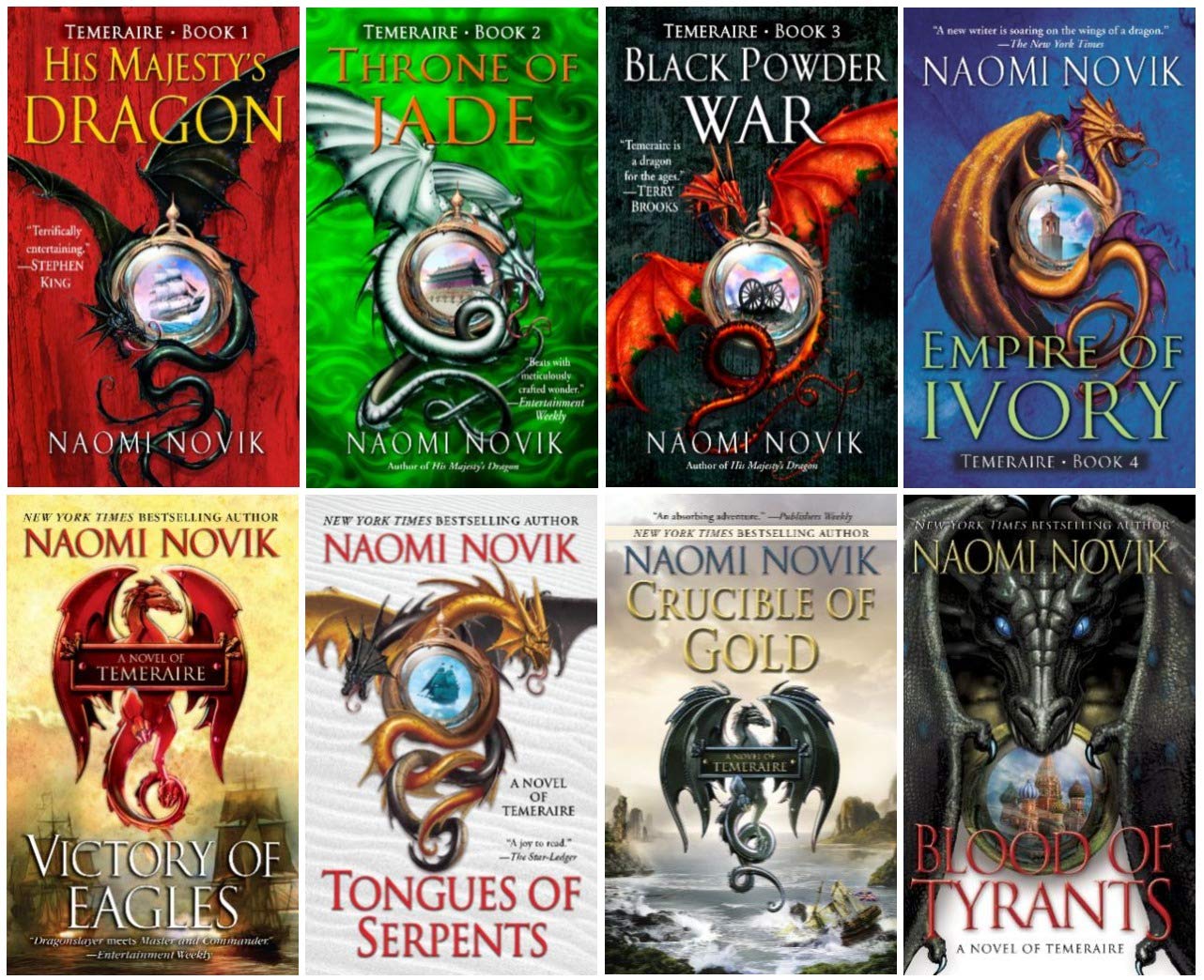
It should be noted that the novels are indeed true series novels: each concluding its sub-story satisfyingly enough, but also advancing an overall arc. The series opens with Captain Will Laurence of the English Navy capturing a French ship, on which there is a dragon egg. When dragons hatch they are "harnessed" by a person who will be their constant companion: usually an aviator, but no such candidate being available the man chosen is Laurence himself. This means the end of his promising Naval career, and an unconventional life as one of the rather raffish Aerial Corps, but the friendship of the dragon, a very unusual specimen he names Temeraire, proves to be ample compensation. His Majesty's Dragon (titled Temeraire in the UK) details the training of Laurence and Temeraire, complete with some internal conflicts and adjustments, leading to their first battles and the revelation of Temeraire's particularly special war-fighting power, unique to his variety of extremely rare dragon. This variety, it transpires, is the Chinese Celestial, usually reserved to be companions of the Chinese Imperial Family.
In Throne of Jade the Chinese protest the British capture of Temeraire (who had been intended as a gift for Napoleon), and the spineless Foreign Office sends Laurence, Temeraire, and crew to China, hoping to negotiate better trading rights in exchange for returning this valuable dragon. But while Temeraire enjoys China, in particular the special privileges -- or, perhaps, ordinary rights that all intelligent creatures ought to enjoy -- given dragons there, he refuses to be separated from Laurence. Also, it turns out there is some political turmoil in China -- the resolution of which leads also to an accommodation that allows Laurence and Temeraire to remain together.
Black Powder War is the story of their desperate land journey first to Istanbul, to collect three more dragon eggs the British have bought from the Turks, then through war-torn Europe, where they learn that Napoleon has a new Celestial -- one who has cause to hate Laurence, Temeraire, and by extension England.
The first book is nearly an unalloyed delight (save the slightly unprepared-for nature of the end), the second is enjoyable but a step down, perhaps a bit too slow; and the third ranks pretty much with the second, though the ending is surprising and quite moving. The series as a whole promises to continue to be very fun reading, with a nicely set up tension between the necessity of defeating Napoleon and the cause of "Dragon's Rights", which Temeraire has at last persuaded Laurence is both morally and practically essential. Both lead characters are engaging and well-depicted, the prose is nicely handled with a sound period flavor, the fantastical elements are not terribly plausible (nor necessarily consistent) but they (draconic characteristics and types, basically) are nicely imagined. Recommended.
Review of Fast Ships, Black Sails (Locus, December 2008)
One coup the VanderMeers managed was to land a novelette from Naomi Novik. (To my knowledge she has only published two other short stories, both quite short, at her website.) “Araminta; or, The Wreck of the Amphidrake” is one of the best pieces in this book. It’s not a Temeraire story -- it is a gender-bending tale of a rather tomboyish girl of a noble family sent by sea to marry the young man her parents have chosen. When pirates attack her ship, she resorts to a special magical protection she has been given … the results are entertaining and in the end Araminta gets the chance to make her own choices for her future, choices that not too surprisingly involve adventure and piracy.
Review of Warriors (Locus, May 2010)
Naomi Novik shows up with her first straight SF story (that I know of), “Seven Years From Home”, about a diplomat sent to an alien planet, charged with mediating somehow between two human variant groups, one of which has colonized one continent by altering themselves to blend in with the established ecology, the other of which, latecomers, are bent on terraforming the planet, and having conquered their continent are now proceeding to the other. The diplomat, not surprisingly, goes native (as it were), only to become complicit in what she can’t help seeing a terrible crime. The story has some intriguing elements, but doesn’t really convince. But it’s nice to see Novik continue to extend her range – she is serving notice that she won’t be tied to Temeraire for her whole career.
Review of Naked City (Locus, August 2011)
More lighthearted are stories like Naomi Novik’s “Priced to Sell”, about various problems a real estate agent deals with in selling to the magical community – slight, to be sure, but fun.
Locus, January 2017
One of my favorite stories in The Starlit Wood is Naomi Novik’s “Spinning Silver”. As one might guess, Rumpelstiltskin in the base story. The conceit is that instead of spinning straw into gold, a moneylender might be seen as spinning silver (a small amount of money) into a larger amount (gold). The narrator is the daughter of a poor village moneylender, too kindly to make a living. The daughter, however, has learned to harden her heart to her father’s clients’ troubles – which often enough are invented anyway – and under her stewardship the family has prospered – but at what cost? Especially when a fairy creature called the Staryk learns of her abilities, and insists that she spin his silver into gold. The mechanism she uses is clever, and the expected complications ensue, especially when the local Duke is involved. Novik very effectively layers the story with meaning – most notably the status of the moneylenders, who are (of course) Jewish – which points as well to a perhaps sometimes missed element of Rumpelstiltskin’s traditional portrayal. As with many of the stories in this book (and indeed in most contemporary fairy tale versions) the agency or lack thereof of the female characters is also central, and quite matter of factly and honestly treated.
Friday, April 24, 2020
Birthday Review: The Other Nineteenth Century, by Avram Davidson
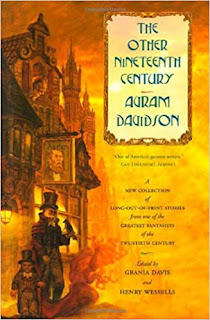
This is slightly belated -- Avram Davidson would have turned 97 yesterday. Gosh, he was a wonderful writer! I've previously covered a couple of his Ace Doubles, and I've posted a survey of his novels, and a review of The Avram Davidson Treasury, so here's a very short bit I wrote for my blog some long while ago about another posthumous collection, The Other Nineteenth Century.
 [On reflection, I've regretted posting that rather casually tossed off old blog entry, and I've produced a more thorough review here:
Review of The Other Nineteenth Century.]

Review of The Other Nineteenth Century.]
Tuesday, April 14, 2020
Birthday Review: Stories of Bruce Sterling
I can't believe I haven't done one of these birthday review collections for Bruce Sterling yet. So here we go! This is a collection of my reviews of his short work from my Locus column. Happy Birthday -- Bruce Sterling turns 66 today.
Locus, September 2002
Bruce Sterling's short story "In Paradise" (F&SF, September) is a fine romp, extrapolating a bit from our current "Homeland Security" measure. Felix is a plumber who falls for a beautiful Iranian woman he sees at the airport, and with the help of a high-tech Finnish cellphone he manages to seduce her. Their whirlwind romance is interrupted when it turns out to have political repercussions. Where then is freedom or paradise in a high-tech, security obsessed, world? Sterling has an answer. A fun story, and oddly romantic (as Sterling often is – perhaps in contrast to his reputation), though it lacks the extrapolative snap of Sterling at his most characteristic.
Locus, January 2003
Another fun piece from the January Asimov's is Rudy Rucker and Bruce Sterling's "Junk DNA", a story fully as frenetic as we expect from that duo. Janna Gutierrez is a half-Vietnamese, half-Latino woman sometime in the next few decades, who more or less randomly enters into business with a Russian immigrant who wants to market a pet based on human junk DNA, particularly the pet owner's own DNA. Before long they are dealing with a big corporation's takeover attempt. How much sense this all makes is questionable, but the story is a fun romp.
Locus, January 2005
Bruce Sterling's "The Blemmye's Stratagem" highlights the January F&SF. Hildegart is a nun who runs a far-flung commercial venture in the Middle East towards the end of the Crusades. Sinan is an Assassin, and at one time Hildegart was one of Sinan's wives. They both work for a mysterious entity called the Silent Master. As the story opens, they are called to their Master once again – they assume simply to receive instructions and to be given another dose of life extension elixir, but in fact something rather more important is going on. The story is by turns cynical, cynically romantic, scary, moving, and fascinating. An award contender, I would think. And at Sci Fiction in December we find Bruce Sterling's "Luciferase", a funny story about a male firefly looking for love, and finding it in a rather dangerous place.
Locus, September 2005
I also liked Bruce Sterling's "The Denial" (F&SF, September), about a husband and wife in an Eastern European town some centuries ago, whose lives are changed by a terrible flood. Indeed, the wife seems to have died in the flood – but to have somehow come back to life. The husband's attempts to deal with his changed wife lead him to an unexpected revelation.
Locus, January 2007
The cover story for the January F&SF is a new novella by Bruce Sterling, certainly a welcome sight. That said, while “Kiosk” is an interesting story, it seems a bit unfocussed – it doesn’t quite work. It concerns an aging Eastern European war veteran, sometime a few decades in the future, who operates a small shopping kiosk which becomes the center of a revolution of sorts when he obtains a black-market “fabrikator”, which can make a duplicate of most anything out of nanotubes. It seems the authorities have all read “Business as Usual, During Alterations” and A for Anything, so they are concerned about such a machine’s impact on the economy … but in the end, information wants to be free. The ideas here are certainly worth exploring – but the story doesn’t really grapple with them – more interesting, really, are the colorful characters – but they don’t really have a story of their own.
Locus, August 2007
The online magazines have not been silent either. I finally caught up with Subterranean’s Spring issue. Bruce Sterling’s “A Plain Tale from Our Hills” is a subtle sketch of a post-catastrophe future, told in Kiplingesque fashion about a wife’s brave effort to keep her husband in the face of an exotic woman’s affair with him. It is of course the stark details of this deprived future, quietly slipped in, that make the story powerful.
Locus, November 2007
Eclipse One is yet another strong original anthology from Locus Reviews Editor Jonathan Strahan. Highlights include a truly odd story from Bruce Sterling, “The Lustration”, about an isolated planet on which the inhabitants have built and maintain an entirely wooden, world-spanning, computer. The protagonist realizes that something strange is happening with the computer, and ends up in a society which guards a terrible secret. The story is in one way almost too strange, but in the end successfully ponders a central SF question
Locus, February 2009
Rudy Rucker and Bruce Sterling have lots of fun with the end of the universe in “Colliding Branes” (Asimov's, February). Bloggers Rabbiteen Chandra and Angelo Rasmussen have learned that for either mystical or physical reasons the structure of the universe is collapsing. So they head for Area 51 (sort of ) to witness the end as best they can – and to have some “pre-apocalypse sex”. Post, too, as it, rather sweetly, turns out.
Locus, June 2009
The March-April Interzone features a Bruce Sterling story – not that he was ever gone, but Sterling seems “back” this year, with a new novel and now “Black Swan”, gritty and savvy, with a journalist lured across multiple timelines, chasing wild tech not to mention a revolutionary version of Nicolas Sarkozy.
Locus, September 2009
And Bruce Sterling offers a clever fantasy about an Italian auto executive encountering the devil – or something like him – in “Esoteric City” (F&SF, August-September). The story is fun, original – certainly worth reading, but at some level it struck me as insubstantial.
Review of Subterranean 2: Tales of Dark Fantasy (Locus, May 2011)
Another story I particularly enjoyed comes from Bruce Sterling. “The Parthenopean Scalpel” concerns an assassin who has to flee the Papal States after the too clumsy success of one of his assignments. In exile he falls in love – but a certain Transylvanian intervenes. The story rides on the well-maintained voice of the main character, and the backstory of Europe in the turbulent middle of the 19th Century.
Locus, June 2012
Nick Mamatas and Masumi Washington offer The Future is Japanese, which collects a number of SF stories about, in some sense, a Japaneses future, as well as a few stories by Japanese SF writers. ... From English-language writers, I liked Bruce Sterling's “Goddess of Mercy”, a characteristically smart and cynical story set on a Japanese island ruled by a Pirate Queen where a woman comes to negotiate for the freedom of a political agitator;
Locus, January 2014
A Bruce Sterling story showed up in Dissident Blog, "N'existe Pas", not really SF but certainly involved with SFnal ideas, so that it seems worth bringing to Locus reader's attentions. It's a somewhat comic story about privacy and the lack thereof, set as a conversation in a Paris cafe between a paparazzo and his brother, a spy (a double agent, indeed), as they await the rumored arrival of the Prime Minister and his newest mistress, while discussing the nature of their similar businesses, and of privacy and surveillance in the modern digital age, eventually involving an American spy and a Syrian woman and an actress who was also previously the Prime Minister's mistress ... nothing much really happens but the story is intellectually interesting and quite funny.
Locus, September 2002
Bruce Sterling's short story "In Paradise" (F&SF, September) is a fine romp, extrapolating a bit from our current "Homeland Security" measure. Felix is a plumber who falls for a beautiful Iranian woman he sees at the airport, and with the help of a high-tech Finnish cellphone he manages to seduce her. Their whirlwind romance is interrupted when it turns out to have political repercussions. Where then is freedom or paradise in a high-tech, security obsessed, world? Sterling has an answer. A fun story, and oddly romantic (as Sterling often is – perhaps in contrast to his reputation), though it lacks the extrapolative snap of Sterling at his most characteristic.
Locus, January 2003
Another fun piece from the January Asimov's is Rudy Rucker and Bruce Sterling's "Junk DNA", a story fully as frenetic as we expect from that duo. Janna Gutierrez is a half-Vietnamese, half-Latino woman sometime in the next few decades, who more or less randomly enters into business with a Russian immigrant who wants to market a pet based on human junk DNA, particularly the pet owner's own DNA. Before long they are dealing with a big corporation's takeover attempt. How much sense this all makes is questionable, but the story is a fun romp.
Locus, January 2005
Bruce Sterling's "The Blemmye's Stratagem" highlights the January F&SF. Hildegart is a nun who runs a far-flung commercial venture in the Middle East towards the end of the Crusades. Sinan is an Assassin, and at one time Hildegart was one of Sinan's wives. They both work for a mysterious entity called the Silent Master. As the story opens, they are called to their Master once again – they assume simply to receive instructions and to be given another dose of life extension elixir, but in fact something rather more important is going on. The story is by turns cynical, cynically romantic, scary, moving, and fascinating. An award contender, I would think. And at Sci Fiction in December we find Bruce Sterling's "Luciferase", a funny story about a male firefly looking for love, and finding it in a rather dangerous place.
Locus, September 2005
I also liked Bruce Sterling's "The Denial" (F&SF, September), about a husband and wife in an Eastern European town some centuries ago, whose lives are changed by a terrible flood. Indeed, the wife seems to have died in the flood – but to have somehow come back to life. The husband's attempts to deal with his changed wife lead him to an unexpected revelation.
Locus, January 2007
The cover story for the January F&SF is a new novella by Bruce Sterling, certainly a welcome sight. That said, while “Kiosk” is an interesting story, it seems a bit unfocussed – it doesn’t quite work. It concerns an aging Eastern European war veteran, sometime a few decades in the future, who operates a small shopping kiosk which becomes the center of a revolution of sorts when he obtains a black-market “fabrikator”, which can make a duplicate of most anything out of nanotubes. It seems the authorities have all read “Business as Usual, During Alterations” and A for Anything, so they are concerned about such a machine’s impact on the economy … but in the end, information wants to be free. The ideas here are certainly worth exploring – but the story doesn’t really grapple with them – more interesting, really, are the colorful characters – but they don’t really have a story of their own.
Locus, August 2007
The online magazines have not been silent either. I finally caught up with Subterranean’s Spring issue. Bruce Sterling’s “A Plain Tale from Our Hills” is a subtle sketch of a post-catastrophe future, told in Kiplingesque fashion about a wife’s brave effort to keep her husband in the face of an exotic woman’s affair with him. It is of course the stark details of this deprived future, quietly slipped in, that make the story powerful.
Locus, November 2007
Eclipse One is yet another strong original anthology from Locus Reviews Editor Jonathan Strahan. Highlights include a truly odd story from Bruce Sterling, “The Lustration”, about an isolated planet on which the inhabitants have built and maintain an entirely wooden, world-spanning, computer. The protagonist realizes that something strange is happening with the computer, and ends up in a society which guards a terrible secret. The story is in one way almost too strange, but in the end successfully ponders a central SF question
Locus, February 2009
Rudy Rucker and Bruce Sterling have lots of fun with the end of the universe in “Colliding Branes” (Asimov's, February). Bloggers Rabbiteen Chandra and Angelo Rasmussen have learned that for either mystical or physical reasons the structure of the universe is collapsing. So they head for Area 51 (sort of ) to witness the end as best they can – and to have some “pre-apocalypse sex”. Post, too, as it, rather sweetly, turns out.
Locus, June 2009
The March-April Interzone features a Bruce Sterling story – not that he was ever gone, but Sterling seems “back” this year, with a new novel and now “Black Swan”, gritty and savvy, with a journalist lured across multiple timelines, chasing wild tech not to mention a revolutionary version of Nicolas Sarkozy.
Locus, September 2009
And Bruce Sterling offers a clever fantasy about an Italian auto executive encountering the devil – or something like him – in “Esoteric City” (F&SF, August-September). The story is fun, original – certainly worth reading, but at some level it struck me as insubstantial.
Review of Subterranean 2: Tales of Dark Fantasy (Locus, May 2011)
Another story I particularly enjoyed comes from Bruce Sterling. “The Parthenopean Scalpel” concerns an assassin who has to flee the Papal States after the too clumsy success of one of his assignments. In exile he falls in love – but a certain Transylvanian intervenes. The story rides on the well-maintained voice of the main character, and the backstory of Europe in the turbulent middle of the 19th Century.
Locus, June 2012
Nick Mamatas and Masumi Washington offer The Future is Japanese, which collects a number of SF stories about, in some sense, a Japaneses future, as well as a few stories by Japanese SF writers. ... From English-language writers, I liked Bruce Sterling's “Goddess of Mercy”, a characteristically smart and cynical story set on a Japanese island ruled by a Pirate Queen where a woman comes to negotiate for the freedom of a political agitator;
Locus, January 2014
A Bruce Sterling story showed up in Dissident Blog, "N'existe Pas", not really SF but certainly involved with SFnal ideas, so that it seems worth bringing to Locus reader's attentions. It's a somewhat comic story about privacy and the lack thereof, set as a conversation in a Paris cafe between a paparazzo and his brother, a spy (a double agent, indeed), as they await the rumored arrival of the Prime Minister and his newest mistress, while discussing the nature of their similar businesses, and of privacy and surveillance in the modern digital age, eventually involving an American spy and a Syrian woman and an actress who was also previously the Prime Minister's mistress ... nothing much really happens but the story is intellectually interesting and quite funny.
Monday, April 13, 2020
Birthday Review: Stories of Theodore L. Thomas
Theodore L. Thomas (1920-2005) is probably best known in the SF field for his novel with Kate Wilhelm, The Clone (expanded from Thomas' short story reviewed herein.) He was a chemical engineer and patent lawyer, and he is also known for a series of four stories examining SFnal notions from a patent lawyer's view, written as by "Leonard Lockhard", because the first of these stories ("The Professional Look") was written with another SF writer/Patent lawyer, Charles L. Harness, and the pseudonym combines their two middle names. He was born on this date, so following is a look at a few of his short stories, based on reviews I did of the old magazines they appeared in.
Review of Space Science Fiction, September 1952
Finally, Theodore L. Thomas's "The Revisitor" is set in the near future after a test has been developed to determine everyone's capacity and abilities. The story tells of a mysterious person taking the test and proving to be a "Number One" -- i.e. perfect in everything, more or less. He embarks on a project to create life ... The meaning is a bit obscure, signalled only at the end by the title and a reference to a lot of progress in the past 2000 years.
Review of Future #28
Theodore L. Thomas's "Trial Without Combat" (9000 words) is another didactic story in nature. In this case the villain is religion. An agent of the Federal Bureau of Control is stationed on a distant planet, charged with guiding it to civilization in subtle ways. Unfortunately, the bleeding hearts/meddlers/whatever back on Earth have decided that simply assassinating the bad guys won't do. (In the story, this anti-assassination view is presented as a ridiculous stance on the face of it.) So our hero must work more cleverly, especially if he wants to get back to Earth in time for his baby to be born. (This is an enlightened future society, so naturally all the women are pregnant and barefoot in the kitchen ...) What's the problem? An oppressive religion, one in particular that has begun engaging in simony. And what's the "subtle" solution? Get arrested for heresy, and in the trial, convince the religious leaders that they are wrong by arguments so sophisticated any sophomore will be glad to use them! And use your handy-dandy force field plus personal spaceship to fend off trouble. A stupid stupid story, kind of a low rent knockoff of Everett Cole's Philosophical Corps.
Review of Super Science Fiction, August 1957
"Twice-Told Tale", by Theodore L. Thomas, is also silly -- an obsessed scientist has determined that space is curved and that a starship can travel around it in 15 years. Everyone scoffs at him. But he gets funding from the Queen -- no, Madam President -- of Castile -- no, Brazil -- and he takes a spaceship -- no, THREE spaceships ... and of course he is proved right. You really don't want to know -- well, you already do know, I'm sure -- what the spaceships were named. (I also did some math. His ships are stated to travel 4*1028c -- so in 15 years they would go some 60,000 light years. THAT is enough to go around the universe?????)
Review of Fantastic, January 1959
Theodore Thomas’s “The Clone” is a somewhat well-known story, later expanded, with Kate Wilhelm, to a novel of the same title. The title creature is not what we would now think of as a “clone,” but rather a spontaneously generated life form, created in the sewers of a Midwestern city that appears to be Chicago, that feeds on anything it encounters, including people.
It’s pure SF horror (with an obvious ecological theme), and it drives from its open to the necessary dark conclusion, mostly by exposition.
Review of Fantastic, February 1964
The other short story is a short-short from Theodore L. Thomas: “The Soft Woman,” a horror story that I confess I didn’t quite get, about a man who encounters a beautiful woman and takes her to bed — with, to coin a phrase, unfortunate effects. Here Thomas was too subtle for me, I suppose — was this revenge from a briefly mentioned previous lover?
Review of Space Science Fiction, September 1952
Finally, Theodore L. Thomas's "The Revisitor" is set in the near future after a test has been developed to determine everyone's capacity and abilities. The story tells of a mysterious person taking the test and proving to be a "Number One" -- i.e. perfect in everything, more or less. He embarks on a project to create life ... The meaning is a bit obscure, signalled only at the end by the title and a reference to a lot of progress in the past 2000 years.
Review of Future #28
Theodore L. Thomas's "Trial Without Combat" (9000 words) is another didactic story in nature. In this case the villain is religion. An agent of the Federal Bureau of Control is stationed on a distant planet, charged with guiding it to civilization in subtle ways. Unfortunately, the bleeding hearts/meddlers/whatever back on Earth have decided that simply assassinating the bad guys won't do. (In the story, this anti-assassination view is presented as a ridiculous stance on the face of it.) So our hero must work more cleverly, especially if he wants to get back to Earth in time for his baby to be born. (This is an enlightened future society, so naturally all the women are pregnant and barefoot in the kitchen ...) What's the problem? An oppressive religion, one in particular that has begun engaging in simony. And what's the "subtle" solution? Get arrested for heresy, and in the trial, convince the religious leaders that they are wrong by arguments so sophisticated any sophomore will be glad to use them! And use your handy-dandy force field plus personal spaceship to fend off trouble. A stupid stupid story, kind of a low rent knockoff of Everett Cole's Philosophical Corps.
Review of Super Science Fiction, August 1957
"Twice-Told Tale", by Theodore L. Thomas, is also silly -- an obsessed scientist has determined that space is curved and that a starship can travel around it in 15 years. Everyone scoffs at him. But he gets funding from the Queen -- no, Madam President -- of Castile -- no, Brazil -- and he takes a spaceship -- no, THREE spaceships ... and of course he is proved right. You really don't want to know -- well, you already do know, I'm sure -- what the spaceships were named. (I also did some math. His ships are stated to travel 4*1028c -- so in 15 years they would go some 60,000 light years. THAT is enough to go around the universe?????)
Review of Fantastic, January 1959
Theodore Thomas’s “The Clone” is a somewhat well-known story, later expanded, with Kate Wilhelm, to a novel of the same title. The title creature is not what we would now think of as a “clone,” but rather a spontaneously generated life form, created in the sewers of a Midwestern city that appears to be Chicago, that feeds on anything it encounters, including people.
It’s pure SF horror (with an obvious ecological theme), and it drives from its open to the necessary dark conclusion, mostly by exposition.
Review of Fantastic, February 1964
The other short story is a short-short from Theodore L. Thomas: “The Soft Woman,” a horror story that I confess I didn’t quite get, about a man who encounters a beautiful woman and takes her to bed — with, to coin a phrase, unfortunate effects. Here Thomas was too subtle for me, I suppose — was this revenge from a briefly mentioned previous lover?
Saturday, April 11, 2020
Birthday Review: Think Like a Dinosaur and Other Stories, by James Patrick Kelly
Today is Jim Kelly's birthday. Last year on this date I did one of my Locus review collections. This year, instead, I'll republish something from Tangent, where I got my start reviewing short fiction!
Review Date: 31 March 1998. This review first appeared in Tangent, issue 20/21, and is copyright 1998 by Richard R. Horton.
Think Like a Dinosaur and Other Stories, by James Patrick Kelly
Golden Gryphon Press, 1997, $22.95
ISBN: 0965590194
 Reading a collection of James Patrick Kelly's stories, I am struck most forcefully by his range. The stories in Think Like a Dinosaur and Other Stories include cynical cyperpunkish adventures, gentle romantic stories, mainstream character explorations, and pure, idea-driven SF, and Kelly can wax passionate, lyrical, comedic or satirical as needed.
Start with the Hugo-winning title story. Michael is a human sapientologist assigned to Tuulen station, a wormhole hub operated by the dinosaur-like Hanen for human use. He guides the human travelers through the process of transmission, which involves a complete scan of their body, and its reconstruction at the receiving hub. Their "original" body is then destroyed, to maintain "balance", to prevent multiple copies of the same person from existing. A transmission problem causes a Kamala Shastri to have to wait to confirm successful recreation of her body at the receiving end: and after it works, Michael must kill her. But now he's gotten to know her, and anyway she's no longer quite the same person he transmitted. Michael's dilemma is agonizing, and, as has been well-documented, is in obvious response to a somewhat similar dilemma at the heart of the famous Tom Godwin story "The Cold Equations". But this story is subtler and better done: especially as it raises questions of identity and the nature of consciousness which echo similar questions in Algis Budrys' great novel Rogue Moon; and also because of the subtle reinforcement of the central questions throughout the story: as Michael and Kamala trade stories of youthful encounters with death, and as the (cold-blooded, of course) Hanen discuss immature Human attitudes towards "balance". A thought-provoking story, which raises intellectual and moral questions, and resolves them ambiguously, and which has said more to me each of the several times I've read it.
Kelly's early reputation was as one of the "humanist" side in the silly and mostly false '80s dichotomy of cyberpunks (Gibson, Sterling) and humanists (K. S. Robinson, Kelly). But several of his most striking stories venture into so-called "cyberpunk" territory. Included here are "Rat", a fast-paced and intriguing tale of a violent, decayed future, where the title character smuggles a large quantity of a fashionable drug into the US, and must try to avoid both federal agents, and the local middlemen who is trying to double cross; and "Mr. Boy", a long novella which is also part of his novel Wildlife. Mr. Boy is 25, but his mother keeps him somatically and emotionally at the age of 12 by repeated "gene twanking". His friends are a 13-year old boy who has been twanked into a dinosaur form, and an artificial intelligence his mother bought him as a companion/bodyguard. Mr. Boy's life begins to come apart when some illegal "corpse porn" is traced to him, and his understanding of his life is shaken when he meets a 17-year old "stiff" (read: untwanked) girl and starts to fall in love. The background details of the story are excellent, very Sterlingesque: Virtual Environment parties, his mother's chosen "twanked" form (Mr. Boy doesn't just live with his mother, he lives "in" her), smash parties, the mall franchise families, and so on. The main story itself is affecting, but a bit obvious: we know from the start just what Mr. Boy needs: to grow up.
Kelly's "sweeter" side shows in "Faith", about a newly-divorced woman who tries the personal ad dating route. Eventually she meets a man who talks to plants (and gets results). She needs to learn trust, or, as it were, faith. It is gently humorous and honestly romantic. An unexpectedly "sweet" story is "Monsters", a seemingly straightforward story about two misfits who work in a dry cleaners. The story takes a successful, almost magical-realist, twist at the end. Throughout the characters are sharply and closely drawn, and very affecting despite very real human weaknesses.
"Breakaway, Backdown" is another outstanding pure SF story. It's a monologue by a young woman who has just returned from a space station, addressing a younger woman who still dreams of space. It very affectingly depicts the real agony of making a choice which quite literally separates one forever from Earth. Kelly suggests, very economically, a convincing separate society of humans adapted for space.
The obligatory "mainstream" story is "Heroics" (which does have a suggestion of clairvoyant dreaming to qualify it as marginal SF). This is a moving look at an ordinary man who thinks of the choices he's made in his life, and can't convince himself that he isn't a coward. A series of dreams about a boat disaster and his failure to help the victims exacerbates his feelings. Finally, as we know will happen, the disaster occurs in real life. The hero's response is honest, and the ending is just ambiguous enough to raise questions in the reader's mind about the real nature of "heroism".
The other stories are similarly good, if sometimes slight. I'll briefly mention the most memorable. "Standing in Line with Mr. Jimmy", which echoes some of "Mr. Boy"'s concerns with independence, as a street-smart hustler, living on state maintenance, faces forced enrollment in a work gang, and considers the way out offered by a mysterious organization. The story's resolution turns on the value of depending on other people instead of free escapes, mechanical aids, or the government. "Pogrom" is a very pointed story about an old person in the next century, held responsible by young people for the decayed state of the world. It's an effective lecture, but unfortunately more lecture or screed than story. "Itsy Bitsy Spider" is a nice, quiet, look at a grown woman's encounter with her long-estranged father, now losing his memory and attended by an unexpected companion, herself.
Short fiction has always been central to genre SF, and story collections are an important way of coherently preserving the best short fiction. But lately economic considerations seem to have made story collections marginal products for big name publishers. I was surprised to see that this is Kelly's first collection (save a brief four story book from Pulphouse): he is one of the best writers in the field, and in my opinion short fiction is his stronger suit. So it's nice to see Jim Turner, who also edited the Ian R. MacLeod Voyages by Starlight collection (which I also reviewed in that issue of Tangent) for Arkham House, providing in Golden Gryphon Press a new outlet for economically marginal but very valuable books like this one.
Review Date: 31 March 1998. This review first appeared in Tangent, issue 20/21, and is copyright 1998 by Richard R. Horton.
Think Like a Dinosaur and Other Stories, by James Patrick Kelly
Golden Gryphon Press, 1997, $22.95
ISBN: 0965590194

Start with the Hugo-winning title story. Michael is a human sapientologist assigned to Tuulen station, a wormhole hub operated by the dinosaur-like Hanen for human use. He guides the human travelers through the process of transmission, which involves a complete scan of their body, and its reconstruction at the receiving hub. Their "original" body is then destroyed, to maintain "balance", to prevent multiple copies of the same person from existing. A transmission problem causes a Kamala Shastri to have to wait to confirm successful recreation of her body at the receiving end: and after it works, Michael must kill her. But now he's gotten to know her, and anyway she's no longer quite the same person he transmitted. Michael's dilemma is agonizing, and, as has been well-documented, is in obvious response to a somewhat similar dilemma at the heart of the famous Tom Godwin story "The Cold Equations". But this story is subtler and better done: especially as it raises questions of identity and the nature of consciousness which echo similar questions in Algis Budrys' great novel Rogue Moon; and also because of the subtle reinforcement of the central questions throughout the story: as Michael and Kamala trade stories of youthful encounters with death, and as the (cold-blooded, of course) Hanen discuss immature Human attitudes towards "balance". A thought-provoking story, which raises intellectual and moral questions, and resolves them ambiguously, and which has said more to me each of the several times I've read it.
Kelly's early reputation was as one of the "humanist" side in the silly and mostly false '80s dichotomy of cyberpunks (Gibson, Sterling) and humanists (K. S. Robinson, Kelly). But several of his most striking stories venture into so-called "cyberpunk" territory. Included here are "Rat", a fast-paced and intriguing tale of a violent, decayed future, where the title character smuggles a large quantity of a fashionable drug into the US, and must try to avoid both federal agents, and the local middlemen who is trying to double cross; and "Mr. Boy", a long novella which is also part of his novel Wildlife. Mr. Boy is 25, but his mother keeps him somatically and emotionally at the age of 12 by repeated "gene twanking". His friends are a 13-year old boy who has been twanked into a dinosaur form, and an artificial intelligence his mother bought him as a companion/bodyguard. Mr. Boy's life begins to come apart when some illegal "corpse porn" is traced to him, and his understanding of his life is shaken when he meets a 17-year old "stiff" (read: untwanked) girl and starts to fall in love. The background details of the story are excellent, very Sterlingesque: Virtual Environment parties, his mother's chosen "twanked" form (Mr. Boy doesn't just live with his mother, he lives "in" her), smash parties, the mall franchise families, and so on. The main story itself is affecting, but a bit obvious: we know from the start just what Mr. Boy needs: to grow up.
Kelly's "sweeter" side shows in "Faith", about a newly-divorced woman who tries the personal ad dating route. Eventually she meets a man who talks to plants (and gets results). She needs to learn trust, or, as it were, faith. It is gently humorous and honestly romantic. An unexpectedly "sweet" story is "Monsters", a seemingly straightforward story about two misfits who work in a dry cleaners. The story takes a successful, almost magical-realist, twist at the end. Throughout the characters are sharply and closely drawn, and very affecting despite very real human weaknesses.
"Breakaway, Backdown" is another outstanding pure SF story. It's a monologue by a young woman who has just returned from a space station, addressing a younger woman who still dreams of space. It very affectingly depicts the real agony of making a choice which quite literally separates one forever from Earth. Kelly suggests, very economically, a convincing separate society of humans adapted for space.
The obligatory "mainstream" story is "Heroics" (which does have a suggestion of clairvoyant dreaming to qualify it as marginal SF). This is a moving look at an ordinary man who thinks of the choices he's made in his life, and can't convince himself that he isn't a coward. A series of dreams about a boat disaster and his failure to help the victims exacerbates his feelings. Finally, as we know will happen, the disaster occurs in real life. The hero's response is honest, and the ending is just ambiguous enough to raise questions in the reader's mind about the real nature of "heroism".
The other stories are similarly good, if sometimes slight. I'll briefly mention the most memorable. "Standing in Line with Mr. Jimmy", which echoes some of "Mr. Boy"'s concerns with independence, as a street-smart hustler, living on state maintenance, faces forced enrollment in a work gang, and considers the way out offered by a mysterious organization. The story's resolution turns on the value of depending on other people instead of free escapes, mechanical aids, or the government. "Pogrom" is a very pointed story about an old person in the next century, held responsible by young people for the decayed state of the world. It's an effective lecture, but unfortunately more lecture or screed than story. "Itsy Bitsy Spider" is a nice, quiet, look at a grown woman's encounter with her long-estranged father, now losing his memory and attended by an unexpected companion, herself.
Short fiction has always been central to genre SF, and story collections are an important way of coherently preserving the best short fiction. But lately economic considerations seem to have made story collections marginal products for big name publishers. I was surprised to see that this is Kelly's first collection (save a brief four story book from Pulphouse): he is one of the best writers in the field, and in my opinion short fiction is his stronger suit. So it's nice to see Jim Turner, who also edited the Ian R. MacLeod Voyages by Starlight collection (which I also reviewed in that issue of Tangent) for Arkham House, providing in Golden Gryphon Press a new outlet for economically marginal but very valuable books like this one.
Friday, April 10, 2020
Resurrected Review: The Fortunate Fall, by Raphael Carter
Today (2/14/2023) I learned that Cameron Reed, the author of this novel (published under a different name) is working on some new fiction, which is pretty exciting. I also learned her name -- and I've updated the post to reflect that.
Review Date: 12/20/96
The Fortunate Fall, by Cameron Reed
Tor, July 1996, $21.95 US
ISBN: 031286034X
 This is really, really, good. Set in the 23rd century, the Russian narrator (Maya, making at least three major SF novels this year to feature a major character named Maya (also Holy Fire and Blue Mars)) is a telepresence "camera": she "witnesses" news events, or anything which could be a story, and her total impressions (sensorium, plus memories: the latter including implanted memories of research on the subject) are transmitted over the net to her audience, although the output is "screened" by another individual (a "screener") who is totally linked with the camera, and who apparently filters sensitive or personal material, and makes sure that the sensorium output comes through OK (red looks red, stuff like that). We slowly learn that Maya has a "past" which she cannot remember, because memories of it have been suppressed, and that that past is related to her love life. We also learn that her world has emerged in recent decades from the domination of a group called the Guardians, and that it is now bifurcated into the technologically advanced, but isolated, African continent, and to something called the Fusion of Historical Nations, which seems to be a shaky reestablishment of roughly 20th century political boundaries.
Maya's latest story is about some of the key events in the liberation of Russia from the Guardians. As she begins her story, her old screener quits and she gets a new one. This new screener is revealed to have quite remarkable abilities, and also seems to quickly fall in love with Maya, which is difficult for Maya to handle because her sexual emotions are suppressed. Maya and Keishi (the new screener) begin to investigate some details of the defeat of the Guardians, details which are for some reason potentially embarrassing to the "new world order". Staying one step ahead of the law, Maya travels across Russia and through the net in search of an interview with a man who has some secrets about the Guardians, their successors, and the nature of the world and the net.
The author pulls off a number of exciting, brilliant things. The nature of this new world and its history are carefully and slowly revealed, along with Maya's own past, and the resolution is well integrated, the tragic ending is both a surprise and not a surprise, and is "earned".
The technological and social details of life in the FHN are wonderfully well realized. In many ways, this book is reminiscent of Sterling in the way future tech and future society are densely integrated with the narrative, and seem so possible. The terminology (Postcops, Weavers, greyspace, etc.) is intriguing, and is introduced in such a way as to seem natural (there are very few lectures), but also be part of the mysteries which are slowly revealed. The realization of the how "mindlink" technology might really affect the world, and also the images of cyberspace, are believable and original.
The prose is very good, mostly clean and elegant, not showy, but occasionally erupting in apt and memorable images. In addition, the story has true momentum: it makes you want to keep reading. This is a gift that not all good writers have, and it's a great plus.
The book falls slightly short in a couple of areas (mere quibbles, really). Much of the second half of the book is a long narrative by the interview subject, and this method of telling the story seemed to me to create a bit of disconnectness. The story really has two protagonists, Maya and Voskrosenye (the interviewee), and their stories are well integrated, but still there is a slight slackening in that the two stories (Maya's personal one, and the story of the nature of Maya's world, which is mostly told through Voskrosenye) don't quite end in synch. Also, the Guardians are a bit stock as villains (though to be sure they are not the only villains). And I thought Maya's original crime was, well, not likely to be such a crime in the 23rd century. But I could be wrong about that.
This book really provokes thought. One virtue is that much is implied and never told, and we have a sense of a whole fascinating underpinning to this world (such as what the African culture is really like) which is hinted at but not explained. Also, the main themes of guilt and personal responsibility are well handled, and there is some very good stuff about the nature of love, and the nature of love on the net, or in Cyberspace, or whatever.
Review Date: 12/20/96
The Fortunate Fall, by Cameron Reed
Tor, July 1996, $21.95 US
ISBN: 031286034X

Maya's latest story is about some of the key events in the liberation of Russia from the Guardians. As she begins her story, her old screener quits and she gets a new one. This new screener is revealed to have quite remarkable abilities, and also seems to quickly fall in love with Maya, which is difficult for Maya to handle because her sexual emotions are suppressed. Maya and Keishi (the new screener) begin to investigate some details of the defeat of the Guardians, details which are for some reason potentially embarrassing to the "new world order". Staying one step ahead of the law, Maya travels across Russia and through the net in search of an interview with a man who has some secrets about the Guardians, their successors, and the nature of the world and the net.
The author pulls off a number of exciting, brilliant things. The nature of this new world and its history are carefully and slowly revealed, along with Maya's own past, and the resolution is well integrated, the tragic ending is both a surprise and not a surprise, and is "earned".
The technological and social details of life in the FHN are wonderfully well realized. In many ways, this book is reminiscent of Sterling in the way future tech and future society are densely integrated with the narrative, and seem so possible. The terminology (Postcops, Weavers, greyspace, etc.) is intriguing, and is introduced in such a way as to seem natural (there are very few lectures), but also be part of the mysteries which are slowly revealed. The realization of the how "mindlink" technology might really affect the world, and also the images of cyberspace, are believable and original.
The prose is very good, mostly clean and elegant, not showy, but occasionally erupting in apt and memorable images. In addition, the story has true momentum: it makes you want to keep reading. This is a gift that not all good writers have, and it's a great plus.
The book falls slightly short in a couple of areas (mere quibbles, really). Much of the second half of the book is a long narrative by the interview subject, and this method of telling the story seemed to me to create a bit of disconnectness. The story really has two protagonists, Maya and Voskrosenye (the interviewee), and their stories are well integrated, but still there is a slight slackening in that the two stories (Maya's personal one, and the story of the nature of Maya's world, which is mostly told through Voskrosenye) don't quite end in synch. Also, the Guardians are a bit stock as villains (though to be sure they are not the only villains). And I thought Maya's original crime was, well, not likely to be such a crime in the 23rd century. But I could be wrong about that.
This book really provokes thought. One virtue is that much is implied and never told, and we have a sense of a whole fascinating underpinning to this world (such as what the African culture is really like) which is hinted at but not explained. Also, the main themes of guilt and personal responsibility are well handled, and there is some very good stuff about the nature of love, and the nature of love on the net, or in Cyberspace, or whatever.
Sunday, April 5, 2020
Belated Birthday Review: Brasyl, by Ian McDonald
Ian McDonald's birthday was back on March 31, but things have been a bit wild around here, and I didn't get around to posting this until today.
Brasyl, by Ian McDonald
A review by Rich Horton
 Ian McDonald's last novel, River of Gods, was in great part a portrait of future India, and so it is easy to view his new novel, Brasyl, as a portrait of future Brazil -- after, a country which is in some ways reminiscent of India, in its size, crowds, jungles, huge cities, and staggering diversity. While being at the same time wholly different. And to a certain extent I suppose that is true -- but only to a small extent. Brasyl ends up being about its SFnal idea more than anything -- that idea being the "we are a simulation running on a computer" one, with the variation being that the computer might be a quantum computer, which opens up parallel universes as part of the simulation.
It is told in three strands, divergent in time, and set in different major areas of the country. One is present day, and set in Rio de Janeiro, and focuses on Marcelina Hoffman, a producer of sensationalist reality TV. The second is set in 2032, in São Paulo, and focuses on Edson Jesus Oliveira de Freitas, an entertainment entrepreneur -- for example, his current project is a pretty girl who can keep a soccer ball in the air forever. The third thread is set in 1732, mostly on the Amazon, and focuses on Luis Quinn, a Jesuit "admonitory" sent to bring a renegade priest back to the fold.
Marcelina's new project is a TV show, timed to coincide with the 2006 World Cup, which will put the goalie who let in the losing goal in the shocking loss to Uruguay in the 1950 World Cup on trial. But she finds her plans sabotaged -- by someone who seems possibly to be her! She is a bit of a mess herself anyway ... and scary as it is, the eventual notion that there are other worlds to which one might even travel becomes almost alluring.
Edson has a large family, and one of his brothers is a criminal. In trying to get him out of trouble, Edson meets a beautiful quantum computer specialist, Fia Kishida. But quantum computers are proscribed tech, in this future of pervasive surveillance, so Fia is a dangerous person to know -- and after a while Edson is wanted himself, and on the run, with a different version of Fia -- and they too are looking to cross universes.
And finally Luis Quinn, in company with a French scientist, Robert Falcon, travels up the Amazon to deal with Father Goncalves, who has been converting Indians to Christianity and enslaving those who won't convert. Between the slavery, and Goncalves' odd version of Christianity, and his apparent desire for personal power, he is a pretty bad guy. But a powerful guy too, and Quinn is forced to try to find a tribe rumored to have great predictive powers, based on ingesting a frog's secretions. Of course, these powers turn out to arise from perceiving the many possible worlds all at once ... and Quinn gains these powers himself.
So on all three threads, the notion of parallel worlds, and travel between them, becomes central. And there is an action plot deriving from conflict across these worlds. I was reminded of Leiber at times, and of course of a certain Robert Charles Wilson novel too. It's a pretty good novel, very colorful, with imperfect but involving characters. It didn't quite work as well as River of Gods to my taste -- I'm not entirely sure why. Perhaps the overarching theme didn't quite convince me. Perhaps some of the cute touches, like the 18th century characters speculating (with the help of a sort of Babbage machine) in very 21 century terms on things like the universe being a computer simulation, turned me off a bit. But these are minor quibbles -- this is a fine novel, well worth your time.
Brasyl, by Ian McDonald
A review by Rich Horton

It is told in three strands, divergent in time, and set in different major areas of the country. One is present day, and set in Rio de Janeiro, and focuses on Marcelina Hoffman, a producer of sensationalist reality TV. The second is set in 2032, in São Paulo, and focuses on Edson Jesus Oliveira de Freitas, an entertainment entrepreneur -- for example, his current project is a pretty girl who can keep a soccer ball in the air forever. The third thread is set in 1732, mostly on the Amazon, and focuses on Luis Quinn, a Jesuit "admonitory" sent to bring a renegade priest back to the fold.
Marcelina's new project is a TV show, timed to coincide with the 2006 World Cup, which will put the goalie who let in the losing goal in the shocking loss to Uruguay in the 1950 World Cup on trial. But she finds her plans sabotaged -- by someone who seems possibly to be her! She is a bit of a mess herself anyway ... and scary as it is, the eventual notion that there are other worlds to which one might even travel becomes almost alluring.
Edson has a large family, and one of his brothers is a criminal. In trying to get him out of trouble, Edson meets a beautiful quantum computer specialist, Fia Kishida. But quantum computers are proscribed tech, in this future of pervasive surveillance, so Fia is a dangerous person to know -- and after a while Edson is wanted himself, and on the run, with a different version of Fia -- and they too are looking to cross universes.
And finally Luis Quinn, in company with a French scientist, Robert Falcon, travels up the Amazon to deal with Father Goncalves, who has been converting Indians to Christianity and enslaving those who won't convert. Between the slavery, and Goncalves' odd version of Christianity, and his apparent desire for personal power, he is a pretty bad guy. But a powerful guy too, and Quinn is forced to try to find a tribe rumored to have great predictive powers, based on ingesting a frog's secretions. Of course, these powers turn out to arise from perceiving the many possible worlds all at once ... and Quinn gains these powers himself.
So on all three threads, the notion of parallel worlds, and travel between them, becomes central. And there is an action plot deriving from conflict across these worlds. I was reminded of Leiber at times, and of course of a certain Robert Charles Wilson novel too. It's a pretty good novel, very colorful, with imperfect but involving characters. It didn't quite work as well as River of Gods to my taste -- I'm not entirely sure why. Perhaps the overarching theme didn't quite convince me. Perhaps some of the cute touches, like the 18th century characters speculating (with the help of a sort of Babbage machine) in very 21 century terms on things like the universe being a computer simulation, turned me off a bit. But these are minor quibbles -- this is a fine novel, well worth your time.
Saturday, March 28, 2020
Birthday Review: Stories of A. Bertram Chandler, and an Ace Double (Nebula Alert)
Today would have been Arthur Bertram Chandler's 108th birthday. He was born in England, became a seaman and eventually settled in Australia. He started writing SF in the 1940s. By the '60s he was producing novels at a high rate, many of them about a spaceship captain named John Grimes. Here's a look at a few of his early stories, and one 1967 Ace Double.
Astounding, July 1946
A. Bertram Chandler's "Stability" is about a spaceship returning from Ganymede with a cargo of non-living protoplasm. Alas, the protoplasm somehow is activated by radiations from the ship's pile, and it moves in such a way as to make the ship unstable. The story concerns the heroic, but not always successful, efforts of the crew to restore stability and land the ship safely. I really wasn't ever convinced.
F&SF, April 1953
Perhaps every issue has a nuclear war story: "Jetsam" by A. Bertram Chandler from April 1953, which is also a first on the moon story, talking of disappeared themes -- it involves an expedition to the moon that discovers evidence that someone else has been there before, leading to a nicely turned twist.
Cosmos, September 1953
"Gateway", by A. Bertram Chandler, on the other hand, was a very pleasant surprise. I thought it the best story in this issue, one of the best Cosmos published. It's set on a passenger liner, heading to New Zealand. The ship experiences some strange manifestations -- weird shadows, compass malfunctions, lights and what looks like land in the open sea. The hero is the second mate, who is romancing, in what might be a serious way, a young woman from New Zealand (possibly part Maori?). The story, at somewhat leisurely pace, depicts the odd happenings over a few days -- the Captain's skepticism -- the scary death of the ship's cat -- the concern of the (Scottish, therefore fey) Nurse and the Surgeon. The resolution is a bit shocking, and quite sad, starkly presented. It displays some of Chandler's obsessions -- the sea, of course, and also the idea of a thin border between this universe and parallel universes.
Cosmos, November 1953
A. Bertram Chandler's "Hot Squat" is a story about people in postwar England (I assumed) claiming abandoned government buildings as living places to escape crowding and in-laws. A couple of couples squat in one such place, only to get a (rather cute) surprise.
Cosmos, March 1954
Chandler's "Shadow Before" is one of his sea stories, about a sailor hoping to make it home for his first child's birth. He seems to be haunted, and a "psychic" couple befriend him but scoff at suggestions that the haunting is time travel -- only ghosts will do for them! We quickly gather that his son is trying to reach him and warn him of an accident upcoming.
Super Science Fiction, August 1957
A. Bertram Chandler's "The Search for Sally" is about a spaceman on the Earth-Mars run who loses his fiancee in a spaceship crash on Mars. But he has a telepathic link with her, and after a few months he begins to sense her again. He is convinced that she survived and has been taken in by the rumored surviving Old Martians, and he joins an expedition to track them (and her) down. The ending twist seemed very familiar to me -- has it been used elsewhere?
Ace Double Reviews, 46: The Rival Rigellians, by Mack Reynolds/Nebula Alert, by A. Bertram Chandler (#G-632, 1967, $0.50)
Mack Reynolds and A. Bertram Chandler were both regular Ace Double contributors. Chandler was the second most prolific Ace Double writer, with 18 "halves". Reynolds published only 10 unique halves, but in 1973 several of his books were reissued in new combinations, bringing his total of Ace Double books to 11, four of which featured his stories on both sides. The Rival Rigellians is about 42,000 words long, and Nebula Alert is about 33,000 words.
The Rival Rigellians is an expansion of a 25,000 word novella, "Adaptation", from the August 1960 Astounding/Analog. (This was one of the "transition" issues, with the cover featuring the "stounding" part of "Astounding" superimposed in blue over the red "nalog" part of "Analog". According to the masthead, the official title was Astounding Science Fact and Fiction.) The novel adds fairly little to the basic story of the novella. Indeed, it adds but two basic factors -- two women are added to the list of characters, providing room for a very unconvincing love story in the one case, and for some cheap moralizing in the other case. (The woman are conveniently a slut and a virtuous woman -- and both are medical doctors.)
The conceit behind the story is that humans have expanded into the Galaxy in an unusual way. They have colonized various planets with rather small groups, 100 to 1000 people, then left the planets alone for 1000 years. Now they hope to bring these colonized planets into the Galactic Commonwealth. But first, they must be brought forward from their apparent debased technological and social levels to the levels of Galactic society. A group of 16 men and 2 women are the pioneers in this effort -- they are sent to the two habitable planets around Rigel. One planet has formed a civilization much resembling Renaissance era Italy, hence it is called Genoa, and the other resembles the Aztec civilization, hence it is called Texcoco. (In the novella, the same 16 men were on the team, but no women.)
The two leaders of the expedition differ on the best means to accomplish their goal. One favors encouraging free enterprise and democracy, the other favors encouraging despotic socialism and a planned economy. Somehow they notice that since there are two planets, they can each try their way, and compare results. The whole experiment will take 50 years -- no big deal for the long lived Earthmen.
The results are not quite as expected, perhaps. The socialist group goes all Hobsbawmian from the start, killing people left and right in the belief that that will be for the best in the long run. The capitalist group begins by setting up competing companies to introduce technological and societal innovations, which works OK for a while but then runs afoul of the established powers (church and aristocracy), and also goes bad when the Earth born owners of the introduced companies start trying to live high on the hog off their earnings. Fortunately, the natives of each planet have their own ideas about what's best for their futures.
It's not really all that bad a story. Parts are just silly, and much is contrived beyond reason. (For starters, I certainly cannot believe that the Earth authorities would send such a screwed up bunch of people to do this mission, with essentially no guidelines.) But beside the silly parts, much is thought-provoking, and I did like the cynical take on the supposedly benevolent Earth people. It's nothing special, but it does have its redeeming values.
Nebula Alert is the third of three stories by A. Bertram Chandler about the Empress Irene of the Terran Federation. By this story she has abdicated and married Benjamin Trafford. Irene owns the formal Imperial Yacht Wanderer, and serves as its first mate, while Benjamin is the Captain. As the story opens they are taking cargo between various Rim planets (though this future is not the same future as the Rim World stories about Commodore John Grimes ... about which more later). They are influenced by the representative of an anti-slavery organization to ferry a number of Iralians back to their home planet. It seems Iralians are perfect slaves, because they breed like rabbits, have very short gestation periods, and inherit their parents' memories and skills. Other than that they all seem to be incredibly sexy (and very humanoid).
It turns out that ships carrying Iralians have been lost repeatedly, perhaps due to pirates trying to catch more slaves. And sure enough the Wanderer runs into pirates. Their only escape route is through the Horsehead Nebula, but space inside the Nebula is strange. The first effect is to cause increased irritability, but that is solved by pairing off all the men and women on the ship, even though that includes a couple human/Iralian pairs. The second effect is to push the ship into an alternate universe (one of it seems like several thousand times Chandler pulled that stunt). And once in the alternate universe who should they encounter but ... Grimes! Surprise!
It's all pretty silly stuff -- Chandler really never seemed to care about little things like logic. That said, it's tolerable fun in its breezy way. Nothing I'd go out of my way to find, but not a story I regret reading, either.
Astounding, July 1946
A. Bertram Chandler's "Stability" is about a spaceship returning from Ganymede with a cargo of non-living protoplasm. Alas, the protoplasm somehow is activated by radiations from the ship's pile, and it moves in such a way as to make the ship unstable. The story concerns the heroic, but not always successful, efforts of the crew to restore stability and land the ship safely. I really wasn't ever convinced.
F&SF, April 1953
Perhaps every issue has a nuclear war story: "Jetsam" by A. Bertram Chandler from April 1953, which is also a first on the moon story, talking of disappeared themes -- it involves an expedition to the moon that discovers evidence that someone else has been there before, leading to a nicely turned twist.
Cosmos, September 1953
"Gateway", by A. Bertram Chandler, on the other hand, was a very pleasant surprise. I thought it the best story in this issue, one of the best Cosmos published. It's set on a passenger liner, heading to New Zealand. The ship experiences some strange manifestations -- weird shadows, compass malfunctions, lights and what looks like land in the open sea. The hero is the second mate, who is romancing, in what might be a serious way, a young woman from New Zealand (possibly part Maori?). The story, at somewhat leisurely pace, depicts the odd happenings over a few days -- the Captain's skepticism -- the scary death of the ship's cat -- the concern of the (Scottish, therefore fey) Nurse and the Surgeon. The resolution is a bit shocking, and quite sad, starkly presented. It displays some of Chandler's obsessions -- the sea, of course, and also the idea of a thin border between this universe and parallel universes.
Cosmos, November 1953
A. Bertram Chandler's "Hot Squat" is a story about people in postwar England (I assumed) claiming abandoned government buildings as living places to escape crowding and in-laws. A couple of couples squat in one such place, only to get a (rather cute) surprise.
Cosmos, March 1954
Chandler's "Shadow Before" is one of his sea stories, about a sailor hoping to make it home for his first child's birth. He seems to be haunted, and a "psychic" couple befriend him but scoff at suggestions that the haunting is time travel -- only ghosts will do for them! We quickly gather that his son is trying to reach him and warn him of an accident upcoming.
Super Science Fiction, August 1957
A. Bertram Chandler's "The Search for Sally" is about a spaceman on the Earth-Mars run who loses his fiancee in a spaceship crash on Mars. But he has a telepathic link with her, and after a few months he begins to sense her again. He is convinced that she survived and has been taken in by the rumored surviving Old Martians, and he joins an expedition to track them (and her) down. The ending twist seemed very familiar to me -- has it been used elsewhere?
Ace Double Reviews, 46: The Rival Rigellians, by Mack Reynolds/Nebula Alert, by A. Bertram Chandler (#G-632, 1967, $0.50)
 |
| (Covers by Kelly Freas and Peter Michael) |
The Rival Rigellians is an expansion of a 25,000 word novella, "Adaptation", from the August 1960 Astounding/Analog. (This was one of the "transition" issues, with the cover featuring the "stounding" part of "Astounding" superimposed in blue over the red "nalog" part of "Analog". According to the masthead, the official title was Astounding Science Fact and Fiction.) The novel adds fairly little to the basic story of the novella. Indeed, it adds but two basic factors -- two women are added to the list of characters, providing room for a very unconvincing love story in the one case, and for some cheap moralizing in the other case. (The woman are conveniently a slut and a virtuous woman -- and both are medical doctors.)
The conceit behind the story is that humans have expanded into the Galaxy in an unusual way. They have colonized various planets with rather small groups, 100 to 1000 people, then left the planets alone for 1000 years. Now they hope to bring these colonized planets into the Galactic Commonwealth. But first, they must be brought forward from their apparent debased technological and social levels to the levels of Galactic society. A group of 16 men and 2 women are the pioneers in this effort -- they are sent to the two habitable planets around Rigel. One planet has formed a civilization much resembling Renaissance era Italy, hence it is called Genoa, and the other resembles the Aztec civilization, hence it is called Texcoco. (In the novella, the same 16 men were on the team, but no women.)
The two leaders of the expedition differ on the best means to accomplish their goal. One favors encouraging free enterprise and democracy, the other favors encouraging despotic socialism and a planned economy. Somehow they notice that since there are two planets, they can each try their way, and compare results. The whole experiment will take 50 years -- no big deal for the long lived Earthmen.
The results are not quite as expected, perhaps. The socialist group goes all Hobsbawmian from the start, killing people left and right in the belief that that will be for the best in the long run. The capitalist group begins by setting up competing companies to introduce technological and societal innovations, which works OK for a while but then runs afoul of the established powers (church and aristocracy), and also goes bad when the Earth born owners of the introduced companies start trying to live high on the hog off their earnings. Fortunately, the natives of each planet have their own ideas about what's best for their futures.
It's not really all that bad a story. Parts are just silly, and much is contrived beyond reason. (For starters, I certainly cannot believe that the Earth authorities would send such a screwed up bunch of people to do this mission, with essentially no guidelines.) But beside the silly parts, much is thought-provoking, and I did like the cynical take on the supposedly benevolent Earth people. It's nothing special, but it does have its redeeming values.
Nebula Alert is the third of three stories by A. Bertram Chandler about the Empress Irene of the Terran Federation. By this story she has abdicated and married Benjamin Trafford. Irene owns the formal Imperial Yacht Wanderer, and serves as its first mate, while Benjamin is the Captain. As the story opens they are taking cargo between various Rim planets (though this future is not the same future as the Rim World stories about Commodore John Grimes ... about which more later). They are influenced by the representative of an anti-slavery organization to ferry a number of Iralians back to their home planet. It seems Iralians are perfect slaves, because they breed like rabbits, have very short gestation periods, and inherit their parents' memories and skills. Other than that they all seem to be incredibly sexy (and very humanoid).
It turns out that ships carrying Iralians have been lost repeatedly, perhaps due to pirates trying to catch more slaves. And sure enough the Wanderer runs into pirates. Their only escape route is through the Horsehead Nebula, but space inside the Nebula is strange. The first effect is to cause increased irritability, but that is solved by pairing off all the men and women on the ship, even though that includes a couple human/Iralian pairs. The second effect is to push the ship into an alternate universe (one of it seems like several thousand times Chandler pulled that stunt). And once in the alternate universe who should they encounter but ... Grimes! Surprise!
It's all pretty silly stuff -- Chandler really never seemed to care about little things like logic. That said, it's tolerable fun in its breezy way. Nothing I'd go out of my way to find, but not a story I regret reading, either.
Friday, March 27, 2020
Birthday Review: The Grand Tour, by Patricia Wrede and Caroline Stevermer, plus capsules of two Wrede novels
Today is Patricia Wrede's birthday. She has long been one of the most enjoyable purveyors of mostly YA fantasy, generally with a light, humorous touch. I haven't seen anything from her in several years, but her sometime collaborator, Caroline Stevermer, has a new book, The Glass Magician, due in about 10 days, following a similar period of publication silence, so there's still hope. Wrede was also a voice of particular reason in the old days at the Usenet newsgroup rec.art.sf.composition, and she maintains a blog now that offers plenty of strong writing advice, Wrede on Writing.
In her honor, then, here's a review I wrote for SF Site of one of Wrede's collaborations with Stevermer, followed by a tiny capsule look at two of Wrede's Enchanted Forest novels.
The Grand Tour, by Patricia Wrede and Caroline Stevermer
a review by Rich Horton
 Back in 1988, Patricia Wrede and Caroline Stevermer published a paperback original novel that originated in a "letter game" the two played. Each took a character and wrote letters to the other as if written by their character. The result was a novel in letters, Sorcery and Cecelia. Over the years that novel became something like a cult classic. Those (like me) who were fortunate enough to have bought it on first release recommended it to other readers, but for some time it was hard to obtain. But the prospect of a sequel finally persuaded a publisher to reprint it, and indeed Harcourt's Magic Carpet imprint has released both Sorcery and Cecelia and The Grand Tour simultaneously.
The Grand Tour becomes one of three notable fantasies from 2004 set in the 19th or early 20th Century in an alternate historical England in which magic works. (The others being Stevermer's fine solo novel A Scholar of Magics and Susanna Clarke's brilliant Jonathan Strange & Mr Norrell.) Of these it is undoubtedly the lightest in tone, but that is no complaint, simply a reflection of its intentions. In Sorcery and Cecelia two cousins in Regency England, Kate and Cecy, exchanged letters which told of their romances, and of certain magical difficulties, to do with Cecelia's apparent latent sorcerous abilities, with Kate's intended's own such abilities, and with a nasty villain wizard who wishes to grab more power for himself. In the new book, Kate has married Thomas, Lord Schofield, and become Lady Schofield, and Cecy has married James Tarleton. The four are setting off to the continent for a joint honeymoon tour. Instead of letters, the book is told in alternating sections from Kate's "commonplace book" (in this case mostly a diary) and from a deposition Cecy gives after the events of the novel.
Almost immediately trouble strikes in various forms. A mysterious lady gives them an alabaster flask of unknown significance. Kate keeps losing gloves (but then, she is clumsy). The ceiling falls on their dinner with Beau Brummell. A thief invades their rooms. Then, on the way to Paris, they are robbed by highwaymen.
In Paris they meet with the Duke of Wellington and it becomes clear that a variety of ancient objects connected with royalty are being stolen. Their mission, then, is to track down whoever is responsible for these thefts, and to try to figure out what they are up to. This is 1817, not long after Napoleon's final defeat, so it is not a surprise that Bonapartists figure in the plot. At any rate, the foursome (and servants) wend their way to Italy via a difficult passage through Switzerland, and it is in Florence, Venice and Rome that things come to a head.
This is an enjoyable book with a set of very pleasant characters. Still, it is not quite the delight that was Sorcery and Cecelia. One problem is simply that the main characters have already met and married their husbands -- there is no romance plot to help maintain the reader's interest. Another problem is that the revelations of the nature of sorcery are less "new" in this book than the original. Put simply -- this book is a sequel, and many of its problems are can be laid at the door of sequelitis. All that said, while I would certainly read Sorcery and Cecelia first, The Grand Tour is a fine novel, well worth your reading time.
[A third volume, The Mislaid Magician, appeared in 2006.]
Capsule Reviews of Dealing with Dragons and Searching for Dragons
The first two of Wrede’s Enchanted Forest series, YA fantasy, very nicely told stories. The first features an atypical princess, Cimorene, who, disgusted by the boring details of life as a princess, runs off to be captured by a dragon, then has to fight off the princes trying to rescue her, and eventually helps the dragons fend off a conspiracy by some evil wizards. The second features the atypical young King of the Enchanted Forest, Mendanbar, tired of dealing with boring princesses looking to marry him, and burdened by the duties of his Kingship, which he takes very seriously, who sets off to solve the mystery of a burned out section of the Forest: possibly caused by dragons? At least, that's what a wizard tells him. No prizes for guessing who the real bad guys are, nor for guessing which atypical princess he eventually meets. The delight in these stories is Wrede’s voice, light-toned and intelligent, and the off-hand jokes about various fairy tale cliches. Very enjoyable indeed.
In her honor, then, here's a review I wrote for SF Site of one of Wrede's collaborations with Stevermer, followed by a tiny capsule look at two of Wrede's Enchanted Forest novels.
The Grand Tour, by Patricia Wrede and Caroline Stevermer
a review by Rich Horton

The Grand Tour becomes one of three notable fantasies from 2004 set in the 19th or early 20th Century in an alternate historical England in which magic works. (The others being Stevermer's fine solo novel A Scholar of Magics and Susanna Clarke's brilliant Jonathan Strange & Mr Norrell.) Of these it is undoubtedly the lightest in tone, but that is no complaint, simply a reflection of its intentions. In Sorcery and Cecelia two cousins in Regency England, Kate and Cecy, exchanged letters which told of their romances, and of certain magical difficulties, to do with Cecelia's apparent latent sorcerous abilities, with Kate's intended's own such abilities, and with a nasty villain wizard who wishes to grab more power for himself. In the new book, Kate has married Thomas, Lord Schofield, and become Lady Schofield, and Cecy has married James Tarleton. The four are setting off to the continent for a joint honeymoon tour. Instead of letters, the book is told in alternating sections from Kate's "commonplace book" (in this case mostly a diary) and from a deposition Cecy gives after the events of the novel.
Almost immediately trouble strikes in various forms. A mysterious lady gives them an alabaster flask of unknown significance. Kate keeps losing gloves (but then, she is clumsy). The ceiling falls on their dinner with Beau Brummell. A thief invades their rooms. Then, on the way to Paris, they are robbed by highwaymen.
In Paris they meet with the Duke of Wellington and it becomes clear that a variety of ancient objects connected with royalty are being stolen. Their mission, then, is to track down whoever is responsible for these thefts, and to try to figure out what they are up to. This is 1817, not long after Napoleon's final defeat, so it is not a surprise that Bonapartists figure in the plot. At any rate, the foursome (and servants) wend their way to Italy via a difficult passage through Switzerland, and it is in Florence, Venice and Rome that things come to a head.
This is an enjoyable book with a set of very pleasant characters. Still, it is not quite the delight that was Sorcery and Cecelia. One problem is simply that the main characters have already met and married their husbands -- there is no romance plot to help maintain the reader's interest. Another problem is that the revelations of the nature of sorcery are less "new" in this book than the original. Put simply -- this book is a sequel, and many of its problems are can be laid at the door of sequelitis. All that said, while I would certainly read Sorcery and Cecelia first, The Grand Tour is a fine novel, well worth your reading time.
[A third volume, The Mislaid Magician, appeared in 2006.]
Capsule Reviews of Dealing with Dragons and Searching for Dragons
The first two of Wrede’s Enchanted Forest series, YA fantasy, very nicely told stories. The first features an atypical princess, Cimorene, who, disgusted by the boring details of life as a princess, runs off to be captured by a dragon, then has to fight off the princes trying to rescue her, and eventually helps the dragons fend off a conspiracy by some evil wizards. The second features the atypical young King of the Enchanted Forest, Mendanbar, tired of dealing with boring princesses looking to marry him, and burdened by the duties of his Kingship, which he takes very seriously, who sets off to solve the mystery of a burned out section of the Forest: possibly caused by dragons? At least, that's what a wizard tells him. No prizes for guessing who the real bad guys are, nor for guessing which atypical princess he eventually meets. The delight in these stories is Wrede’s voice, light-toned and intelligent, and the off-hand jokes about various fairy tale cliches. Very enjoyable indeed.
Sunday, March 22, 2020
Birthday Review: Stories of Raymond Z. Gallun
Raymond Z. Gallun (1911-1994) was one of the writers who graduated from the Gernsback Era SF magazines to John W. Campbell's Astounding. His early story "Old Faithful", from Astounding in 1934, was very popular. He published short fiction regularly until the mid-1950s, and after that mostly just a few novels through 1985. Today would have been his 109th birthday. In his honor, here's a review of four of his 1950s short stories, plus a link to a review I posted some while ago of his 1961 novel The Planet Strappers.
Review of The Planet Strappers
Thrilling Wonder Stories, April 1951
Finally, Raymond Z. Gallun's "The First Long Journey" is another story about man overcoming the incredible difficulty of space travel. This is about a man on the first trip to Mars, and his difficulty believing he'll make it, all alone as he is. He whiles away the time remembering a girl he used to know, talks to himself a lot ... and nothing much happens, certainly nothing that convinced me.
Planet Stories, March 1952
Raymond Z. Gallun (1911-1994) was one of the few Hugo Gernsback discoveries to continue to produce work after Campbell's revolution. That said, he was mostly silent after the mid-50s. His most famous story is probably still "Old Faithful", from Astounding in 1934, which featured a sympathetically portrayed Martian. "Return of a Legend" is also set on Mars. A small human research station is the only Earth presence on mostly uninhabitable Mars, but there are stories about one old "wilderness tramp" who survived on the land for a few years. Then a man and his young son show up, and the two end up going native for long stretches. The father dies inevitably, but the boy is never discovered. He must have died, surely, but then he is found. His father's younger sister shows up and tries to make a relationship with him, but the boy misses Mars too much and escapes again, and so his aunt, now married to one of the long time Mars regulars, goes on a trek to try to find him, and they too end up required to find a way to survive on the surface. It's not really that plausible, but Gallun works pretty hard to make is at least a bit believable, and their eventual struggle to make a family and to become "real Martians", even as the research station is abandoned, ends up pretty moving.
Science Fiction Adventures, July 1953
The Feature Novel is Raymond Z. Gallun's "Legacy From Mars" (15500 words). Some miner types on Mars discover intelligent fish. They take the fish back to Earth with them, and the fish learn how to speak English. They also make music. The money-grubbing Captain has some nefarious plans, but rather implausibly, he is foiled, and the two good guys (along with the daughter of one who becomes the wife of the other) end up touring with the fish as a novelty act. But eventually the fish have their own plans ... Rather a silly story, I thought.
Science Fiction Stories, 1953
Raymond Z. Gallun's "Comet's Burial" (7500 words) is a somewhat predictable story about a pair of prospectors on the Moon. The older one is convinced that the way to make the Moon a going concern is to find water -- and that water exists below the surface, and can be brought to the surface by crashing a comet into the Moon. The younger man is not so sure, but he finds himself shanghaied into helping his partner in this mad scheme -- and they end up in prison for there efforts. However ... d'ya think maybe they might end up vindicated? It's somewhat hackneyed, but reasonably entertaining.
Review of The Planet Strappers
Thrilling Wonder Stories, April 1951
Finally, Raymond Z. Gallun's "The First Long Journey" is another story about man overcoming the incredible difficulty of space travel. This is about a man on the first trip to Mars, and his difficulty believing he'll make it, all alone as he is. He whiles away the time remembering a girl he used to know, talks to himself a lot ... and nothing much happens, certainly nothing that convinced me.
Planet Stories, March 1952
Raymond Z. Gallun (1911-1994) was one of the few Hugo Gernsback discoveries to continue to produce work after Campbell's revolution. That said, he was mostly silent after the mid-50s. His most famous story is probably still "Old Faithful", from Astounding in 1934, which featured a sympathetically portrayed Martian. "Return of a Legend" is also set on Mars. A small human research station is the only Earth presence on mostly uninhabitable Mars, but there are stories about one old "wilderness tramp" who survived on the land for a few years. Then a man and his young son show up, and the two end up going native for long stretches. The father dies inevitably, but the boy is never discovered. He must have died, surely, but then he is found. His father's younger sister shows up and tries to make a relationship with him, but the boy misses Mars too much and escapes again, and so his aunt, now married to one of the long time Mars regulars, goes on a trek to try to find him, and they too end up required to find a way to survive on the surface. It's not really that plausible, but Gallun works pretty hard to make is at least a bit believable, and their eventual struggle to make a family and to become "real Martians", even as the research station is abandoned, ends up pretty moving.
Science Fiction Adventures, July 1953
The Feature Novel is Raymond Z. Gallun's "Legacy From Mars" (15500 words). Some miner types on Mars discover intelligent fish. They take the fish back to Earth with them, and the fish learn how to speak English. They also make music. The money-grubbing Captain has some nefarious plans, but rather implausibly, he is foiled, and the two good guys (along with the daughter of one who becomes the wife of the other) end up touring with the fish as a novelty act. But eventually the fish have their own plans ... Rather a silly story, I thought.
Science Fiction Stories, 1953
Raymond Z. Gallun's "Comet's Burial" (7500 words) is a somewhat predictable story about a pair of prospectors on the Moon. The older one is convinced that the way to make the Moon a going concern is to find water -- and that water exists below the surface, and can be brought to the surface by crashing a comet into the Moon. The younger man is not so sure, but he finds himself shanghaied into helping his partner in this mad scheme -- and they end up in prison for there efforts. However ... d'ya think maybe they might end up vindicated? It's somewhat hackneyed, but reasonably entertaining.
Wednesday, March 18, 2020
Old Romance Novel: Chelsea, by Nancy Fitzgerald
Old Romance Novel: Chelsea, by Nancy Fitzgerald
a review by Rich Horton
 Chelsea is a romance novel from 1979, published by Doubleday. The Regency was the default period for sweet historical romances back then, but Chelsea is set in the Victorian Era, in fact, exactly 100 years prior to publication, in 1879. I could find nothing online about the writer, Nancy Fitzgerald. The endpapers claim she's a full time writer living in Venice, CA, with her daughter, Shaw, and a cat; and they mention a previous job at the Los Angeles Museum of Art. The books, which I found at an estate sale, is a Doubleday hardcover. (There was a paperback edition.) She published two previous novels, also with titles evoking London geography: St. John's Wood and Mayfair. This book is concerned with the art world -- given her Museum experience, I wonder if the others were as well. I could not find any evidence of any novels besides those three, but Sean Wallace came to the rescue. It seems Fitzgerald's real name is Waverly Fitzgerald. She has published a number of nonfiction books, five humorous mysteries co-written with Curt Colbert as by Waverly Curtis, other mysteries under her own name, other historical fiction, and some short stories. She also teaches writing.
The nominal protagonists of the book are Cecily Hawthorne, a beautiful redheaded orphan who is serving as a governess; and Devin Shepard, a noted portrait painter, friend of all the famous painters of that time (Rossetti and Landseer and Morris and Alma-Tadema and Leighton and Millais and so on -- lots of name dropping though no convincing portrayals of the actual men). Shepard, who seems to be very well off, has just seen off a mistress/model and needs another one for his planned Royal Academy show entry. It so happens that when he tells his butler what sort of woman he wants for his picture, the butler mentions Cecily, who is in a very unsuitable situation (evil mother, nasty child).
Somewhat unconvincingly, Shepard finds Cecily and convinces her to come model for him. Things go nicely for a while, with (predictably) Cecily finding herself attracted to Shepard, but determined to preserve her virtue. She lucks into a different governess job when she gets made enough at Shepard to leave.
And then the real plot of the book is set in motion. Cecily's new place is with a silly woman, Mrs. Fluster, who has had an unexpected child in her 40s. Her first two children are a nice but plain girl who loves cooking, and a useless boy who has no interest in his father's business. The father had somehow lost control of his business, and the new owner is running it into the ground, and thus the family is close to bankruptcy. Their only hope is an American heiress who shows some interest in the boy. The household also includes a maid and a footman as comic relief -- and the two are besotted with each other.
The other key family is the Hollys, a fairly well to do but not really rich family with a plain daughter who is 32 and unmarried -- preventing her several sisters from marrying their various suitors. The mother decides that Devin Shepard would be a worthwhile husband -- but the daughter, Constance Holly, another plain but worthy woman, is convinced Shepard sees nothing in her. Add a young gigolo type who preys on married woman and who is chasing Mrs. Fluster; and a prig of a clerk who has decided he loves Cecily, though once he meets Mrs. Fluster's daughter he falls for her -- but can't give up his obsession with Cecily.
The arc of the novel is pretty clear -- the clerk will end up with the Fluster girl and will save the family business because as a clerk he at least understands business; Constance Holly and the gigolo type unexpectedly fall in love; the younger Fluster boy will end up with his American heiress; and the maid and footman of the Flusters will, after comical problems, get together. And of course Devin and Cecily will finally get together -- at the Royal Academy show in which Devin's picture of Cecily is exhibited.
That's just romance novel convention. But the novel doesn't really work. It wants to be a comedy, and tries and tries but so much of the comic business is overdone, and falls flat. The best comic character, Shepard's butler Willett, really doesn't have enough to do. The Fluster's maid, who befriends Cecily, is supposed to be really funny but mostly she just leadenly uses the wrong words. Mrs. Fluster and Lady Holly are likewise supposed to be funny but again, they are just labored cliches. The two plain young woman, Joconda Fluster and Constance Holly, are actually likeable characters, but minor. And Cecily and Devin are essentially ciphers -- their "romance" has no chemistry, it just doesn't convince.
One might also have hoped that the historical details would be solid, but they really don't work well either. As I noted, the artistic milieu is just sketched in -- name dropping -- I never believed it. And there are some howlers, as well. For example, the book is set in 1879, and Oscar Wilde is given a scene, which is perhaps not entirely impossible but seems unlikely, as he really didn't get established as an artistic figure until 1881. More seriously, the Fluster boy is supposed to be a candidate to buy a commission in the Army -- but the selling of commissions was ended in 1871.
All in all, this is a pretty weak example of the then flourishing romance genre. It does seem that Fitzgerald may have found her real metier in other genres since then, however.
a review by Rich Horton

The nominal protagonists of the book are Cecily Hawthorne, a beautiful redheaded orphan who is serving as a governess; and Devin Shepard, a noted portrait painter, friend of all the famous painters of that time (Rossetti and Landseer and Morris and Alma-Tadema and Leighton and Millais and so on -- lots of name dropping though no convincing portrayals of the actual men). Shepard, who seems to be very well off, has just seen off a mistress/model and needs another one for his planned Royal Academy show entry. It so happens that when he tells his butler what sort of woman he wants for his picture, the butler mentions Cecily, who is in a very unsuitable situation (evil mother, nasty child).
Somewhat unconvincingly, Shepard finds Cecily and convinces her to come model for him. Things go nicely for a while, with (predictably) Cecily finding herself attracted to Shepard, but determined to preserve her virtue. She lucks into a different governess job when she gets made enough at Shepard to leave.
And then the real plot of the book is set in motion. Cecily's new place is with a silly woman, Mrs. Fluster, who has had an unexpected child in her 40s. Her first two children are a nice but plain girl who loves cooking, and a useless boy who has no interest in his father's business. The father had somehow lost control of his business, and the new owner is running it into the ground, and thus the family is close to bankruptcy. Their only hope is an American heiress who shows some interest in the boy. The household also includes a maid and a footman as comic relief -- and the two are besotted with each other.
The other key family is the Hollys, a fairly well to do but not really rich family with a plain daughter who is 32 and unmarried -- preventing her several sisters from marrying their various suitors. The mother decides that Devin Shepard would be a worthwhile husband -- but the daughter, Constance Holly, another plain but worthy woman, is convinced Shepard sees nothing in her. Add a young gigolo type who preys on married woman and who is chasing Mrs. Fluster; and a prig of a clerk who has decided he loves Cecily, though once he meets Mrs. Fluster's daughter he falls for her -- but can't give up his obsession with Cecily.
The arc of the novel is pretty clear -- the clerk will end up with the Fluster girl and will save the family business because as a clerk he at least understands business; Constance Holly and the gigolo type unexpectedly fall in love; the younger Fluster boy will end up with his American heiress; and the maid and footman of the Flusters will, after comical problems, get together. And of course Devin and Cecily will finally get together -- at the Royal Academy show in which Devin's picture of Cecily is exhibited.
That's just romance novel convention. But the novel doesn't really work. It wants to be a comedy, and tries and tries but so much of the comic business is overdone, and falls flat. The best comic character, Shepard's butler Willett, really doesn't have enough to do. The Fluster's maid, who befriends Cecily, is supposed to be really funny but mostly she just leadenly uses the wrong words. Mrs. Fluster and Lady Holly are likewise supposed to be funny but again, they are just labored cliches. The two plain young woman, Joconda Fluster and Constance Holly, are actually likeable characters, but minor. And Cecily and Devin are essentially ciphers -- their "romance" has no chemistry, it just doesn't convince.
One might also have hoped that the historical details would be solid, but they really don't work well either. As I noted, the artistic milieu is just sketched in -- name dropping -- I never believed it. And there are some howlers, as well. For example, the book is set in 1879, and Oscar Wilde is given a scene, which is perhaps not entirely impossible but seems unlikely, as he really didn't get established as an artistic figure until 1881. More seriously, the Fluster boy is supposed to be a candidate to buy a commission in the Army -- but the selling of commissions was ended in 1871.
All in all, this is a pretty weak example of the then flourishing romance genre. It does seem that Fitzgerald may have found her real metier in other genres since then, however.
Friday, March 13, 2020
Birthday Review: Chasm City, by Alastair Reynolds
Today is Alastair Reynolds' birthday. Last year I presented a collection of my reviews of his short fiction, so here instead is a review, from my old blog, of his second novel, Chasm City.
 I have a copy of Alastair Reynolds' second novel, Chasm City, just out in England, for review at SF Site. (Presumably it won't be published in the US until next year: his first novel, Revelation Space, published last year by Victor Gollancz, has just recently been published in the States.) Like Revelation Space it is very long (in this case over 260,000 words), and it is set in the same future. Chasm City is the main city of the planet Yellowstone, which orbits Epsilon Eridani. Some 7 years prior to the action of the book, it was devastated by the Melding Plague, which destroyed the nanomachines on which much of the high-tech infrastructure depended. This places it some time prior to most of the action of Revelation Space. (That book had a couple of threads on Yellowstone, one a flashback to decades prior to the Melding Plague, and one occurring a few years after the action of Chasm City. Most of Revelation Space is set still a few decades later, however. Because travel in Reynolds' universe is restricted to sub-light speeds, and because his novels feature characters going between star systems, they tend to take place over long time frames.) Tanner Mirabel comes to Yellowstone from Sky's Edge (a planet of 61 Cygni A -- it's nice to see all these classic SFnal star systems: Delta Pavonis also figures in Revelation Space), looking to kill Argent Reivich, who had killed the woman Tanner loved.
The story unfolds in three threads, all nominally from Tanner's POV. The first thread takes place over a rather short period in Chasm City as he looks for Reivich. Another tells, in flashbacks, of Tanner's association with the arms dealer Cahuella back on Sky's Edge, and Cahuella's wife Gitta, and Reivich's attempt on Cahuella's life (in revenge for Cahuella supplying the weapons that killed Reivich's family), which led to Gitta's death. Finally, Tanner has apparently been infected with an "indoctrination virus", which implants memories of Sky Hausmann, the sometimes revered, sometimes hated, last Captain of the first ship to reach Sky's Edge. As those memories return to Tanner, at first in dreams, later more insistently, he learns a somewhat different, much stranger, story of the journey of the colonizing generation starships from Earth to 61 Cygni.
This is a better novel than Revelation Space, but it does have faults. First the good stuff: it's full of neat SFnal ideas, not necessarily brilliantly new, but very well realized: the generation ships (treated rather differently than usual in SF), some genetic technology, some alien ecosystem stuff, even a hint of a communication system reminiscent of the Dirac Communicator in James Blish's "Beep". It sets up expectations for a pretty spectacular closing revelation, tying together the three threads, and pretty much delivers on those expectations. The resolution had elements that I expected, and were nicely foreshadowed, plus elements that were a great surprise, but which still worked for me. Thus, I'd say, that in terms of large-scale plot and setting, the book works very well. As for the prose, it is sound, serviceable, hard SF prose: nothing impressive, but not too clunky either. The faults, then, lie in some small-scale plot elements, and in characterization. The plot, particularly Tanner's attempts to find Reivich, depends on a lot of implausible coincidence, or luck, or super-powerful characters who still don't kill their rivals when reasonably they should, or secret organizations suddenly being penetrated by little more than brandishing a gun in the face of underlings. More tellingly, the characters are a bit undermotivated, and they are pretty much all evil and violent, but not really presented in such a way. More than several times, we are told that such and such a character, single-mindedly bent on killing several other characters, is really not bad and is justified in so doing. This seems to represent an awfully cynical view of humanity: everyone is purely out for number one, everyone is pretty much ready to kill anyone in their way. Most particularly, the main character or characters (we can include Sky Hausmann), are objectively quite villainous, yet presented (well, not Sky, but Tanner) as quite sympathetic, in a way that doesn't really work. Particularly as Tanner seems to have little enough trouble getting women to fall in love with him. I should say that to an extent Reynolds gives explanations of some of these things (which it would be a spoiler to reveal), but that I was still not convinced.
On balance, though, a pretty impressive book. The faults are the faults of much SF, especially hard SF, and the virtues are the virtues of the same sort of SF. It doesn't, then, transcend its subgenre at all, but it does do very well within those boundaries. And for a long book it reads smoothly enough, and keeps the interest.
I have a copy of Alastair Reynolds' second novel, Chasm City, just out in England, for review at SF Site. (Presumably it won't be published in the US until next year: his first novel, Revelation Space, published last year by Victor Gollancz, has just recently been published in the States.) Like Revelation Space it is very long (in this case over 260,000 words), and it is set in the same future. Chasm City is the main city of the planet Yellowstone, which orbits Epsilon Eridani. Some 7 years prior to the action of the book, it was devastated by the Melding Plague, which destroyed the nanomachines on which much of the high-tech infrastructure depended. This places it some time prior to most of the action of Revelation Space. (That book had a couple of threads on Yellowstone, one a flashback to decades prior to the Melding Plague, and one occurring a few years after the action of Chasm City. Most of Revelation Space is set still a few decades later, however. Because travel in Reynolds' universe is restricted to sub-light speeds, and because his novels feature characters going between star systems, they tend to take place over long time frames.) Tanner Mirabel comes to Yellowstone from Sky's Edge (a planet of 61 Cygni A -- it's nice to see all these classic SFnal star systems: Delta Pavonis also figures in Revelation Space), looking to kill Argent Reivich, who had killed the woman Tanner loved. The story unfolds in three threads, all nominally from Tanner's POV. The first thread takes place over a rather short period in Chasm City as he looks for Reivich. Another tells, in flashbacks, of Tanner's association with the arms dealer Cahuella back on Sky's Edge, and Cahuella's wife Gitta, and Reivich's attempt on Cahuella's life (in revenge for Cahuella supplying the weapons that killed Reivich's family), which led to Gitta's death. Finally, Tanner has apparently been infected with an "indoctrination virus", which implants memories of Sky Hausmann, the sometimes revered, sometimes hated, last Captain of the first ship to reach Sky's Edge. As those memories return to Tanner, at first in dreams, later more insistently, he learns a somewhat different, much stranger, story of the journey of the colonizing generation starships from Earth to 61 Cygni.
This is a better novel than Revelation Space, but it does have faults. First the good stuff: it's full of neat SFnal ideas, not necessarily brilliantly new, but very well realized: the generation ships (treated rather differently than usual in SF), some genetic technology, some alien ecosystem stuff, even a hint of a communication system reminiscent of the Dirac Communicator in James Blish's "Beep". It sets up expectations for a pretty spectacular closing revelation, tying together the three threads, and pretty much delivers on those expectations. The resolution had elements that I expected, and were nicely foreshadowed, plus elements that were a great surprise, but which still worked for me. Thus, I'd say, that in terms of large-scale plot and setting, the book works very well. As for the prose, it is sound, serviceable, hard SF prose: nothing impressive, but not too clunky either. The faults, then, lie in some small-scale plot elements, and in characterization. The plot, particularly Tanner's attempts to find Reivich, depends on a lot of implausible coincidence, or luck, or super-powerful characters who still don't kill their rivals when reasonably they should, or secret organizations suddenly being penetrated by little more than brandishing a gun in the face of underlings. More tellingly, the characters are a bit undermotivated, and they are pretty much all evil and violent, but not really presented in such a way. More than several times, we are told that such and such a character, single-mindedly bent on killing several other characters, is really not bad and is justified in so doing. This seems to represent an awfully cynical view of humanity: everyone is purely out for number one, everyone is pretty much ready to kill anyone in their way. Most particularly, the main character or characters (we can include Sky Hausmann), are objectively quite villainous, yet presented (well, not Sky, but Tanner) as quite sympathetic, in a way that doesn't really work. Particularly as Tanner seems to have little enough trouble getting women to fall in love with him. I should say that to an extent Reynolds gives explanations of some of these things (which it would be a spoiler to reveal), but that I was still not convinced.
On balance, though, a pretty impressive book. The faults are the faults of much SF, especially hard SF, and the virtues are the virtues of the same sort of SF. It doesn't, then, transcend its subgenre at all, but it does do very well within those boundaries. And for a long book it reads smoothly enough, and keeps the interest.
Thursday, March 12, 2020
Birthday Review: Stories (and a novel) by Christopher Anvil
Christopher Anvil (real name Harry Crosby) was born 11 March 1925. He died in 2009. He began writing under his own name in 1952, but started selling to John Campbell in 1956 under the Anvil name. He became well known for very Campbellian "Stupid Aliens outsmarted by Smart Humans" stories. John Clute, in the Science Fiction Encylopedia, suggests that his non-Campbell stories show a more interesting side -- be that as it may, he was mostly a Campbell writer, kind of a low-rent Eric Frank Russell clone, and I confess I never found his work that interesting. Here's a look at a couple of his short stories, and a fixup novel
Astounding, December 1957
Anvil's "Truce by Boomerang" is a slight story, not really convincing even on its own terms, about a means of enforcing peace between neighboring nations. For some convoluted reason, a not very useful matter transmitter can be adapted to automatically return any missiles, etc., launched by one side to its own territory (perhaps explicitly to the bigwigs' headquarters). I never really understood how this worked, however ...
Analog, July 1961
The other story is from Christopher Anvil: “The Hunch” (5300 words). Stellar Scout James Connolly is assigned to figure out why two new model scout ships have disappeared recently. Pirates are suspected, but the route they were taking avoided known pirate haunts.
He and his boss set out to follow the same route, and in so doing they encounter issues with the advanced new equipment on the new model ship … more or less the sort of mildly amusing stuff I expected.
Galaxy, October 1968
Christopher Anvil (real name Harry Crosby) was an Analog regular (I think of him as John Campbell's "Eric Frank Russell replacement"), and "Behind the Sandrat Hoax" really does look like a story aimed at Campbell. There is a persistent rumor that eating a sandrat on Mars will allow one to survive if marooned without water in the Martian desert, and when a man does survive in impossible circumstances, there is an investigation into how he might have survived. But the scientific authorities can't believe in the silly "sandrat" notion -- the man is sent to an asylum, while the scientist who dares to give some credence to the notion that eating a sandrat could help one get water in a desert has his career ruined, as a series of letters reveal the bureaucrats suppressing evidence, etc. A bit over-obvious, with over the top villains.
Pandora's Legions
I was warned. Recently I mentioned that I might find something of interest in Eric Flint's planned reissue of some Christopher Anvil stories, and Greg Feeley asked, incredulously it seemed, why I would think these stories would be of any interest. Well, you see, I'd hardly ever read any Anvil, only a story or two, and I don't mind Eric Frank Russell, held to be an influence on Anvil, and ... well, I was curious. So I bought Pandora's Legions, a clumsy fixup novel consisting of one shorter novel and several short stories about the invasion of Earth by the Centran Empire, and the aftermath, as the Centrans try to deal with their uneasy new conquest.
It sucks. To put it crudely. It sucks bowling balls through a coffee stirrer. The story opens with a novelette published in Astounding in the mid-50s, "Pandora's Planet". Earth is besieged by the overwhelmingly powerful Centrans, humanoid aliens who have a huge empire. But them thar plucky Earthmen won't give up, and not only that, they are just plain smarter than Centrans. The Centrans fear them for their brains, but they eventually realize that human intelligence carries a disadvantage: humans are less apt to cooperate with each other. The Centrans end up winning, only by using incredible force of numbers, and they plot to take advantage of human intelligence by allowing humans to be spread thinly through part of their empire, hoping that the human ideas will be beneficial. In a way, this story was OK, though not very good, as low-grade Eric Frank Russell imitation.
In the early 70s Anvil expanded it into a novel. In the novel, the humans spread through the Galaxy are portrayed as causing all sorts of chaos. The viewpoint character,\ Centran general Klide Horsip, must deal with humans who have introduced fascism, rampant capitalism, communism, and all sorts of evils. But humans, by subverting the Centrans on the planets they take over, are becoming way too strong. Luckily, a loyal human has a plan ... an unconvincing one, mind you, but still. More luckily still, all this is really what the true powers behind the Centran throne have intended all along. Plus the climax involves a clumsily introduced menace that has historically kept Centrans from getting too smart. Eh? It's a bad novel.
Eric Flint has admitted that the novel is bad (or, at least, not real good). His solution? He has interleaved a three mostly unconnected stories set in the same universe with the chapters of the novel. These stories are Analog-style problem stories, where human John Towers, working for the Centrans, deals with problems in subverting other dangerous alien races, such as a race of teleporters, or a race of beings who have evolved to constantly fight for food and who will not communicate. These are novelettes published in Analog in the 60s. They aren't particularly good, though they aren't horrible. They are, again, low-grad Eric Frank Russell imitations. They are symptomatic of what was wrong with Analog in the 60s -- Campbell couldn't get Russell to write any more, it seems, and so he tried to find substitutes. Anvil was a substitute, but the ersatz nature of the product shows. But mixed into the novel they are just silly. They really don't fit. Basically, you end up reading the novel in pieces, taking time out to read the novelettes. What was going through Flint's mind I have no idea. There is also a short, added at the end, also set in the Centran empire but otherwise unconnected, which was apparently rejected by Campbell. It ran in If, and it's a screed against psychiatry. It seems beating the patient until he is cured is a preferable approach.
Astounding, December 1957
Anvil's "Truce by Boomerang" is a slight story, not really convincing even on its own terms, about a means of enforcing peace between neighboring nations. For some convoluted reason, a not very useful matter transmitter can be adapted to automatically return any missiles, etc., launched by one side to its own territory (perhaps explicitly to the bigwigs' headquarters). I never really understood how this worked, however ...
Analog, July 1961
The other story is from Christopher Anvil: “The Hunch” (5300 words). Stellar Scout James Connolly is assigned to figure out why two new model scout ships have disappeared recently. Pirates are suspected, but the route they were taking avoided known pirate haunts.
He and his boss set out to follow the same route, and in so doing they encounter issues with the advanced new equipment on the new model ship … more or less the sort of mildly amusing stuff I expected.
Galaxy, October 1968
Christopher Anvil (real name Harry Crosby) was an Analog regular (I think of him as John Campbell's "Eric Frank Russell replacement"), and "Behind the Sandrat Hoax" really does look like a story aimed at Campbell. There is a persistent rumor that eating a sandrat on Mars will allow one to survive if marooned without water in the Martian desert, and when a man does survive in impossible circumstances, there is an investigation into how he might have survived. But the scientific authorities can't believe in the silly "sandrat" notion -- the man is sent to an asylum, while the scientist who dares to give some credence to the notion that eating a sandrat could help one get water in a desert has his career ruined, as a series of letters reveal the bureaucrats suppressing evidence, etc. A bit over-obvious, with over the top villains.
Pandora's Legions
 |
| (Cover by Patrick Turner) |
It sucks. To put it crudely. It sucks bowling balls through a coffee stirrer. The story opens with a novelette published in Astounding in the mid-50s, "Pandora's Planet". Earth is besieged by the overwhelmingly powerful Centrans, humanoid aliens who have a huge empire. But them thar plucky Earthmen won't give up, and not only that, they are just plain smarter than Centrans. The Centrans fear them for their brains, but they eventually realize that human intelligence carries a disadvantage: humans are less apt to cooperate with each other. The Centrans end up winning, only by using incredible force of numbers, and they plot to take advantage of human intelligence by allowing humans to be spread thinly through part of their empire, hoping that the human ideas will be beneficial. In a way, this story was OK, though not very good, as low-grade Eric Frank Russell imitation.
In the early 70s Anvil expanded it into a novel. In the novel, the humans spread through the Galaxy are portrayed as causing all sorts of chaos. The viewpoint character,\ Centran general Klide Horsip, must deal with humans who have introduced fascism, rampant capitalism, communism, and all sorts of evils. But humans, by subverting the Centrans on the planets they take over, are becoming way too strong. Luckily, a loyal human has a plan ... an unconvincing one, mind you, but still. More luckily still, all this is really what the true powers behind the Centran throne have intended all along. Plus the climax involves a clumsily introduced menace that has historically kept Centrans from getting too smart. Eh? It's a bad novel.
Eric Flint has admitted that the novel is bad (or, at least, not real good). His solution? He has interleaved a three mostly unconnected stories set in the same universe with the chapters of the novel. These stories are Analog-style problem stories, where human John Towers, working for the Centrans, deals with problems in subverting other dangerous alien races, such as a race of teleporters, or a race of beings who have evolved to constantly fight for food and who will not communicate. These are novelettes published in Analog in the 60s. They aren't particularly good, though they aren't horrible. They are, again, low-grad Eric Frank Russell imitations. They are symptomatic of what was wrong with Analog in the 60s -- Campbell couldn't get Russell to write any more, it seems, and so he tried to find substitutes. Anvil was a substitute, but the ersatz nature of the product shows. But mixed into the novel they are just silly. They really don't fit. Basically, you end up reading the novel in pieces, taking time out to read the novelettes. What was going through Flint's mind I have no idea. There is also a short, added at the end, also set in the Centran empire but otherwise unconnected, which was apparently rejected by Campbell. It ran in If, and it's a screed against psychiatry. It seems beating the patient until he is cured is a preferable approach.
Subscribe to:
Comments (Atom)