Thursday, January 23, 2020

Home, by Marilynne Robinson

Today I thought I'd repost my review, published when it first came out, of the great Marilynne Robinson's third novel, Home. Robinson is a truly remarkable writer of fiction (I find her essays less convincing, though still well-written.) All of her novels have had adoring notice, so this novel is not by any means forgotten, and it's not at all old (though it probably did sell well.) But it does deserve as much mention as it can get!

Home, by Marilynne Robinson

a review by Rich Horton

Home is Marilynne Robinson's third novel. Her first, Housekeeping, appeared in 1980, and it was to be 24 years before she produced another, Gilead (2004). She was a teacher at the University of Iowa's famous Program in Creative Writing (which has produced such famous writers as Joe Haldeman), and it would seem that she is a proponent of writing what you know. She grew up in Idaho, and Housekeeping is set in a small Idaho town that resembles her home town. And Gilead and Home are both set in a town in her current home of Iowa, and are much concerned with Protestantism, particularly Congregationalism and Presbyterianism -- and Robinson is quite notably a Congregationalist and also an admirer of John Calvin, founder of Reformed Protestantism, of which Presbyterianism is one of the most prominent contemporary US branches. [Her fourth, and to date latest, novel, Lila (2014), is also set in Gilead, just after the events of Gilead and Home.]

More to the point, those three novels are easily among my favorite three novels of the past three decades -- they are astonishing works, distinguished by quite remarkable prose (which to my ear differs quite a bit between the first novel and the much later second and third novels), and by truly acute and closely observed characterization.

Gilead, which won the Pulitzer Prize, is written from the point of view of John Ames, a Congregationalist minister in the small town of Gilead, Iowa. He has married late in life, and has a young son, and the novel is presented as a long letter to this son, written in the knowledge that the elder man's health is failing. It tells of the history of Gilead, particularly as embodied in Ames' grandfather, a vigorous abolitionist, and of Ames's life, and especially of his long friendship with fellow minister Robert Boughton, a Presbyterian. Boughton's particular trial is his "prodigal" son Jack, who at the time of Ames's writing his "letter" has come home after a 20 year absence.

Home is a direct companion to Gilead, covering exactly the same time frame, but from the point of view of the Boughton family. In particular, the book centers on three people: Robert Boughton himself, and two of his children, the just-returned Jack, and his youngest child, Glory, a pious and loyal woman of 38, who had been a teacher, but who has returned to Gilead after a terrible romantic disappointment: her long term fiance, she has finally learned, was in fact married the whole time, and was perhaps interested in Glory mainly for the money he sponged from her.

Glory is the viewpoint character. Her father is failing, her mother ten years dead, and so she must care for him. When Jack returns, she prepares to care for him as well, but he is full of a rueful pride, and insists on helping in his own way, while only slowly accepting her help, and even more slowly opening up (in a limited fashion) about the last 20 years of his life, and his particular torments. As portrayed here, Jack seems a basically good man, who throughout his life has struggled with, perhaps, a difficulty with conformity, in particular to societal norms and also to Christianity. Over the years he has clearly learned the Bible backwards and forwards, yet cannot profess belief. This perhaps is at the heart of his rift with his father. In a more worldly sense, Jack's reaction to stress seems to have been to turn to drink, and clearly for many of those 20 years away from Gilead he has been functionally alcoholic, and pushed for one reason or another to crimes sufficient that he spent some time in prison. He feels deeply that he has betrayed most of those close to him by his feelings and acts, yet he resents, I think, the obligation that that sense of betrayal seems to indicate.

Finally, Jack has apparently lived for several years with a woman named Della in St. Louis, a churchgoing woman, singer in a choir, daughter of a minister, and for much of this time he has been happy and well-behaved. But something has precipitated a rift here as well -- it's not quite clear exactly what, though we know that her father disapproves completely of the relationship.

All this is revealed in bits and pieces over several weeks of life in Gilead, Jack seeming to be improving in temperament as he repairs the family car and works on the property. Meanwhile Glory tries to make her own life in what are to her bitterly constricting circumstances. And their father is declining precipitously. Jack goes so far as to try to befriend John Ames, who is suspicious of him based on history, as well as John's wife and son.

The first two thirds or so of the novel are in a sense all careful setup, though quietly very involving throughout. Robinson builds as rigorous and intense a picture of the characters of her three central figures as I can recall in any novel, through close description, elegantly described conversation, and a window into Glory's thoughts. Then the final 100 or so pages are about as moving as any novel I've ever read. In a way very little happens -- it is remarkable how powerful such tiny events and clipped words become. There is an apparently harsh and pointed sermon by John Ames. A relapse by Jack. Bitter words from Robert Boughton -- followed by nearly complete physical collapse. A visit from Jack and Glory's older brother. A letter from Jack's lover Della. And a surprising visit -- and revelation -- to close the novel. (Though this revelation, probably guessable anyway, will be no surprise to readers of Gilead.)

It is hard for me to describe how powerful the last series of scenes are -- how Robinson arranges that words and sentences cut so deeply. It is a real example of novelistic power, in the purest naturalistic novel tradition. In a way the core of Home is no more than a long novelette -- but it would mean very little without the establishing work done in the first couple hundred pages. This is a magnificent novel. And Marilynne Robinson is a great writer -- I urge those who haven't to seek out Gilead as well, and perhaps particularly Housekeeping, which despite the virtues of the two more recent books, may remain my favorite of her works.

Tuesday, January 21, 2020

Birthday Review: Stories (and a book review column) of Judith Merril

Judith Merril was born Josephine Juliet Grossman on January 21, 1923; and she died in 1997. She was one of the great clutch of fans/writers born in the years around 1920. She edited fanzines in the mid-40s, published her first story, "That Only a Mother" (which ended up in the SF Hall of Fame) in 1948, and she was a fairly active writer for the next 15 years or so, publishing four novels and some 25 short stories.

But by far her most significant contributions to the field of SF were as an editor and as a critic. In 1956 she began publishing a series of Best of the Year volumes, which ran for 12 numbers total. These books got more and more eclectic as time went on. By the end she was eagerly looking for content from non-genre sources, much of it kind of minor, even silly, but the general effect was positive, encouraging readers to broaden their ideas of what SF could do. She also published a major anthology highlighting the English New Wave, England Swings SF, in 1968, and if much of the contents (not to mention the title) haven't dated well, it was a significant moment in the New Wave era. Around that time she moved to Canada, and she was a major figure promoting SF in Canada, and Canadian SF, in ways such as introducing Dr. Who episodes, and editing the first of the long running original anthology series featuring SF by Canadians, Tesseracts.

Finally, from 1965 to 1969, she was the regular book reviewer for F&SF, and I discuss one of those book reviews below. I also discuss a few of her stories, and one novel -- alas, as with many of these reviews of work by older writers, my rather random selection process means that much of what I cover was among her weaker work.

Astounding, June 1948

Judith Merril's "That Only a Mother", about a woman who doesn't accept that her new child is severely mutated due to atomic radiation, was even scarier on rereading than when I first read it, though I don't really buy the premise, in fact, I reject it out of hand. Fathers love "disabled" children as well!

Future, March 1951

One thing I do with these old magazines is check the letter column for letters from writers -- either current as of that time, or fans who would later become pros. This issue had an interesting letter from Judith Merril, signed Judith Merril Pohl. Merril was complaining about Lowndes's review of one of her books in a earlier issue. Lowndes' reply was rather testy. That didn't stop him from printing a story by her in this very issue, though! -- "Woman's Work is Never Done!", a terrible, and quite sexist, short-short about a nagging mother complaining about her daughter messing up a shopping trip.

Galaxy, June 1951

(Cover by Chesley Bonestell)
Finally, "Mars Child" is the first of two novels that Cyril Kornbluth and Judith Merril wrote together. The other is Gunner Cade, serialized in Astounding in 1952. "Mars Child" was published in book form as Outpost Mars in 1952, and later as Sin in Space in 1961. That last reprint was by Galaxy/Beacon, which published a number of mildly racy SF books (such as Poul Anderson's Virgin Planet, and Laurence Janifer and Randall Garrett's Pagan Passions) -- I assume that possibly "Mars Child"/Outpost Mars was revised to add some additional titillation for this later publication. The two novels, along with Merril's first solo novel, Shadow on the Hearth, were reprinted in an omnibus by NESFA Press, Space Out!, in 2008. (Merril published only one other novel, The Tomorrow People (1961), and in all honesty I would have to say that the fact that her excellent reputation in the field rests mostly on her editing and criticism is quite fair -- she wrote a few decent stories, a couple of which are very good indeed. [I should note again that I have not read all of Merril's work, and probably not her best work: Joachim Boaz, for example, recommends "Dead Center" (which I read long ago, age 15 or so, but don't remember), "The Shrine of Temptation", and three linked stories about a generation ship, "Survival Ship", "Wish Upon a Star", and "The Lonely".])

(Cover by Robert Stanley)
I've never read Outpost Mars (or "Mars Child") before, but I went ahead and read this second part of the serial. It's fairly standard Mars colony stuff -- there is a struggling series of colony cities on Mars, still highly dependent on Earth. Most cities are supported by industrial concerns and are in essence company cities. One city, Sun Lake, is a cooperative, focused on scientific research, especially on trying to adapt to Mars -- to make it possible to live on Mars without depending on supplies from Earth. This segment concerns an obviously trumped-up charge of stealing the addictive drug marcaine that might destroy Sun Lake, as well as the visit of a crusading journalist to Mars, and also the birth of a child on Mars who might actually survive. (Previous children have all failed to thrive.) It's really typical stuff, with politics perhaps a bit to the left of the usual ... I'm tempted to read the whole thing (actually I'm more tempted to read Sin in Space) ... but I doubt it'll be anything special.

Space Science Fiction, November 1952

Judith Merril's "Hero's Way" was a bit silly, I thought. (Should I also confess that I find most of her fiction pretty weak, and that considered as a writer (as opposed to editor or critic) I think her rather overrated?) It's about space explorers, and how being a hero might not be all it seems to be. Evidence in the story? Pretty thin. I did note that apparently Venus was explored decades before the Moon, which I find just that little bit unlikely.

The Petrified Planet (1952)

The Petrified Planet was a Twayne Triplet -- a book featuring three different stories based on the same science fictional concept. Judith Merril contributed one of her best stories to the book, "Daughters of Earth". I think this story -- an account of six generations of women central to the human colonization of extraterrestrial planets -- has been underrated from the very start. In part this may be because it was first published in an anthology that, while somewhat famous, didn't seem to sell well; and was never reprinted until Merril's 1968 collection also called Daughters of Earth. Also, it's fair to say that a significant subplot involving communication with silicon-based aliens stretched my sense of plausibility a bit (though I think this subplot may have been in part aimed at satisfying the theme of the anthology.) But the character stuff, the portrayal of the women, really works. 

Venture, March 1957

The first thing I thought when reading Rose Sharon’s “The Lady Was a Tramp” was, gee, “Rose Sharon” sure seems like a pseudonym! And sure enough it is – “Rose Sharon” was Judith Merril. I’m not sure why she used a pseudonym for this story – she collected it only three years later under her own name. According to the ISFDB, it’s the only time she used a pseudonym for a solo work. (Of course, she and Cyril Kornbluth published two novels (“Mars Child” aka Outpost Mars aka Sin in Space; and Gunner Cade) under the rather transparent pseudonym “Cyril Judd”.)

Anyway, “The Lady Was a Tramp” is about a talented graduate of the Space Academy, an IBMan (a curious term to our ears, apparently a computer programmer for the navigation system of the ship), named Terry Carnahan, who has been assigned, not to a gleaming new Space Navy Transport, but to a creaky “tramp steamer” sort of ship, the Lady Jane. He is disgusted by this, and even more disgusted to learn that of the crew of five one is a woman, the Medical Officer, who seems to freely offer her body to everyone on the ship. It turns out (not surprisingly) that this is part of her duty as Medical Officer – to keep the men on the ship psychologically in good shape. A horribly sexist idea, to my mind. Terry must either come to terms with this idea, or flush out of the service … Obviously, one thing going on here is conflating Terry’s feelings (and those of all the crewmen) for the ship (called a lady, obviously) with the Medical Officer. And both are, I guess, tramps. More sexism, I think! Maybe I missed something, maybe Merril was being satirical, but this story doesn’t work for me.

Galaxy, August 1961

And finally there is Judith Merril's "The Deep Down Dragon". A woman and her husband each replay the other's reaction to a virtual sequence in which the woman is menaced by a fierce alien beast on what seems to be Mars. Each comes off rather well -- and we learn the rationale behind it all. Not a bad story. (I note that I am often struck, in stories from the '60s and earlier, how women writers as much as men were fairly reflexively sexist.)

F&SF, January 1966

And there is a book review column by Judith Merril. She writes from London, in September of 1965, and her subject is how much better things are in England: the drinking, people's looks, the rock and roll, and the SF -- the New Wave SF (though Merril does not here use that term). She focuses on three major fairly young writers: J. G. Ballard, Brian W. Aldiss, and John Brunner. Brunner is, she notes, the most "conservative in terms of literary technique". Aldiss she calls the most versatile, and Ballard "unique". I'd say she was spot on all down the line. She also predicts that had Ballard been in the US he would have left the SF field "before he entered it" -- "not one in ten of his early stories would have sold in the States". She doesn't spend much time on specific books, though she does briefly touch on Brunner's Telepathist (aka The Whole Man), Aldiss's Greybeard, and Ballard's The Drought (aka The Burning World). Merril also makes the comment I noted in my look at the December Galaxy, about Brunner: "he might have become a ... Silverberg." As I noted then, and as I see, as Silverberg said himself in his wonderful eulogy for Brunner, in fact Silverberg and Brunner did have careers of quite similar shape -- Merril simply missed that Silverberg was growing just as Brunner was, and at the same time.

Friday, January 17, 2020

Birthday Review: Stories (and a novel) by William Browning Spencer

William Browning Spencer had his 74th birthday on January 16. Slightly belatedly, then, here's a review of a few of his short stories, including a collection, plus a brief review of his novel Resume with Monsters. Spencer is a really cool writer -- alas, I've seen nothing for several years now. I've compared him to the likes of Brad Denton, Jonathan Lethem, Don Webb, and Jonathan Carroll. Comparisons can be invidious -- Spencer is his own inimitable writer -- but perhaps those writers define the sort of weird and utterly original space Spencer inhabits.

Review of F&SF, June 2000

This issue's third short story is one of the brilliant ones: "The Foster Child", by *William Browning Spencer.  (His novels Resume With Monsters and Zod Wallop are pretty darned brilliant as well.)  This is a story of a young girl who speaks only in quotes from poems, poems which she can never have encountered.  Does she somehow have direct access to the Muse, the source of poetic inspiration?  Spencer doesn't back off from his concept, but takes it to a striking conclusion.  Neat stuff.

Locus, May 2002

"The Essayist in the Wilderness", by William Browning Spencer, is a nicely offbeat story about a lottery winner who decides to become a nature writer, only to be betrayed by his lack of knowledge of such things as crayfish.

Locus, March 2007

William Browning Spencer returns with “Stone and the Librarian” (F&SF, February), a decidedly odd piece combining ingredients from Marcel Proust and Robert E. Howard, not to mention Hemingway and Burroughs.

Review of Subterranean: Tales of Dark Fantasy 2 (Locus, May 2011)

Also at some level horror -- almost Lovecraftian – is William Browning Spencer’s “The Dappled Thing”, which opens in an almost Steampunk mode, with an airship crossing form England to Brazil to try to rescue a proper English girl from her seducer, but which turns darker when the girl is found near a pool feared by all the local people – a pool containing the title creature. The conclusion is strongly dark in contrast to an at times almost jaunty earlier story.

Review of The Return of Count Electric

The Return of Count Electric and Other Stories  is the first story collection from the author of such fine novels as Zod Wallop and Resume with Monsters, William Browning Spencer.  It dates to 1993 or so, though my copy is a nicely presented 1998 paperback from White Wolf's Borealis imprint.  Spencer is an off-beat writer who might be compared to Jonathan Carroll or Bradley Denton.  His stories are usually set in the present day, and feature fairly ordinary people confronted with rather weird happenings -- for example,  Resume with Monsters  concerns a failed novelist and temp who must resist the incursion of Lovecraftian monsters into our world.  The off-beat elements in this collection are usually not even fantastical -- suddenly homicidal wives, serial killers, even entomologists fighting in the backwoods of Central America may be strange and horrific, but they aren't fantasy.  Most of the stories here are quite short, and kind of humourous while also disquieting. For instance, "A Child's Christmas in Florida" concerns a very poor family whose kids think Christmas involves picking a nice family from whom to steal all their presents.  "Best Man" concerns a man's long time friend who is always screwing things up, which the man's wife finds very irritating.  The "best man" offers an extreme way of redeeming himself to the wife -- with unfortunate results.  And "Looking Out for Eleanor", the story which most directly reminded me of Brad Denton (in  Blackburn  mode), follows a loser who hooks up with a simple-minded but very beautiful woman, and becomes a serial killer in order to protect her from supposed threats to her virtue.  A straight-laced social services representative follows them from Texas to Florida, for similar reasons.  The main attraction of these stories is the strange central characters, who somehow come off as human despite being quite around the bend. 

Review of Resume With Monsters

When last I read a William Browning Spencer novel I compared him to Jonathan Carroll and Jonathan Lethem.  Later I added Brad Denton to the list.  Having read, finally, Spencer's  Resume with Monsters , and perhaps more importantly, two Don Webb novels, I am prepared to say that Spencer also has points of resemblance with Don Webb.  Well, one thing's obvious: they write weird quasi-SF novels set in Austin, TX.  But, really, reading  Resume with Monsters  I did think quite often of, especially,  Essential Saltes by Webb.  Not to the denigration of either book, mind you.   Resume  is about a failed novelist working in a series of dead-end temp jobs, who discovers that the Old Ones from Lovecraft's Cthulhu Mythos are using the horrible corporation he works with as points of entry to try to take over the Earth.  This discovery, and his reaction to it, cost our protagonist, Philip Kenan, his girlfriend. She runs off to Austin, and he follows her, basically stalking her.  But his luck changes a bit, as his novel finally gets published, and earns him one devoted fan, and as he meets a skeptical retired psychologist.  But his old girlfriend is still in the grip of an evil corporation, and Philip must decide whether he can ignore his knowledge about the Old Ones and live sanely like his psychologist wants him to, or whether he will risk everything to save a woman who is engaged to someone else and who he no longer loves anyway.  And will she thank him for that?  This is quite a good novel, often very funny, often moving, quite sharp about the depression caused by a broken relationship, and bitterly satirical about the way of corporations.   Definitely worth reading.

Old Children's Book: Mrs. Pickerell Goes to the Arctic. by Ellen MacGregor

Old Children's Book: Mrs. Pickerell Goes to the Arctic, by Ellen MacGregor

a review by Rich Horton

(Cover by Paul Galdone)
I thought it time to return to a subtheme of this blog -- old children's books. Well, I thought that when I found a copy of Miss Pickerell Goes to the Arctic for 50 cents (the same price it sold for from Scholastic in the 1970s!) at an estate sale last weekend. I remembered Miss Pickerell as a the heroine of a series of books that some people used to cite as early science fiction they read when they were kids. (Particularly, I suppose, the first in the series, Miss Pickerell Goes to Mars, from 1951.) I never encountered these books as a child, so I thought a look would be interesting.

Ellen MacGregor was born in 1906 in Baltimore. She seems to have lived a peripatetic life -- she got her degree in Library Science from the University of Washington in Seattle, and worked as a librarian in Hawaii, in Chicago, and in Florida among other places. She began writing in the 1940s, and her first children's book was published in 1947. Miss Pickerell first appeared in a short story in 1950, and the story was expanded into Miss Pickerell Goes to Mars. Two further Miss Pickerell books appeared before she died, only 47, in 1954. She had completed the fourth Miss Pickerell book, the one at hand, Miss Pickerell Goes to the Arctic, and that came out the same year. (These books were copiously illustrated by Paul Galdone, an artisit I remember very well from my childhood.) Several further Miss Pickerell books were written by Dora Pantell, and credited to Pantell and MacGregor for a while, though as far as I can tell, it's unlikely that Pantell was working from any material MacGregor left behind.

The Miss Pickerell books were noted at the time for their effort to emphasize accurate science, even when she was traveling to Mars. I have to say that this entry does seem mostly accurate, at least as of 1954. The pedagogic side of MacGregor's writing is quite noticeable, with fairly frequent stops to somewhat awkwardly emphasize (usually to Miss Pickerell) some scientific fact.

Miss Pickerell is a middle aged spinster, living on a farm in Square Toe City with her beloved cow and also with her adult niece and nephew, Dwight and Rosemary. The action in this book begins with Miss Pickerell at a soda fountain, discussing the encyclopedia Miss Pickerell has lent to the soda jerk, Mr. Esticott, who is also a train conductor. This opens the opportunity for some information about the migration habits of the arctic tern to be given to the reader ... and for Mr. Esticott to mention his cousin Foster, a retired Arctic bush pilot.

Miss Pickerell is looking for a present for her cow, and one thing leads to another, as she learns that Foster would desperately love to fly to the Arctic to help with a research expedition, while she also meets a salesman trying to market his new snowmobile/mobile home. So Miss Pickerell agrees to buy the mobile home for her cow ... but then there's an emergency on the Arctic expedition, and somehow Foster ends up flying his plane up there with the snowmobile in the back, accompanied by Miss Pickerell and the salesman (who is also an engineer and a pilot.)

The action concerns terrible weather in the Arctic, a crash landing, lack of fuel for the snowmobile, and a desperate mission to get fuel and then get to the original expedition to rescue them. Miss Pickerell's ends up on an ice island, and her beloved umbrella comes in handy. (Given away on the cover.) All in all there's not a ton of tension, and things all seem a bit implausible, but I can see that I might have liked this as a kid. Miss Pickerell is a reasonably fun character, anyway.

Wednesday, January 15, 2020

Birthday Review: Stories of Robert Silverberg

SFWA Grand Master Robert Silverberg turns 85 today. He's been part of my reading for almost 50 years -- when I was 11 or 12, I happened across his first "novel", a juvenile called Revolt on Alpha C. I confess that didn't make much of an impression on me, and I'm not sure I made any connection between that novel and the (much better!) Silverberg stories I began to read a couple of years later, when I started into books like the Nebula Award volumes. His Nebula winning novel A Time of Changes was one of the first books I bought from the Science Fiction Book Club, early in 1975. Since then I've read dozens of his novels and countless short stories, often truly outstanding, and from very early in his career, never less than professional and engaging.

In the past I've posted reviews of several of his Ace Doubles here, but I've not looked at his short fiction. Here's a set of reviews I've done, some from early in his career, and some from quite late, after I began reviewing for Locus. As with many of these review sets, I haven't covered his very best work -- most of which I read before I was writing about what I read. But this is a nice cross section of some fine work from across his career, including his last novel (unless you count Roma Eterna, a fixup of linked short stories.)

Astounding, December 1957

Robert Silverberg's "Precedent" is set on a world of somewhat primitive aliens, who have been contacted by humans. Humans are the dominant force in this section of the galaxy, and indeed they have never encountered an alien race at a comparable level of development. Their policy is to engage the alien races as friends, trying to avoid "Cargo Cult" reactions. One arm of this policy is that humans on the planet are required to be subject to alien laws. Curiously, this has only been a problem once before, and the man who mistakenly violated a law was sentenced to trial by ordeal, which he survived. Now it has happened again -- a Lieutenant rather brazenly ate his lunch on the temple steps at a sacred hour.

The story is told from the point of view of the base commander, and we learn that this is all part of his plan. Apparently he is disgusted by the local laws, so he has set up the Lieutenant to violate one. The guy is a ringer, of course, an expert boxer. So when, during his trial by combat, he defeats the much larger alien champion, and confesses to his guilt anyway, the aliens are presented with a conundrum -- how can their legal system be correct if it allows contradictory results? I have to admit, I'm not convinced that the local authorities would react as planned.

If, August 1958; Science Fiction Adventures #20

Silverberg's "The Wages of Death" is a reprint from the August 1958 issue of If. On a colony planet that has just rebelled and declared its freedom from Earth, the few remaining Loyalists face a sentence of death. They decide to hire an adventurer to guide them across a continent to a spaceship which will take them to a safer world. The story centers on the relationship between Macintyre, more or less the leader of the Loyalists, and their cynical, in-it-for-the-money guide, Wallace. Wallace is portrayed as a man who will do anything necessary for his own good -- and Macintyre begins to wonder if that includes double crossing his group. The ending is a bit shocking (though well established), and quite a bit cynical. It's hard to decide who if anyone to like in the story, which may be the point. (Even the larger question of whether Earth or the colony planet is right in their struggle is not clear cut -- and I have to wonder if the story resonates a little differently for English readers than for Americans.) Really, not a bad piece of work. Silverberg, even from the earliest, was ever a competent writer, and ever a readable writer. If this early work doesn't compare to the stories from the mid-60s on -- well, so what? Comparison with Brunner's career seems interesting. At any rate, this early story is a pretty effective effort.

Galaxy, December 1965

Silverberg's "The Warriors of Light" is about an ambitious acolyte in a future religious organization, the Brotherhood, built on scientific principles, and devoted to achieving life extension for humanity. His ambition trips him up, and promises to stunt his advancement, so he becomes vulnerable to recruitment by a heretical splinter group, which arranges for his transfer to the hub of the Brotherhood's research program, in exchange for his agreement to spy for the splinter group. The whole working out is rather cynical, in a believable way. The story seemed to call for both predecessors and sequels, and it turns out that indeed it is the second of five stories which were knitted together into one of the first of Silverberg's middle period novels, To Open the Sky. (I haven't read the novel.) This is fine work, though not as intense nor as absorbing as much of the great work that was coming from Silverberg in the succeeding years.

Locus Online review of three serials, 2002

(Cover by Fred Gambino)
Robert Silverberg's new novel, "The Longest Way Home", was serialized in the October/November and December 2001, and January 2002, issues of Asimov's.  It's about 87,000 words long.  It's more or less a Young Adult novel, featuring anyway a 15 year old boy as protagonist, and a fairly clear cut moral issue for him to ponder as he quite explicitly Comes Of Age,  and some sweet initiatory sex.  I found it quite fun to read as well, very fast moving, not particularly complex but interesting.  As with much later Silverberg, the furniture of the novel seems heavily influenced by Jack Vance, though of course the prose is pure Silverberg, no trace of Vance at all.

Joseph Master Keilloran, the 15 year old eldest son of Martin Master Keilloran, heir to the families large estate in the southern continent of Helikis on the planet Homeworld, is visiting his cousins on the northern continent, Manza.  One night he is woken by gunfire and explosions.  Soon he realizes that the Folk of his cousins' estate are rebelling, and slaughtering the ruling Masters.  Joseph escapes with the help of a sympathetic Folk retainer.

We learn that the planet Homeworld was colonized from Earth millennia  previously by the ancestors of the Folk.  The Folk established a rather agrarian, low tech way of life.  Centuries later, they were conquered in turn by another wave of Earth colonists, the ancestors of the current Masters, who established a higher tech system, quasi-Feudal, with the Masters ruling, and the Folk basically serfs.  As presented (from Joseph's POV, of course) the Masters' rule has been quite benign, but it's still oppressive, of course.  And there is a good deal of racism in the Masters' view of the Folk.  The planet is also inhabited by a variety of intelligent species, most notably the so called Indigenes, who have approximately human intelligence.  The other "higher" species have somewhat lesser intelligence, but are clearly sentient and sapient, with spoken languages at least.  Probably in part due to a habit of coexistence with other intelligent species, and in part due to a somewhat contemplative and fatalistic philosophy, the Indigenes tolerate the presence of both the Folk and the Masters -- and after all, as far as we are allowed to see, humans of both waves of colonization seem to have been quite careful and non-exploitative in their interactions with the Indigenes and other intelligent native species of this world.

Joseph decides to find his way home.  He has no idea of how widely spread is the Folk rebellion against the Masters; and he has to travel several thousand miles to the southern continent to boot.  On foot, with nothing but a backpack and a few implements.  The basic theme that emerges is that he will have no chance without help and cooperation.  He is first helped by an inscrutable "noctambulo" -- part of a species which has different "consciousnesses" during day and night.  This being feeds Joseph grubs and the like, then guides him to the nearest Indigene village.  Joseph, by this time severely injured, is nursed to some semblance of health by the Indigenes, who soon realize that he has some basic medical knowledge (essentially just First Aid plus a tiny amount of vet stuff learned from farm work) which they lack, and Joseph ends up in essence trading his medical services for first shelter and food, then travel southward, as the Indigenes shuttle him from village to village for some months, generally going south.  After that stops working, Joseph escapes again and wanders through the mountains, only to be rescued from near starvation by some free Folk, Folk who lived in a remote enough place to have never been subjugated by the Masters.  Eventually his wanderings continue ... until, much changed both externally and internally, he is finally restored to his family.
(Cover by Jim Burns)

The story, then, is really very simple.  But it's interesting throughout, and Joseph is a nice enough character to spend time with.  The aliens Silverberg imagines are fairly neat.  The central moral learning that Joseph must undergo is obvious enough -- more or less that the Folk are real people and don't deserve to be enslaved, no matter how benignly, but still this message is presented well.  And we can hope that he might be able to help guide the southern continent into a more just political and social change than the Rebellion in the north, which is clearly accompanied by atrocities on the level of say the Rwandan genocide, even if at some level probably understandable.  Though Silverberg doesn't really suggest what Joseph may do to accomplish this.

Locus, March 2003

Speaking of continuing series, Robert Silverberg's latest Roma Eterna alternate history is "The Reign of Terror" (Asimov's, April), in which a decadent and spendthrift Emperor drives his two Consuls to extreme measures to root out corruption in Rome: but extreme measures have a way of corrupting those who use them. This is one of the better efforts in this project.

Locus, June 2003

The strongest story of a fairly strong June issue of Realms of Fantasy is a reprint, Robert Silverberg's "Crossing Into the Empire". Gateways into a mysterious city of the past open up every six months or so, and men cross over to trade modern trinkets for ancient art. One such man is caught, and ends up facing a logical and interesting fate.

Locus, April 2006

The latest SFBC collection of novellas is Gardner Dozois’s One Million A.D. The six stories here are all set nominally at least several hundred thousand years in the future, and mostly they do a pretty good job of actually suggesting a fairly radical future. Perhaps Robert Silverberg’s “A Piece of Old Earth” is the exception – it’s set in his New Springtime world, that is to say, on Earth after humans have been succeeded by the Six Races who have been in turn been succeeded by a new civilization emerging from a long hibernation. So it is far in the future, but the tech level is not even quite present day, and the main characters are monkey-derived folks who act pretty much like us. But the story is entertaining, about a young architect who has an affair with an aristocratic historian, and is thus drawn into a journey across the sea to encounter the sad remnants of a pre-Winter race.

Locus, August 2011

The August Asimov's also features an enjoyable Majipoor story from Robert Silverberg, “The End of the Line”, in which a loyal assistant to the Coronal investigates the issue of Majipoor’s native sentient species, the shapeshifting Metamorphs, in hopes of avoiding war.

Thursday, January 9, 2020

In Memoriam, Mike Resnick

Mike Resnick died early this morning at the age of 77. He was an extremely successful SF writer, with 5 Hugos and  a Nebula to his name. He was also a significant figure as an editor, with a great many themed anthologies in the '90s and oughts, giving encouragement to any number of new writers. He was the executive editor of Jim Baen's Universe, a very impressive early online SF 'zine. And for the past few years he edited Galaxy's Edge, a very attractive magazine with a noticeable focus on new writers, humorous stories, and classic reprints. Resnick was always willing to "pay it forward".

I met Resnick a number of times, at a few Worldcons and several Windycons. We shared a few panels, and I had the opportunity to sit and chat with him at length on a couple of occasions. He was a nearly peerless storyteller -- not all writers are storytellers in the flesh, but Resnick was. A raconteur, as they say, and it was great fun just to listen to him talk.

I didn't get a chance to review much of his major, award-winning, work. But in his honor, here are a few things I wrote about some of his later stories.

Locus, July 2003

Speaking of heartstring-tugging, Mike Resnick engages in some of the same in "Robots Don't Cry" from the July Asimov's. A pair of interplanetary salvagers come across an ancient robot on an abandoned planet. The robot, they learn, was a guardian for a doomed, diseased, woman. The interplay between the sarcastic narrative of the tough salvager and the sentimental core of the story keeps it just this side of maudlin – at any rate it worked on me.

Locus, March 2004

The February Asimov's opens with a fine, affecting, short story by Mike Resnick, "Travels With My Cats". Ethan Owens finds a travel book of that title by one Miss Priscilla Wallace at the age of 11, and against all odds becomes fascinated with its tales of exotic lands. But his life becomes mundane and lonely, and at 40 he remains unmarried, a copy editor for a small-town newspaper. Then his rediscovery of the book kindles an interest in the author – dead since 1926. But somehow she appears on his porch one evening, and the two, as well as her cats, strike up a relationship – with a somewhat unexpected ending.

Review of Adventure Vol. 1 (Locus, October 2006)

The funniest story here is probably “Island of Annoyed Souls” by Mike Resnick, one of his Lucifer Jones tales. He’s been writing these for a long time, sending the Right Reverend Jones from continent to continent over the course of three collections to date. Now he’s in South America, and he comes to an island in the Amazon, where, we soon learn, lives a version of Wells’ Dr. Moreau, along with a bunch of very annoyed criminals who have been turned into animals.

Locus, January 2008

And Mike Resnick’s “Alastair Baffle’s Emporium of Wonders” (Asimov's, January) is a thoughtful story about one of those mysterious shops, this on a magic supply store at which a couple of boys meet, leading to a lifelong partnership. And now they are aging, and try to find the store one last time. Inevitably, when they find it, they find that there is real magic on offer. But is such magic really worth the price?

Review of Fast Forward 2 (Locus, November 2008)

Mike Resnick and Pat Cadigan contribute “Not Quite Alone in the Dream Quarter”, a crime story of sorts about interactions with aliens who are fascinated by human emotions of all sorts, including those involved in murder.

Locus, January 2014

In Old Mars, some authors embrace the pulpish past wholeheartedly – most notably Mike Resnick, with “In the Tombs of the Martian Kings”, featuring a Earthman named Scorpio and his doglike blue Venusian sidekick Merlin as they guide a Martian scholar to the supposed site of the tomb of alien kings who ruled Mars long ago … This might be said to set a template: it's fun implausible stuff, with a nice closing twist.

Wednesday, January 8, 2020

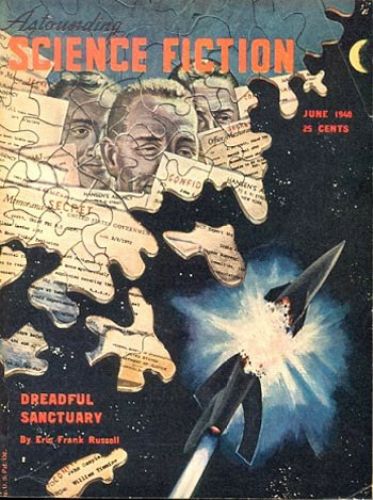
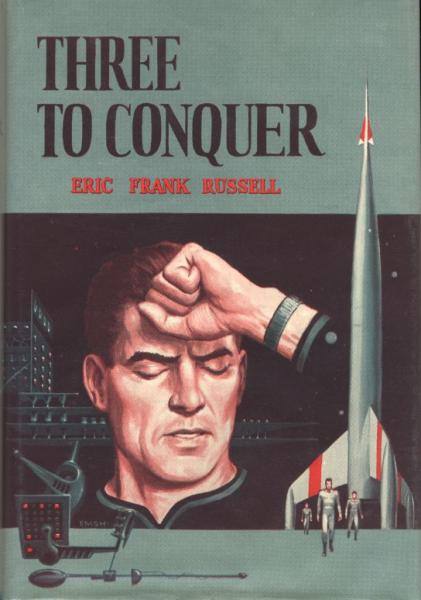
Birthday Review: Dreadful Sanctuary, Three to Conquer, and stories by Eric Frank Russell

Eric Frank Russell was a UK writer who was quite popular in SF from the appearance of his classic novel Sinister Barrier in Unknown in 1939 (supposedly one motivation for John Campbell starting that fantasy companion to Astounding was his desire to publish Sinister Barrier) until his retirement in 1965. He was born on January 6, 1905, and died in 1978. Here is a slightly belated birthday review, covering two of his novels that were Astounding serials, "Dreadful Sanctuary" and "Call Him Dead" aka Three to Conquer, and a couple of short stories as well.

Astounding, June, July, August 1948

(Cover by William Timmins)
Eric Frank Russell's "Dreadful Sanctuary" was serialized in Astounding in 1948. It's a surprisingly long book for a three-part serial: about 92,000 words. I read it in the serialized version, then a later, strangely revised, book version.

The story involves John Armstrong, an engineer and inventor involved with the 18th attempted moon shot. The previous 17 rockets have all blown up, mostly just as they were about to reach the moon. Armstrong decides that some organized opposition is sabotaging the rockets. One other scientist had similar ideas -- but when Armstrong talks to him he suddenly dies. Armstrong gets involved with the sister of this man, beautiful physicist Clair Mandle, and with her help, and that of a newspaperman and a PI, he starts to get close to the truth. He finds himself at a strange club, where he is kidnapped and asked "How do you know you are sane?" These guys tell him that Earth is a sort of prison planet, where all the insane people from the other planets (Mercury, Venus and Mars) are kept. These people are color coded (somewhat queasily): Mercurians are black, Venusians brown, the only native Earthmen are the "yellow" Asians, and Martians are white. (I think the rationale is closeness to the burning rays of the Sun.) But because of Earth's conditions, the other planets send all the nuts to Earth. However, some descendants of insane people might be sane -- and this club believes they can determine who the truly sane are. The insane need to be kept on Earth: hence the destruction of the spacecraft, at least until the "Nor-Mans" ("normal" or "sane" men) take over.

Our hero, however, is skeptical of the whole idea, as well as repelled, and he escapes, only to encounter another group of nuts ... Suffice it to say that the action and twists keep coming, and that Russell's resolution makes much more sense than the nuttiness I've outlined above. Still, it's not all that great a book -- a fun enough, fast enough read, but not really original enough in concept. It's also a bit marred by the attempt at American tough-guy banter, silly enough in itself, but further marred by the occasional Briticisms that EFR couldn't seem to keep out (though I think he got better at doing "American" later in his career).

Oddly, the book was reissued in revised form 1963 by Lancer Books. I also have that edition, and I took a quick look at it. It was cut somewhat, I think, but more strangely, the ending was completely changed. I'll put details at the end after the book cover pictures and a spoiler warning.*

Other Worlds, May 1950

This is a novelette by Eric Frank Russell, "Dear Devil", which is highly regarded in some quarters. It's OK, and original, but maybe a bit too implausible and a bit too overtly sentimental for my tastes. It concerns a Martian expedition sent to Earth shortly after a war has destroyed civilization. One Martian pushes to stay, by himself, on Earth to try to help the tattered remnants of humanity survive. He works to overcome instinctive revulsion, and over time influences the human children to create the beginnings of a new order, which in communion with the Martians may help the two peoples reach for the stars.

Astounding, January 1955

Eric Frank Russell's "Nothing New" is about humans visiting a planet suspected of having immortal residents. They find what seem to be rather long-lived people, but not very interesting people, then they leave. And we get a final twist revealing HOW long-lived the aliens are. I liked the story, though it is rather a trifle.

Astounding, August, September, October 1955

(Cover by Kelly Freas)
Eric Frank Russell was an Astounding regular, a British writer who adopted a rather American "voice" to sell to Campbell. Some of his novels remain fairly well-regarded, most notably perhaps Wasp, which I read some years ago when Del Rey reissued some of his best stuff. "Call Him Dead" is much less well known: it was serialized in Astounding in 1955, and published in book form the next year as Three to Conquer. It's about a secretly telepathic man who has on occasion used his abilities to help the police and the FBI solve crimes. One day he "hears" a man dying -- after going to try to help the man, a state trooper, unwillingly he again becomes involved in investigating a crime. It turns out that the criminals are something quite different -- for one thing, they can detect our hero when he "probes" their mind. The novel waits a while to reveal what they are, so I won't spoil it, but the working out of things isn't really terribly interesting. All in all it's pretty minor stuff. It winds up with a silly-ish coda about the telepathic man's loneliness -- and how it is resolved, an ending that is noticeably different from Poul Anderson's "Journeys End", which I imagine might have been written in direct response to this story.

(Cover by Ed Emswhiller)


(Cover by Ed Emshwiller)


SPOILERS for both versions of Dreadful Sanctuary follow:


In the original, Armstrong eventually learns that the "Nor-Men" are really nutters, albeit powerful and well-connected. They are Earth humans like everybody, but their leader has made them buy into this silly fantasy of being actually "sane" people from Mars. The hero and his friends discover the secret location of the 19th and 20th spaceships, and how they were to be sabotaged.  They gamble that they can fix the problems, or avoid them, and that when they reach the moon, that fait accompli will lead to the collapse of the "Nor-Man" club. Sinisterly, the "Nor-Men" are using their political power to try to start a World War, which will divert attention from space efforts -- but if Americans reach the moon, the War effort might collapse. Armstrong and a friend each take one spaceship -- Armstrong crashlands in the Pacific but is saved, and witnesses (in Clair's arms, we presume) his friend triumphantly reach the moon.

In the 1963 Lancer version, Armstrong continues into space while his friend crashes. The villains call him up, tell him that Clair and his other friends are in custody, and that his ship is damaged and won't be able to land on the moon. He goes hurtling into space, and his dying thoughts are "How do I know I'm sane?" Which is a neat last line, I have to admit.

Dave Langford claims that the Lancer editor pasted that unhappy ending on the book, and I suppose he might have had that direct from EFR. But I wouldn't be shocked if EFR had that idea himself, especially as he knew it would allow him a killer last line, but knew that the book would never sell to Campbell in that form.

Thursday, January 2, 2020

Birthday Review: Short Fiction of Isaac Asimov

Birthday Review: Short Fiction of Isaac Asimov

Today would have been (officially -- the actual day is unknown) Isaac Asimov's 100th birthday. In the past I have posted reviews of Asimov Ace Doubles -- but why not a collection of my looks at his short fiction? This is a decidedly skewed look -- it's based entirely on those stories I happened across over the last couple of decades in reading old issues of SF magazines, so it misses many of his best stories, including my clear favorite of all his stories, "The Dead Past". But it does cover a couple of his very worst stories, so there's that!

Astounding, June 1948

Notable in the June 1948 issue were Isaac Asimov's "No Connection!", about intelligent bears far in the future, and the horrible idea that the disgusting monkeys from across the planet could possibly be related to the noble primates who had previously inhabited the planet, but who had gone extinct. This may be my single favorite Asimov story from the 1940s.

Universe, December 1953

"Everest" is an Isaac Asimov short-short (1200 words) which is mildly famous for predicting that the summit of Everest would first be reached in 1952, which it was. However, for a story published in late 1953, that wasn't too terribly impressive. (He wrote the story before Hillary and co. climbed the mountain, of course.) The trick here is what the first man to get to the top would find -- not much of a surprise for an SF story.

F&SF, December 1955

"Dreaming is a Private Thing" is one of Asimov's better known stories, and, I think, one of his best. The new art here is dreaming -- creating dreams that can be recorded for other people to experience. The story doesn't really turn on plot -- it examines dreaming as art, and its affect on a couple of talented dreamers -- a young boy just showing the ability, and a highly admired professional. He also considerd pornographic dreams, and low quality dreams, and their commercial effects. It's a smart and believable story.

Super Science Fiction, December 1957

And finally, Isaac Asimov's "The Gentle Vultures" also concerns aliens who plan to dominate Earth -- they simply mean to wait out the Cold War until the inevitable nuclear holocaust occurs.  But the humans won't cooperate - won't start the war!  Again, I thought the central idea was too gimmicky, too much a setup.

Infinity, January 1958

"Lenny" is one of Asimov's later Robot stories, and one of his worst. It's about a robot that is (by an absurd mechanism) altered to remain perpetually a child. Being a child, it doesn't know its own strength, so injures someone, which could be a major PR issue. But Susan Calvin is determined to save Lenny ... and in the end comes up with a thoroughly unconvincing rationale to allow that. One of the main issues I have with the story is the violence it does to Calvin's well-established character -- this is Asimov at his most cloyingly sexist.

Super Science Fiction, April 1958

Isaac Asimov is here with "All the Troubles of the World", one of his Multivac stories, about a super-powerful computer. In this case the computer becomes neurotic after absorbing the knowledge of, well, all the troubles of the world.

Fantastic Universe, January 1959

At this stage of his career Isaac Asimov could be kind of annoying – he wrote some really slapdash stuff (in amongst some excellent work, to be sure). He had a deal with various editors of lower-end magazines whereby he would offer them a new story. If they wanted to pay the same rate the top-end magazines paid, they could have the story. If not, he'd send it to the top magazines, and if they took it fine. If not, Asimov would give the story to the lower-end magazine. I don't know if this deal applied with Fantastic Universe, but if it did, I'm fairly sure “Rain, Rain, Go Away” was a story they got at their rate, not Asimov's. (Actually Wikipedia says the idea for the story came from F&SF editor Robert P. Mills, but that he rejected it, not surprisingly.) It's about an odd family of “foreigners” who seem terribly afraid of rain. The neighbors insist on getting to know them better, including an outing on what seems a very nice day … but an unexpected rainstorm comes up. I won't give the ending away, but it's really trivial. Asimov at pretty much his worst.

Saturday, December 28, 2019

Birthday Review: The Sinful Ones/You're All Alone, by Fritz Leiber

Fritz Leiber was born on Christmas Eve in 1910. He died in 1992. He was named an SFWA Grand Master in 1982, and received Lifetime Achievement World Fantasy and Balrog awards as well. He also won six Hugos, two for Best Novel, two for Best Novella, and one for Best Short Story, plus a curious special award for "the use of SF in advertising". He's one of my favorite writers, so I I'm doing this belated birthday review of one of my favorites among his novels, The Sinful Ones, and its earlier version, "You're All Alone." The reviews are very brief capsules, I will add.

(Cover by Robert Gibson Jones)
The Sinful Ones had an odd publication history. It began as a novella called "You're All Alone", slated for John Campbell's fantasy companion to Astounding, Unknown. When the World War II paper shortage killed Unknown, Fritz Leiber had to abandon it. (At this time he had to take a defense job, too.) After the war he rewrote his original idea from scratch, first as a 40,000 word novel called "You're All Alone", which was published in Fantastic Adventures for July 1950. He expanded it by about 50% and this version ended up at a rather sleazy house, Universal, who added some "spicy" sex scenes, in a way that embarrassed Leiber. (They also hung the not awful but not as good as "You're All Alone" title of The Sinful Ones on it.) That edition was published in 1953 as an omnibus with another novel, about bullfighting, Blood, Bulls and Passion. (Not by Leiber.)

Finally, in 1980, Leiber had a chance to reprint the novel at Pocket Books, but he no longer had his original manuscript. So he worked from the published version, but rewrote the sex scenes. Which ended up being a good idea, I think. They're pretty good scenes (I think Leiber is a good writer of sex scenes), and there's no way the Leiber of 1953 would have written those scenes.


The Sinful Ones is a very good urban fantasy, from before there were urban fantasies. It's about a man in Chicgao, stuck in a rut, with his ambitious girlfriend pushing him to get a better job. One day he meets a strange, scared, young woman, Jane Gregg. Something about this encounter kicks him out of his rut, and he realizes in essence that he and only a few other people, including Jane, are truly "alive". As long as he is out of his "routine", nobody else perceives him. The novel is spooky, and sexy, and thought-provoking, and scary. It's a real good read, too, and the portrayal of Chicago is fun as well.  The eventual resolution is only OK, not great, but it hints at better things.

(Cover by Michael Whelan)
I read "You're All Alone" for comparison's sake. It's quite significantly different from The Sinful Ones. For the most part, the longer novel is superior, in my opinion, though some of that may be because I read it first. The basic story is the same, though: Carr Mackay discovers that almost everybody is an unconscious part of a machine: only a few people are capable of independent action. Most people use this power to play awful games with the unconscious people, but Carr is discovered by a young woman, Jane Gregg, who will not act like this, and tries to hide from the rival groups of evil awakened people. After resisting the true nature of the world for a while, Carr finally gives in, falls in love with Jane, and at the end finds himself in a desperate battle with the villains.

It's an intriguing premise (reminiscent, to me, of the movie Dark City, which I happened to see at about the same time as I first read The Sinful Ones). The conclusion in both cases is OK, but a bit abrupt, and in neither case is any larger issue resolved, beyond Carr and Jane's immediate danger. (Which may actually be the more honest approach.) But the longer novel does work things out much better, and has some decent sex scenes (added in 1980, actually, so it might not be fair to criticize "You're All Alone" for its lack of same), and in general Jane and Carr are both more fleshed out. (The edition I have of You're All Alone is an Ace paperback including the 40000 word short novel and two novelets: "Four Ghosts in Hamlet" and "The Creature from Cleveland Depths", both very well worth reading as well.)

Thursday, December 19, 2019

Old Bestseller: Lavender and Old Lace, by Myrtle Reed

Old Besteller: Lavender and Old Lace, by Myrtle Reed

a review by Rich Horton

Sometimes -- often! -- the life stories of the writers of these Old Bestsellers are more interesting, more lurid, than the stories in their novels. I've covered a couple of writers who were murdered in the past. Here's a writer who committed suicide at the age of 36, despite what seems to have been a fair amount of commercial success. To be sure, commercial success does not necessarily translate to personal happiness.

Myrtle Reed was born in 1874 in Chicago. Her father was a preacher and the editor of a literary magazine (the Lakeside Monthly), and her mother was a writer on theological subjects. Myrtle published juvenilia as early as the age of 10, and continued to write, though she showed signs of depression from early on, and did not attend college after a breakdown. Her first novel, Love Letters of a Musician (1899), went through at least 15 printings, and the book at hand, Lavender and Old Lace (1902) was also wildly successful. (My copy is a Grosset and Dunlap reprint from 1907.)

Reed married James McCullough, who worked in real estate, in 1906, after a courtship of some 15 years. Alas, the marriage does not seem to have been a success, and McCullough turned to drink, and spent considerable time away from home. Reed, long a user of Veronal, committed suicide in 1911. This quote, from her posthumous novel Threads of Gray and Gold, seems possibly only too personal: "The only way to test a man is to marry him. If you live, it's a mushroom. If you die, it's a toadstool."

(Incidentally, as Greg Feeley divined, this title was what Joseph Kesselring was riffing on when he gave his play Arsenic and Old Lace its title.)

So, what of this novel itself? I have to say, I found it kind of a mess. A promising mess, in that the established situation could have resulted in a pretty neat story. But the novel fumbles things badly.

It opens with 25 year old Ruth Thorne coming to her aunt's house by the sea for a few months of rest. She's had some sort of health breakdown, and needs to take a few months off her job as a women's issues reporter for a newspaper. (Her job is presumably in New York, and her Aunt's house must be in, perhaps, Connecticut? Never made clear.) Oddly, though, Ruth's aunt, Miss Jane Hathaway (whom she has never met) has gone overseas on a suddenly planned trip. Ruth meets the maid of all work, Hepsley, and settles in to a very languid life, her only duty a strange one: to light a lamp and leave it in the window of the attic every night.

Soon Ruth has explored the attic and found some curious hints of an interesting past for her aunt. A seafaring man seems to have been important. And a man named Charles Winfield is mentioned. Along with a notice of Mr. Winfield's marriage to another woman, and that woman's death. But Rose is a gentlewoman, and refuses to snoop further.

Soon she encounters an old, but perhaps estranged, friend of Miss Hathaway, a Miss Ainslie. Miss Ainslie obviously has her own secrets, and she is considered very odd by the rest of the village. But Ruth and Miss Ainslie quickly become very close friends. More complications arise from M iss Hathaway's maid Hepsley's extended courtship by a local yokel; and then by the appearance of a young man who also works on a newspaper, and who also is on a rest cure -- in his case, his eyes have failed him. This man has the intriguing name of Carl Winfield. Before long Ruth is reading the daily newspaper to Carl, and as the reader expects, they begin to become close ...

The resolution is prompted by the sudden return of Miss Hathaway, who is no longer Miss Hathaway, but instead Mrs. Ball. Mr. Ball is named James, and he seems not too happy about his perhaps forced marriage. It seems he is the mysterious man in Miss Hathaway's past, who maybe ran away to sea to escape her clutches. Then what of the mysterious Charles Winfield? And the light in the window? And Miss Ainslie's past, not to mention her unusual interest in young Carl Winfield?

I'm sure you can all guess the answers to these questions. Alas, they are revealed in a terribly anticlimactic fashion. So the novel really disappoints. But there are lots of interesting elements. Hepsley and her beau, for example, are sometimes amusing comic foils. So too is James Ball, and his relationship with his new wife, the former Miss Hathaway, is also played, fairly effectively, for laughs. And the whole story of the light in the window, and Miss Ainslie's secret, is reasonable scaffolding for a cool mystery. But for all that, Reed just doesn't make the whole mix work.

Wednesday, December 18, 2019

Birthday Review: Stories of Michael Moorcock

Today's birthday review is of one of the most significant figures in SF history, SFWA Grand Master Michael Moorcock. Moorcock, who turns 80 today, was a hugely important editor, the man who helmed New Worlds through the mid to late 1960s, the very apex of the New Wave. He was also (is also!) a major writer, with contributions to heroic fantasy, to science fiction, and to literary fiction.

My reactions to Moorcock have been wildly varied. I loved Behold the Man when I read it as a novella at age 14 or so in a Nebula volume. I adored the Dancers at the End of Time series. But I never got on at all with his Jerry Cornelius stories. I read a few Elric novels and my reaction was more or less "Meh". And I've run across a few stories over time that I just hated. I compare him to James Blish as one of the few writers who could be just terrible on occasion, and absolutely brilliant the next time out.

Below I offer a set of review of some of his stories, mostly less well-known. Some are from Locus reviews, and some are from much earlier. Some of the stories are weak, some are very good. And it all opens with, of all things, a look at a letter he wrote very early in his career!

Retro-Review of Fantastic, July 1962

The letter column was quite irregular in Fantastic, but it's present in the July issue, for something of a special occasion, perhaps. Michael Moorcock, then a very young writer (his first story, in collaboration with Barrington Bayley, appeared in New Worlds in 1959, and his first solo work in 1961 in Science Fantasy), had read comments about Mervyn Peake and his Gormenghast books in Fantastic earlier that year, and he wrote to mention that Peake (whom he knew well) was seriously ill and unlikely to write another Titus Groan Book. He commends the anthology Sometime, Never to the Fantastic readership (which included good stories by Peake, William Golding, and John Wyndham). He disputes reader Pat Scott's contention that the Gormenghast books were "Gothic" (a common characterization), and instead suggests Peake's writing, despite the grotesqueries and "purple prose", is more objective -- more like Shakespeare than Dylan Thomas. He compares Steerpike to Richard III. He laments the likelihood (which proved true) that Peake would write no more. He praises Fritz Leiber highly (much better, he suggests, than Dunsany). And he finds time to praise Fantastic in particular.

Retro-Review of Science Fiction Adventures, November 1962

The lead "Short Novel" is Michael Moorcock's "The Sundered Worlds", at 24,000 words. The blurb for "The Sundered Worlds" reads "Michael Moorcock, a rising young London author, has been making quite a name for himself in our bi-monthly companion Science Fantasy. With a developing flair for other-world descriptiveness, we prevailed upon him to try a long science fiction story -- with the following surprising result." (I assume Carnell meant to ascribe the "developing flair for other-world descriptiveness" to Moorcock, though a strict reading of that sentence would suggest it concerns the means Carnell himself used to convince Moorcock to try SF.) I haven't read any of Moorcock's earlier stories, those that made him a "rising young ... author". Certainly his later career bears out Carnell's belief in him. But "The Sundered Worlds" does not!

"The Sundered Worlds" is, to put it mildly, a mess. It begins like a low-grade imitation of A. Bertram Chandler, and sort of makes up stuff as it goes along to get worse, trending towards a transcendent ending that would have been OK if it had been set up better. I was reminded, besides Chandler, of the sort of wild pulp flights of imagination that I associate with a much earlier time -- John Boston suggests Planet Stories, but I was thinking of something earlier and less pure adventure oriented. All this could certainly be made to work, after a fashion, but it doesn't work here. The writing is downright poor (at the sentence level), the imagination is slapdash, the characterization is arbitrary (and sexist), and of course the scientific rationale is nonexistent.

The hero is Renark, a powerful Guide Senser, who meets with his friends Talfryn and Asquiol, the latter a disgraced nobleman, on the isolated Rim planet Migaa. From this planet the three plan to transition to the "Shifter", a curious planetary system that apparently traverse several universes in an extra-dimensional path. Renark apparently believes he must learn the secret of the Shifter System, for, it transpires, the Human universe has begun to contract, and humanity must find another universe to inhabit. The three men, along with a beautiful young woman Asquiol has taken up with, Willow, make their way to the Shifter. After fighting off an attack from hostile aliens, they find the world colonized by humans who have made it to the Shifter. There Renark must find a mad woman called Mary the Maze, who has visited the strange planet called Roth, or Ragged Ruth -- a planet that exists simultaneously in many dimensions. There Renark will meet aliens who will lead him to the ultimate secrets of the nature of the multiverse, and the possible destiny of humans, if they can evolve themselves sufficiently. Or something like that.

In description it doesn't sound hopeless. But in execution it is. I really suspect Moorcock didn't know where he was going as he wrote the story. I also think he was still learning to write -- the prose seems to improve as the story continues (or else I became acclimated to the style). What was going on? Andy Robertson suggests that Moorcock was cynically working out his hatred of SF, by writing a story so bad that it would demonstrate the emptiness of the genre. I have to doubt that was really his intention. At any rate, he demonstrated rather that it was possible to write a really bad SF story -- but I think we knew that already. John Boston suggests more of an attempt to recreate an old style of superscience story, with a dimension-transcending fate for humanity, etc. etc. This seems closer to the mark -- the problem being that by 1962 such a story needed a greater degree of writing skill and imagination than may have been necessary in, say, 1936.

It occurs to me that I have perhaps been harder on this story than I would be if the same thing was written by someone I had never heard of. This may well be -- I expect more from a celebrated writer like Moorcock, and thus I may be more critical when my expectations aren't met. And the Moorcock of 1962 may simply not have had the skills that he eventually developed.

There is a sequel, "The Blood Red Game", that appeared in the last issue of Science Fiction Adventures, #32. I'll be reviewing that in a day or two. The two stories combined were published as a novel, under each title at different times: The Sundered World and The Blood Red Game.

Retro-Review of Science Fiction Adventures, May 1963

(Cover by Gerard Quinn)
"The Blood Red Game" is a direct sequel to "The Sundered Worlds". The protagonist of "The Sundered Worlds", Lenark, went down with the ship -- or universe -- at the end of that story, so this time around the nominal hero is Asquiol. He leads an expedition of humans to another universe, where they encounter inexplicably hostile aliens. It turns out the aliens believe in resolving conflict via games, and they agree to play the "Blood Red Game" of the title with humans in lieu of direct war. But the humans, not surprisingly, are losing anyway -- the game, a sort of telepathic battle of intimidation, was invented by the aliens after all.

Luckily a rebellious man named Roffrey fled the earlier space battle out of a combination of cowardice and orneriness. He makes his way to the Sundered World of the previous story, and there meets Asquiol's one time lover Willow, and Asquiol and Lenark's former associate Talfryn. Roffrey also tracks down Mary the Maze, the madwoman from the previous story. She turns out (that is to say, Moorcock's conveniently makes it up on the spot) to be Roffrey's estranged wife. The four head back to the other universe and -- surprise -- they turn out to be fabulously good players of the Blood Red Game. Naturals, you might say. Well -- 20 some thousand words later, the aliens are vanquished, Mary is sane, Asquiol is a god more or less, and "The multiverse ... delighted them ..."


Review of Leviathan 3 (Locus, May 2002)

I was less impressed with Michael Moorcock's "The Camus Referendum", a Jerry Cornelius story, to do with future corporatism and war, which frankly reduced me to pretty much reading sentences without assigning them meaning. This happened to me with a similar Jerry Cornelius story in Interzone a couple years back. I can only conclude that I am out of sympathy with Moorcock's aims here. There is also a Moorcock novel excerpt, "The Vengeance of Rome, Chapter 3", which is nicely written but which reads like a novel excerpt and not like a complete story.

Locus, April 2004

One very intriguing debut publication is Argosy, a magazine launched at least somewhat in the tradition of the early 20th Century magazine of that name, in that it will feature a "catholic" array of stories -- stories from all genres. One bit of welcome news is that each issue will feature a separately bound novella. The novella for January-February 2004 is Michael Moorcock's "The Mystery of the Texas Twister". Metatemporal investigators Seaton Begg and Taffy Sinclair investigate a dastardly plot to start an unjust war, involving Texas politicians. I was a bit disappointed, as the action was downright silly without really being very funny.

Locus, November 2007

Interzone’s July-August issue is a Michael Moorcock special. It includes an interesting extract from a memoir of Mervyn Peake that Moorcock is working on, a Guest Editorial, an interview, a novel extract, and one new story, “The Affair of the Bassin les Hivers”, a very entertaining story of a murdered prostitute and time travel, featuring as usual for Moorcock members of his multiversal repeating cast, such as Una Persson.

Review of Solaris 2 (Locus, February 2008)

Michael Moorcock’s “Modem Times” is a wild mélange of incidents across his multiverse – these stories have never been to my taste (perhaps I need to have read more of Moorcock’s Jerry Cornelius stories to get them) – but I suspect this will appeal to devotees of the Cornelius branch of Moorcock’s storytelling. (For me, I’ll take more Seaton Begg and more Jherek Carnelian.)

Locus, June 2008

Another more traditional kind of weirdness is displayed in the long Elric story Michael Moorcock offers, “Black Petals” (Weird Tales, March-April). Elric is seeking a flower which blooms but once a century, and which he hopes will offer him a way to avoid using Stormbringer, the sword that when drawn must kill, and that he must use to sustain his life. He joins a party formed by a couple of sisters who wish to rescue their father, who was lost in the ruined city of Soom, where the flower blooms. It is reasonably conventional Sword and Sorcery – that is, conventional in the way the genre was redefined by the likes of Moorcock – and while it’s familiar stuff, it’s quite effective.

Locus, October 2010

There are plenty further excellent stories in Stories, for example Michael Moorcock’s novelette also called “Stories”, a roman à clef retelling the history of New Worlds as if it had been a mystery magazine instead of SF, and featuring thinly disguised versions of the likes of Tom Disch and J. G. Ballard.

Monday, December 16, 2019

Birthday Review: Stories of Randall Garrett

Randall Garrett would have turned 92 today. Last year I reviewed his Psi-Power trilogy with Laurence M. Janifer as by Mark Phillips, all serialized in Astounding, beginning with "That Sweet Little Old Lady". This year, a look at some of his short fiction, that I've covered in a number of my looks at old SF magazines.

Retro-Review of Space Science Fiction, May 1953

Garrett's "Instant of Decision" features an intelligence agent tracking down a saboteur who discovers a mysterious and invulnerable intruder. The agent recovers a device from the intruder which turns out to be instructions for students of a future Galactic Empire studying Ancient Earth. Was the intruder a time traveler? At the same time he is assigned to track down a spy from the "Eastern League", with the hopes of averting a nuclear war. But the spy gets away, and the agent follows ... leading to a tense confrontation and a rather ironic ending, Not a bad story, not a great one.

Retro-Review of Science Fiction Adventures, December 1956

The most amusing aspect of this magazine is the contents list. In particular, it includes one story by Robert Randall, who, as most know, was actually Chum Robert Silverberg in collaboration with Randall Garrett. It also includes a story by Calvin Knox and David Gordon. Well, Calvin Knox was Silverberg's nicely Protestant pseudonym, and David Gordon was a pseudonym for -- Randall Garrett! The Robert Randall story is "Secret of the Green Invaders", the Knox/Gordon story is "Battle for the Thousand Suns". There is also a story by Edmond Hamilton, "The Starcombers", and a short story by Harlan Ellison, "Hadj". So -- an all-star lineup -- though in 1956 Ellison's name surely wasn't that prominent, and "Robert Randall", "Calvin Knox", and "David Gordon" hardly had the clout that "Robert Silverberg" and "Randall Garrett" do in retrospect.

Robert Randall's "Secret of the Green Invaders" is a fairly cute story in the tradition of Eric Frank Russell and Christopher Anvil. Earth has been ruled by a series of alien overlords for about a millennium, after humans nearly destroyed the planet. Galactic politics have led to a confusing series of changes in the particular alien race that rules Earth, but for the past few years the green-skinned Khoomish have been in charge. Josslyun Carter is the leader of a small resistance group descended from the US Marines, but just as he is ready to launch a rebellion attempt, he is arrested. He expects death, but the Khoomish leader has other uses for him ... I daresay most readers will guess the ending twist fairly easily, but its still nicely enough done.

The other Silverberg/Garrett collaboration is rather more routine. In "Battle for the Thousand Suns" Dane Regan is the exiled son of the rightful King of Jillane, one star of the Empire of a Hundred Kings, which controls a thousand or so stars in a globular cluster. The kicker is that humans in this cluster have mutated so that certain males, who have become the nobility, can kill or injure non-nobles by thought. Dane returns to the cluster in disguise and becomes a successful member of the space navy, but attracting too much notice as an up-and-comer is dangerous, and he finds himself the target of duels and nefarious attempts at his life. So he disappears again and returns as a playboy, romancing the daughter of his hated rival, who is poised to become the new Emperor. The end of the story turns partly on a "tradition" pulled rather out of the authors' hat, and partly on a twist about the nature of the new Emperor that seems to in retrospect support the idea of this oppressive nobility ruling the Cluster. On the whole, a competently executed but very ordinary story.

Retro-Review of Imaginative Tales, July 1957

This issue features four stories by some combination of Randall Garrett and Robert Silverberg, who, as I recall, were working together at the time, producing reams of fiction for the likes of Hamling. They often collaborated, and they shared pseudonyms. These stories are "Devil's World", by Garrett alone, "Hot Trip for Venus", listed on the TOC as by "Ralph Burke", bylined Garrett above the story's text, and possibly by both Silverberg and Garrett, though Silverberg doesn't remember -- perhaps it was Garrett alone; "Pirates of the Void", as by "Ivar Jorgensen", in this case, says Silverberg, was written by Garrett alone (the "Jorgensen" pseudonym was actually Paul Fairman's, but Hamling thought it was a house name, and to Fairman's distress, he used to slap it on stories by the likes of Silverberg); and finally "The Assassin", by Silverberg alone.

They're mostly fairly weak, though I did like "The Assassin". This is about a man who invents a time machine in order to stop John Wilkes Booth from killing Lincoln. The way his effort (inevitably) fails is very logical. The other stories are all pretty formulaic adventure, and each is at least a twist short of real interest. "Pirates of the Void" is the best of these, I suppose, about a sort of maintenance tech on an artificial satellite who happens to be their when pirates arrive. He has to hide, then find a way (unarmed) to subdue the criminals. I thought he had it a bit too easy ... "Hot Trip for Venus" probably has a more interesting setup, as a space pilot discovers that the spaceship line's owner and son are running drugs to the primitive inhabitants of Venus. He plans to return to Venus and find proof -- but his pilot license is pulled, so he implausibly impersonates another pilot ... and then on Venus it's just a short jaunt into the woods and he runs across the bad guy. Again ... just too easy. Likewise "Devil's World", where a man sent to investigate suspected crime on Mercury is caught and forced to work on the sunside. Again, his eventual turning of the tables was just too easy. And, in all of these stories -- not that it matters, really -- the scientific notions are just silly.

Retro-Review of Infinity, January 1958

"Beyond Our Control" is Randall Garrett at close to his worst -- no trace of his wit, no particular interest to the conception. Yardgoods. It's about a communications satellite that suddenly goes off orbit. It's vital to restore it to the proper place, so after some terribly unconvincing discussions of how it might have had its orbit altered, a robot probe is sent up -- and they find something surprising -- an alien. As I said, really a weak story.

Retro-Review of Fantastic, January 1959

“The Price of Eggs”, by Randall Garrett, is fairly silly SF, not uncommon for Garrett, with a distinct sexual aspect, unusual perhaps in SF of that day.

It is set on a planet occupied by a very humanoid race, which therefore humans decide, magnanimously, not to terraform. They are trying to negotiate a deal for an anti-cancer drug (available from a local plant), when one of the diplomats gets himself involved with a local princess. The problem is, the local species, for all that they are very humanoid (and the women very pretty), are egg-layers. And not, obviously, interfertile with humans.

The man in question is forced to marry the princess he’s gotten involved with, and if he can’t ensure the succession in a fairly short time, well, he’ll be executed. (Because of course divorce is unthinkable for a royal woman.) A sharp young Lieutenant is given the job of extricating the foolish man, and he comes up with a (reasonably science-fictional) solution.

As I said, it’s kind of silly, and it goes on too long for its (negligible) substance, but it’s entertaining enough anyway. (As I have noted before, the title of the “King” of the alien species here is “Shann,” and Garrett doesn’t miss the opportunity to originate a horrible pun that Roger Zelazny repeated in Lord of Light.)

Retro-Review of Analog, July 1961

The opening novelette is Randall Garrett’s “A Spaceship Named McGuire” (15200 words). A troubleshooter is hired to solve two problems for Mr. Ravenhurst, a leading spaceship manufacturer. One problem is that his new model spaceship, controlled by an AI (named McGuire, rather tritely as an abbreviation for the model number), has a problem – the AI keeps going insane. The other problem is that his daughter is intractable, and needs a bodyguard to make sure she gets to finishing school.

That the two problems are related is not a surprise – alas, the rather sexist working out of things is not a surprise either. This story had promise for a while, but flattened horribly at the end.

Retro-Review of Fantastic, January 1962

“Hepcats of Venus” is the sort of thing Randall Garrett could (and often did) toss off fairly casually, or so it seems to me: mildly amusing, a bit topical (if in this case by the time of publication probably a tad out of date), not too concerned with plausibility either as to scientific details or plot. Lord and Lady Curvert are supposedly British aristocrats but in reality they are Galactic Observers, charged with protecting the nascent Earth society from themselves and from nasty extraterrestrials. They notice that a jazz trio is making a splash at the Venus Club in New York… and that the the instruments seem to be part of the players’ bodies. Of course this all turns out to be a dastardly plot by shapechanging aliens…

Retro-Review of F&SF, February 1966

"Witness for the Persecution" is a fast-moving story in which a businessman attempting to introduce anti-gravity, and hence cheap space travel, is targeted for assassination by the Powers That Be -- but a mysterious visitor saves him almost against his will. Enjoyable enough, if minor.