Friday, April 19, 2019

Birthday Review: Two Novels by Tom Purdom

Today is Tom Purdom's 83rd birthday. Purdom is one of my favorite lesser-known SF writers, mostly for his really impressive late short fiction, an outpouring of stories, mostly in Asimov's, that began in 1990 and has continued with little abatement for three decades. And I plan a review compilation (from Locus) later today. Before that, Purdom published some intriguing short fiction, beginning in 1957) and five shortish novels. He has written entertainingly about his career on his website.

I've already posted reviews of the three of his novels that appeared in Ace Doubles, including a post one year ago today! Here are reviews of his other two novels (not counting the fixup Romance on Four Worlds from 2005, which is essentially a collection of  his four "Casanova" stories from Asimov's.) These books appeared in 1971 and 1972.

Reduction in Arms, by Tom Purdom

a review by Rich Horton

Reduction in Arms is Tom Purdom's fourth novel, published in 1971. Its subject matter is rather interesting, somewhat dated in many ways -- very 70s, though with some resonance with today's "current events".

The story is told mainly from the viewpoint of Jerry Weinberg, a US weapons inspector working in the Soviet Union. It appears to be set in the mid-80s, at a guess. A strict arms-limitation treaty has just been signed, such that both countries (and China, Britain, France, and other nuclear powers) have agreed to allow regular and sometimes random inspections of any facility that may house weapons building or research. The problem is that "weapons research" might be done is a very small area, when you consider that weapons might include tailored viruses. And indeed, Weinberg is suddenly summoned to inspect a Russian psychiatric hospital, because the Americans have learned that a distinguished microbiologist has been undergoing "treatment" there for some time. The US has information that the man has been seen in a bar -- entirely inconsistent with his supposed mental illness.

When they get to the hospital, they are denied entry to certain floors, including the microbiologist's floor, on the grounds that experimental treatments on those floors are so rigorous that any disturbance will completely ruin things. Naturally the inspectors are suspicious, but protocol requires that they go through channels. Things are further complicated by factions in both the US and Russia which oppose the disarmament treaty, and which are itching for a "incident" which will make it politically necessary that it be abrogated. So Weinberg must balance several possibilities -- that this might be staged by the Russians to embarrass the US; that this might be staged by US hardliners -- or if not staged, that a minor infraction will be fanned into something more serious for political reasons by said hardliners; that the Russians really are trying to get away with something; that everything is innocent and the US will come out with egg on its face; or some combination of the above.

The ideas here are interesting and worth thinking about, but a lot ends up not very convincing. Purdom's ideas about the future of psychiatry, in this and even more in other novels (particularly The Barons of Behavior) are downright scary but also, I think, a bit unlikely. I also found the likelihood of such an arms control treaty as described rather low -- and the danger that it could be readily circumvented by an even better hidden remote lab higher than described. Also, the book rather drags -- it's very talky for about the first half, though the second half moves much more rapidly, with plenty of action. Still, not in my opinion one of Purdom's best efforts.

The Barons of Behavior, by Tom Purdom

a review by Rich Horton

The Barons of Behavior is an interesting book on several grounds. Purdom, as I have mentioned before, is an interesting author with an interesting career shape: he began selling SF in the late 50s, and published a dozen or so stories, and 5 novels, through the early 70s.

The Barons of Behevior, from 1972, was and remains his last novel. He published two more stories at long intervals until the 90s, when he returned to the field with a vengeance -- he has published dozens of stories since 1990, most in Asimov's, many absolutely first rate.

The first thing that strikes me about The Barons of Behavior is that it is very uncommercial. Its hero is hardly admirable -- or, if admirable in many ways, he is also not very likeable, and he is shown doing many bad things. The plot is resolved ambiguously, and long before the natural end of the action. The general theme is very scary, and the "good guys" are forced to use the tactics of the bad guys, and not in very nice ways.

The "hero" is Ralph Nicholson, a psychiatrist based in Philadelphia (I believe). The book is set in either 2001 or 2003. Nicholson is concerned about the tactics of Martin Boyd, the Congressman representing Windham County in New Jersey. Boyd is using psychological profiles of every resident of his district to control their reactions and voting. He has even arranged for neighborhoods to be adjusted so that only people of a given profile live in them.

Nicholson, and his boss, another politician, believe that the only way to stop Boyd is to get him out of Congress, and the only way that can happen is to arrange for someone else to get elected. But the only way they can counteract Boyd's psych work is to do the same -- choose a candidate and slant his message in a way that matches the psych profiles of voters.

But Boyd plays dirty -- he kidnaps Nicholson, using his bought-and-paid-for police force, and threatens to use a profile of Nicholson's wife to suborn her. Will Nicholson stay the course? Will Nicholson's chosen politician go along with the not precisely ethical actions urged on him, including staged incidents designed to make voters support a "citizens' patrol", organized by the candidate? Will Nicholson's wife stay faithful? Will all this effort even be enough?

Along the way we get something of a picture of Nicholson's character and history, and of the civic background of his time. Perhaps all this is a bit sketchy, but it's of some interest. Notably the sexual mores are loose and a bit weird seeming -- in particularly Nicholson's pursuit of his wife is very calculated, including carefully planned affairs with other women. All this ties into the psychological themes of the novel, of course.

For all the interesting ideas and considerable ambition, however, the book isn't quite successful. It really doesn't overcome its odd (presumably purposefully so) truncated structure and its unlikable characters. But I think the ambition and honest of the effort deserves admiration.


Thursday, April 18, 2019

Old Bestseller Review: The Story of Doctor Dolittle, by Hugh Lofting

Old Bestsellers: The Story of Doctor Dolittle, by Hugh Lofting

a review by Rich Horton

The first chapter book I ever owned was The Story of Doctor Dolittle, which my mother bought for me from some sort of children's book club in the late 1960s -- I assume I was 8 or 9. I loved it, and went straight to the library (Nichols Library (the REAL Nichols Library, not the bloodless replacement that you'll find there now) in Naperville, IL) to find the others. I read each of the books at least a dozen times, to the point that it was a (gentle) joke of my mother's, when I'd come back from the library with another Doctor Dolittle book (plus others, of course -- Danny Dunn, or Narnia, or Cowboy Sam, or whatever.) There were about a dozen books in all, the last three or so posthumous compilations of shorter pieces.

Hugh Lofting was born in 1886. The genesis of the Doctor Dolittle books was letters he wrote to his children from the trenches of World War I. He was injured in the War, and after it was over he and his family moved to Connecticut. The first book, the one at hand, The Story of Doctor Dolittle, was published in the US in 1920 -- it didn't appear in the UK until 1924. I never knew this -- I always assumed Lofting was purely English -- the books are so very English in tone. The second book in publication order (though I read them in internal chronology) was The Voyages of Doctor Dolittle, published in 1922. It won the Newbery Medal. It is, in my opinion (as of 1970 or so!) by far the best of the books. Lofting died in 1947.

There have been two prominent movies based on Doctor Dolittle -- the 1967 Rex Harrison feature, and the 1998 Eddie Murphy feature. The latter spawned three sequels (of which the last couple were direct-to-video.) Another movie, unrelated to these, is planned for release in 2020. None of the movies are terribly faithful to the books, though the Harrison movie does use some incidents from a few of the books, notably The Voyages of Doctor Dolittle and Doctor Dolittle in the Moon.

There is, of course, an elephant in the room regarding the Doctor Dolittle books, and that is their racist elements. And let's not paper that over -- they are real, and worst are pretty shocking. The most racist stuff is in fact in the first book, in particular a scene in which a black prince asks Doctor Dolittle to turn him white so he will be attractive to the woman he's entranced by (in fact, Sleeping Beauty.) The interesting thing is that that scene was completely (and somewhat clumsily) deleted from the edition I first read. I didn't know that until a couple years later when I checked the book out of the library in order to look at the original illustrations. 10 or 12 year old Rich Horton was, I assure you, no particular paragon of wokeness (I was a typical child of an affluent suburb in which opposition to racism was a given, but actual knowledge of real black people was pretty slim -- there was one black kid in my high school, for instance.) Even so, I was shocked even then reading those scenes, and for one of the very few times in my life I found myself approving censorship. The later books are much better to my eyes (others may disagree) -- the black characters are portrayed somewhat stereotypically (as are pretty much all the characters, if we're honest), but they are given more agency and are regarded sympathetically. Since the late 1980s, editions of the Doctor Dolittle books have been revised, alas sometimes clumsily, to attempt to remove the questionable elements. I still think the books are enjoyable, but I'd have to say tread carefully.

My impetus to reread the book was a book sale in my town, given by the owner of a fine local used
book store which I have patronized for decades, The Book House. They just lost the lease on half their shop, so they need to reduce stock a lot. The owner lives in my town (her daughter was in grade school with my kids), and she had a sale out of (I assume) her house -- and I found a rather battered copy of the 49th impression (from, I'd guess, the 1950s.) It includes the same Hugh Walpole introduction, originally for the Tenth Edition, that was also in the book club edition I had as a child. The illustrations are by Lofting himself.

So what happens in The Story of Doctor Dolittle? John Dolittle is a physician in a small English village, Puddleby-on-the-Marsh. He lives with his sister, but over time his financial incompetence, and his love of animals (so that many live in his house) cause his practice to founder. But he learns how to speak to the animals, and soon is a renowned veterinarian (renowned among animals, at least.) Before long his household consists primarily of a monkey, Chee-Chee; a dog, Jip; an owl, Too-Too; a duck, Dab-Dab; and a pig, Gub-Gub. Plus of course the sarcastic parrot Polynesia. Chee-Chee reports that his relatives in Africa have reported a terrible plague among the African monkeys, so Doctor Dolittle proposes to sail to Africa to try to cure them.

In Africa they encounter the King of the Jolliginki (whose son is the Prince mentioned above.) He distrusts white men because they have stolen his gold (he had a point, I thought), so he imprisons the Doctor, but Polynesia schemes to get him out. He escaped Jolliginki and reaches the land of the monkeys, and effects a cure. And then it's time to return to England.

The journey home is mainly menaced by the Barbary Pirates. But the help of a bunch of birds, plus the cleverness of Jip, allows them to escape and indeed rescue a boy and his uncle, who had been taken by the pirates. And then -- back home.

This story shows its origin -- as a series of letters -- and its author's inexperience. It's episodic, illogical, often silly. But of course it has its charming aspects. Still, reading it at 59 I didn't recapture the magic of 50 years ago. But I'm not the audience any more. That said, The Story of Doctor Dolittle was never my favorite of the books -- I have some hope that the later books retain the charm I so loved back then. But I'm not sure when I'll get a chance to read them.

Tuesday, April 16, 2019

Birthday Review: Take a Girl Like You, by Kingsley Amis

Birthday Review: Take a Girl Like You, by Kingsley Amis

a review by Rich Horton

Kingsley Amis was born 16 April 1922. He was one of the great comic novelists of the 20th Century, and also a long-time proponent of SF (and a writer of a number of SF novels and short stories.) In his memory, here's a review I wrote some time ago of one of his best novels.

Kingsley Amis opened his career with the novel that remained his most famous work to the end of his life: Lucky Jim. His next two novels were generally regarded as disappointments, at least relative to Lucky Jim. It is with his fourth novel, Take a Girl Like You, that Amis again hit his stride. This is as with almost all of Amis's works a comic novel, but much darker than Lucky Jim, with a cad for a leading man and a rather sad (morally) ending. (Spoilers will follow, but none that I think would interfere with a reader's enjoyment.)

The protagonist is Jenny Bunn, a 20 year old girl from the North of England who has come to a middle class town near London to be a schoolteacher. Jenny is an extremely beautiful woman, a bit naive, and brought up with fairly conventional notions of sexual morality. Which have been a bit of a burden to her since about the age of 14, when she noticed that all of a sudden she was constantly the object of not always welcome male attention.

Soon enough at her somewhat depressing boarding house she meets a very charming and handsome man named Patrick Standish. Patrick is breaking up with her fellow boarder, a somewhat ramshackle Frenchwoman named Anna Le Page. Patrick immediately notices Jenny, the way all men seem to, and not long after he has asked her on a date. Which is quite a lot of fun, until Patrick closes the evening by rather insistently trying to seduce her.

Patrick is a schoolteacher himself, at a private school for boys, and apparently rather good at his job. He has the same problems with his bosses that every Amis leading man seems to have: his headmaster is pleasant enough but ineffectual, and another teacher is a very nasty piece of work. But we slowly gather that Patrick is far from blameless: most egregiously, he is not trying very hard to resist the head's 16-year-old daughter's pathetic attempts to sleep with him. He also cruelly torments the clumsier and stupider people around him.

The novel portrays Patrick's courtship of Jenny, over roughly a year's period. This includes attempts to persuade her that her moral views are outdated, a long period of trying to be "not a bastard", failed attempts to resist having sex with other women he encounters while away from Jenny (the dates are a good thing, see, to prove to himself he really loves Jenny ... but he still has sex with the women) ... and finally an ultimatum to Jenny to sleep with him or end the relationship. When Jenny wavers, he breaks it off, then rapes her after she gets drunk. (It's what we now call date rape -- possibly at the time it would not have been regarded as rape, quite, though in no way does Amis seem to approve.) At the end Jenny is resigned that she will stick with Patrick -- she likes him too much, and she has no virginity left to protect. This is all rather dispiriting, though quite true to her character I think. As it happens, this is the only novel to which Amis wrote a sequel: Difficulties With Girls, a couple of decades later, in which Jenny and Patrick are married, but Patrick is still philandering. That book ends a bit happier, with Jenny gaining the ultimate upper hand in their relationship.

I think this is an excellent novel. The various characters are thoroughly believable to me, and a varied and odd lot. Amis's comic eye for dialogue, and internal dialogue, is sharp as ever. The novel is funny when it needs to be, and honest and sad when it needs to be.

Monday, April 15, 2019

In Memoriam, Gene Wolfe (1931-2019)

In Memoriam, Gene Wolfe

Gene Wolfe died yesterday, April 14, 2019 (Palm Sunday!) His loss strikes me hard, as hard as the death last year of Ursula K. Le Guin. Some while I ago I wrote that Gene Wolfe was the best writer the SF field has ever produced. Keeping in mind that comparisons of the very best writers are pointless -- each is brilliant in their own way -- I'd say that now I'd add Le Guin and John Crowley and make a trinity of great SF writers, but the point stands -- Wolfe's work was tremendous, deep, moving, intellectually and emotionally involving, ambiguous in the best of ways, such that rereading him is ever rewarding, always resolving previous questions while opening up new ones.

It must be said that for me Wolfe lived primarily through his fiction -- I can't really say I knew him, though I did meet him a few times, and I think (unless my memory betrays me) we shared a panel once at an SF convention. But we never spoke at length. I'll tell a couple of personal stories, though -- one of which isn't really mine.

This first story concerns his magnificent early novel The Fifth Head of Cerberus (curiously, originally published as "Three Novellas by Gene Wolfe".) I worked at Waldenbooks in 1976-1977, and I ran the SF section. My manager loved SF too, and she insisted we stock The Fifth Head of Cerberus, even though it was well past its sell-by date (it first appeared in 1972.) I certainly didn't complain -- but she told me a story. At her previous store, at the Woodfield Mall in Schaumburg, IL, she had kept the book on the shelves past when it would normally have been stripped and returned. And one day she saw a somewhat chubby middle-aged man looking at the book, with an expression of gratitude. This was Gene Wolfe, who then lived in Barrington, not far from Woodfield Mall.

My slightly more personal story concerns the first time I met Wolfe -- at an autograph table at Archon, the St. Louis area SF convention. I asked him to sign a copy of one of my first anthologies, Fantasy: The Best of the Year 2006 Edition, which included his story "Comber". He happily complied, then asked, with a certain sharpness (feigned, I think!) "Why didn't you put my story "Memorare" in the new book?" I didn't have an answer (though, really, "Memorare" is pretty long, and it wasn't easy for me to fit novellas in those first, slimmer, books.) I did reprint his story "Bloodsport" in my 2011 book.

The stories, though. The stories. He's best known, I suppose, for his novels, specifically the four volume Book of the New Sun, which completely wowed me when it appeared between 1980 and 1983. I remember voting book one, The Shadow of the Torturer, first in a poll run by the Champaign Urbana Science Fiction Association for Best SF Novel of all time, presumably in 1981 (after all, that's when I graduated from the University of Illinois.) The rest of his so-called "Solar Cycle" is also exceptional -- The Urth of the New Sun, and two more series, the tetralogy The Book of the Long Sun and the trilogy The Book of the Short Sun. There were a few short stories in that series as well, and one of them, "Empires of Foliage and Flower", is truly remarkable.

Other novels are unmissable as well. My personal favorites include the very early Peace, The Fifth Head of Cerberus of course, and the fairly late novel The Sorcerer's House.

Likewise he was wonderful at shorter lengths. Among the short stories I truly loved "La Befana", "The Other Dead Man", "The Island of Doctor Death and Other Stories", "How the Whip Came Back", "How I Lost the Second World War and Helped Turn Back the German Invasion", "When I Was Ming the Merciless", "Straw", "The Rubber Bend", "The Marvelous Brass Chessplaying Automaton", "Suzanne Delage", "The War Beneath the Tree", and "All the Hues of Hell".

But, then -- there are the novellas. SF is home to many fantastic writers of novellas -- Ursula K. Le Guin, Damon Knight, and Kim Stanley Robinson come immediately to mind. But nobody matches Gene Wolfe. I'll just list them -- the three from The Fifth Head of Cerberus first ("The Fifth Head of Cerberus", "'A Story', by John V. Marsch", and "V.R.T."). Plus "Forlesen", "Seven Americen Nights", "The Eyeflash Miracles", "Silhouette", "Tracking Song", "The Death of Doctor Island", "The Ziggurat", "Golden City Far", "Memorare". I mean -- what a list, what an incredible list of fabulous stories.

I feel that I'm not getting to the heart of what made Gene Wolfe so great. For some of that, you just need to read him. But -- what was he about? Part of it was playfulness. Simple things, like his collection The Castle of the Otter, named after a Locus misunderstanding of the title of the fourth Book of the New Sun novel (The Citadel of the Autarch.) Or like his "Island Doctor" stories: "The Island of Doctor Death and Other Stories", "The Death of Doctor Island", "The Doctor of Death Island", "Death of the Island Doctor". Or the secret of the name of the family in The Fifth Head of Cerberus (and the cute nod to Vernor Vinge in that passage.) All that is fun -- sometimes serious fun, but fun. But what was he really after? Virtue. Identity. Truth. The slippery nature of truth. So -- the shapechangers in The Fifth Head of Cerberus. The various Silks in the Long Sun and Short Sun books. The secret of the life of Alden Weer in Peace. The quest of Able in The Wizard Knight.

I'll leave with a quote -- thanks to John Kessel for this -- from the end of "Forlesen", one of Wolfe's greatest, and least appreciated, novellas: The main character, having died, asks:

"I want to know if it's meant anything . . . if what I suffered -- if it's been worth it."

"No," the little man said. "Yes. No. Yes. Yes. No. Yes. Yes. Maybe."

Birthday Review: The Stepsister Scheme, by Jim C. Hines

Birthday Review: The Stepsister Scheme, by Jim C. Hines

Today is Jim C. Hines' birthday. And in his honor, here's a short review I did for my previous blog some time ago, of his novel The Stepsister Scheme. (I reviewed its sequel, The Mermaid's Madness, at Fantasy Magazine, as well.)

Jim C. Hines's The Stepsister Scheme is the first in his new series concerning the adventures of Cinderella, Snow White, and Sleeping Beauty. The lead character is Cinderella -- Danielle Whiteshore -- who is adjusting to her new "happily-ever-after". She really is in love with her Prince (which turns out not to be the case for Snow White or Sleeping Beauty), and is pretty content, when all of a sudden one of her stepsisters shows up and tries to assassinate her. Her stepsister, the prettier and stupider of the pair, has learned some magic, but with the help of a handmaid who turns out to be Talia, also known as Sleeping Beauty, and also with the help of Danielle's animal friends, the assassination attempt fails. But her stepsister gets away.

Danielle quickly learns that her mother-in-law has secretly taken in Snow White and Talia (aka Sleeping Beauty) after the two fled intolerable home situations. (Snow White is wanted for the murder (in self-defense of course) of her evil stepmother -- her "Prince" turned out to be no help, and her true lover was the huntsman who saved her life. Talia, on the other hand, resents the fairies who gave her the gifts -- and the curse -- and she hates the "Prince" who wakened her by raping her while she slept and making her pregnant -- she only woke because of the pain of childbirth.) The two young women act as spies for the Queen. Snow White is magical adept, and Talia a martial arts adept. Now, it seems, Danielle's husband, the Prince, has been kidnapped by Cinderella's stepsisters and taken to Faerytown. The three young women go on a mission, where their three complementary talents (Snow's magic, Talia's weapons skills, and Danielle's ability to talk to animals, plus her innate niceness) all combine to, after much difficulty, uncover the nature of the stepsisters' plot, and the nature of their allies.

On the surface it seems it might be a romp. And there are aspects of the romp to it -- a fair amount of light jokes, some fun playing with the details of the "true stories" behind the fairy tales. But there's a lot of serious intent, and dark details, behind everything, as the details I mention above about the true stories of Snow White and Sleeping Beauty might indicate. The characters of the three princesses are well-portrayed, and each is quite different to the others. The plot involves real pain, some moral ambiguity, and a less than easy resolution. But it's never dreary -- it's a fun and adventure-filled story to read. Good work. I'm reading the second one, The Mermaid's Madness, now -- which adds the Little Mermaid to the mix. (Presumably the third book, Red Hood's Revenge, will bring in Little Red Riding Hood.)

Sunday, April 14, 2019

Birthday Review: Short Fiction of Rachel Swirsky

Today is Rachel Swirsky's birthday. In the last decade or so, Rachel has produced some of the most exciting, thoughtful, and original fiction in our field. Here's a selection of my Locus reviews of her short fiction:

Locus, August 2007

The June Interzone features an original feminist parable from Rachel Swirsky, “Heartstrung”. The arresting central idea has girls removing their hearts and sewing them to their sleeves as they pass to adulthood – and in the process (differently than the figure of speech “heart on one's sleeve” implies) become distanced from their emotions.

Locus, February 2008

At Electric Velocipede for Fall  ... Rachel Swirsky has really made a splash with her first few stories, and “How the World Became Quiet: A Post-Human Creation Myth” is another strong outing. It is a story of the far future, when the trees unite to eliminate humanity – though humans change in unexpected ways.

Locus, June 2008

Rachel Swirsky is a very exciting new writer, and at the March-April Weird Tales she offers another of her short, intense, stories – and each I’ve seen from her has been unique. “Detours on the Way to Nothing” is a very odd account of a strange sort of creature arranging an encounter with a man. Everything about her is odd: feathered hair, voluntarily removed tongue, mysterious sudden appearance – but “her” story, or lack thereof, is the philosophical center of this piece. One of those stories I’m not sure I understood at all, but that still fascinated. Which is a specific kind of “weird”, and one that seems definitely a goal of new editor Ann VanderMeer.

Locus, September 2008

In June’s Fantasy Magazine ... Rachel Swirsky is as ever interesting, and as ever original, and as ever trying a different tone, as she too looks at a human woman marrying a god. But “Marrying the Sun” is not dark, but an amusing and deadpan look at the problems of a relationship with the Sun – things like your wedding dress going up in flames.

Locus, June 2009

At Tor.com in April one oustanding piece is Rachel Swirsky’s “Eros, Philia, Agape” (March), which retells an old tale: an intelligent robot (here created to be a lover for a rich woman) yearns to be free. Where the story shines is the sort of freedom he craves – Swirsky depicts the protagonist magnificently, convincingly a created intelligence, and yet his own person, and yet not a human, exactly.

Locus, January 2010

If Baen’s Universe is closing, another publisher-associated site, though with a quite different structure and business model, seems to be doing quite well. Tor.com continues to feature excellent work, including in November an atmospherically sad Rachel Swirsky story, “A Memory of Wind”, which tells the story of the sacrifice of Iphigenia from her point of view.

Swirsky is also impressive at much shorter length at Beneath Ceaseless Skies for October 22. “Great Golden Wings” is a lovely little story, very simply told – a “cinematographist” trying to get financing for his invention against the resistance of people like magicians – who think movies might be competition for their illusions – is showing his early film (of dragons) at court. One court lady is enchanted – others merely hope to gain social points. I liked the introduction of a technologist into a fairly standard-seeming fantasy world, and I liked the depiction of the wonder felt by Lady Percivalia, and her trapped characterization.

Locus, September 2010

Rachel Swirsky has also not published a novel, and I don’t know of any forthcoming. But her short fiction continues to excite readers, and indeed two separate novelettes from 2009 ended up on award ballots (“The Memory of Wind” for the Nebula, and “Eros, Philia, Agape” for the Hugo). Through the Drowsy Dark is a strong mix of fiction and poetry. Several of the stories are new to this volume, and are well-done – but not SF or Fantasy. The story unfamiliar to me that most impressed me may be unfamiliar to many readers: “The Debt of the Innocents” first appeared in the 2007 UK anthology Glorifying Terrorism. It’s strong SF, positing a future in which energy shortages doom many poor babies to unnecessary deaths because of lack of incubators. The viewpoint character is a nurse who joins a terrorist movement to resist this. The story doesn’t really insist on taking a side, though it presents its arguments in a curiously asymmetric fashion. The effect in the end is quite powerful.

Locus, November 2010

Rachel Swirsky contributes a novella to Subterranean Magazine’s Summer Issue, their “Special Novella Issue”. “The Lady Who Plucked Red Flowers beneath the Queen’s Window” is, as far as I can recall, her longest published story (and longest title!). It does show signs of structural strain: it has a decidedly episodic structure, a common solution, I think, used by writers extending to greater lengths than they are used to. But it still works. The title character, Naeva, is a loyal servant (and lover) to her Queen, but she is killed in the Queen’s service. However she is preserved as a spirit, to be brought back magically to give advice, at first to her Queen, but eventually to future – even very far future – generations. This is a bitter pill for Naeva to swallow, not least because of what she learns about her Queen. It becomes still bitterer as the future changes, and as her culture is forgotten, and she must put up with such abominations as cultures in which men have status, and indeed in which women love men. The story slingshots farther and farther into the future, lightly touching on a variety of fantastical (and even rather SFnal) cultures, and touches at transcendence by the end. Excellent work.

Locus, May 2011

In Eclipse 4, I really liked Rachel Swirsky’s “Fields of Gold”, about a young man who finds himself in a strange afterlife, complete with famous people, and a few people he knows. He quickly gathers that one of the people there is his estranged wife, who may have murdered him, but perhaps more important to him is his cousin and childhood best friend. The story is part about why and how he died, and why and how he more or less wasted his life; but it’s also about what really made him happy, and the ending is quite moving and ambiguously hopeful.

Review of Life on Mars (Locus, May 2011)

Rachel Swirsky’s “The Taste of Promises” is a again about a kid putting himself in extreme danger. Tiro runs away from his Martian city with his brother – who we quickly learn has been uploaded due to a disease – and ends up at another city. He hopes to find a way to get his brother a body, but he must learn to understand what his brother might really want. And deal with pirates, too.

Locus, November 2013

Finally, there's a new horror magazine out, The Dark, edited by Jack Fisher and Sean Wallace. The first issue features four well-written stories, all by women, the best and strangest of which is Rachel Swirsky's “What Lies at the Edge of a Petal is Love”, which is more “weird” than “horror”, about a man who finds his wife (and children) becoming plants.

Locus, October 2014

In the Summer Subterranean, Rachel Swirsky's “Grand Jeté (The Great Leap)” is perhaps her longest story yet, and very good, about Mara, a girl dying of cancer, and her reactions (and her father's, and her replacement, called Ruth) to her father's making an android version of her, into which her personality is downloaded. Seems creepy, but by the end the story – and the characters – come to terms with this. It's a powerful story of character, interleaving Jewish themes (the golem, Jewish festivals and prayers, the Holocaust) with the ballet (Mara's mother was a ballet dancer, and the story alludes strongly to Coppélia), and with science fiction and AI and identity.

Locus, February 2016

The best fantasy in the December Lightspeed is a playful take on Alice in Wonderland by Rachel Swirsky, “Tea Time”, about the March Hare and the Mad Hatter, lovers in a time-stopped Wonderland. The main interest in this case is the extended and effective prosodic whimsy.

Locus, April 2016

Also interesting in the February Clarkesworld is “Between Dragons and Their Wrath” by An Owomoyela and Rachel Swirsky, told by Domei, a 14-year-old in a war-torn land, gathering dragon scales despite the danger of uncontrolled changes. Change – forced and unforced, and otherness, and of course the detritus of war is central to this moving story.

Friday, April 12, 2019

Birthday Review: Mister Boots, by Carol Emshwiller

Mister Boots, by Carol Emshwiller

a review by Rich Horton

Carol Emshwiller died two months ago, just short of her 98th birthday, which would have come today. She is one of the key, yet underrated, figures in SF over the last several decades. (Underrated because she was not terribly prolific, and because so much of her work was short fiction, as well as because she had a very individual voice.) I wrote about her short fiction at the time of her death, here: In Memoriam, Carol Emshwiller. So, today, on her birthday, here's my rather brief review from back in 2006 or so of her novel Mister Boots.

Mister Boots is a YA novel from Carol Emshwiller, published in 2005. Emshwiller's late in life flowering continues to be one of the remarkable stories of recent SF. (Not that she hasn't been a brilliant writer from the late 50s -- but she has never been so prolific as in the last few years, and she is as good or better a writer as she has ever been, even in her 80s.)

This book is about a girl named Bobby Lassiter, who has just turned 10 as we meet her. She is living in the California desert with her mother and her 20 year old sister. The depression is just around the corner, but this family knows poverty just fine -- they barely scrape by on the proceeds of the older women's knitting. The father, who was evidently terribly abusive (physically -- whippings of all three -- not sexually) left them when Bobby was very young. Bobby (full name Roberta) is apparently called Bobby because the father wanted a boy -- and, indeed, no one but her sister and mother knows she's a girl.

She meets a man on their property one night, who tells her he is really a horse, named Mister Boots. He too has been abused by his human owners. Bobby feeds and clothes him, and eventually takes him home. Events follow quickly from their. The mother dies. Mister Boots and the older girl, Jocelyn, fall in love. Their father, Robert Lassiter, returns and the abuse begins again. He wants Bobby to become a magician, just like him -- and she finds she is good at that, and wants to do it. They head to LA (Bobby dressed as a boy -- which her father still thinks she is), and become a successful magic act, despite Mister Boots's refusal to turn into a horse onstage. Bobby makes her first ever friendship with a girl her age: a similarly bereft Mexican girl named Rosie whom she meets in a sort of hobo camp. They meet their father's long time mistress -- or is she really his wife, and are they illegitimate? But then the Depression hits, and the money dries up, and things get worse and worse, until a final revelation and a final horrible act.

It's a charming and hopeful story in one sense, with a delightful narrator in Bobby. (Yet a real seeming narrator -- not a prodigy, for instance, and far from a perfect person.) Yet it is also quite dark -- the depression, the abuse, and a somewhat tragic denouement. Which I think means it's really pretty much like real life. A very fine little novel.

Birthday Ace Double: Lord of the Green Planet, by Emil Petaja/Five Against Arlane, by Tom Purdom

Ace Double Reviews, 29: Five Against Arlane, by Tom Purdom/Lord of the Green Planet, by Emil Petaja (#H-22, 1967, $0.60)

by Rich Horton

Today would have been Emil Petaja's 104th birthday. I've already posted other Ace Double reviews about Petaja, and about Tom Purdom, so I won't go into biographical details here, but just get on with the review, as I wrote it about 15 years ago.

(Covers by Kelly Freas and Jack Gaughan)
A fairly obscure Ace Double this time. I read it mainly because I'm planning to read all of Tom Purdom's novels. And I figured I ought to give Emil Petaja another chance. Five Against Arlane is Purdom's third novel, and his third and last Ace Double. It's about 48,000 words long. Lord of the Green Planet is about 41,000 words long. It's one of 8 Ace Doubles by Petaja, and it's the first of a pair of linked novels, the other being Doom of the Green Planet (1968).

As I've mentioned before, Tom Purdom has had a rather bifurcated SF career -- he published a passel of stories and five novels between the late 50s and early 70s, then was all but silent for almost two decades before returning with an extremely impressive array of recent stories. His previous two novels, The Tree Lord of Imeten and I Want the Stars, were both interesting stories, not entirely successful but worth reading. Much the same can be said of Five Against Arlane.

The story opens in medias res as Migel Lassamba kidnaps a couple of people at gunpoint, desperate to get a heart to transplant into his lover. Interesting perhaps, but there must be more going on than that? And we soon gather that Migel and his lover are part of a group of five people trying to unseat the ruler of Arlane, David Jammet. Eventually we learn that Jammet is an idealist who believes that humans are essentially evil, and that he is trying to breed a better race. In the interim, he uses mind control devices to keep the population in line.

Migel is successful in gaining the heart, but at the disastrous cost of one of his group's high-tech patrol cars (flying cars with armor and heavy guns, basically). His group returns to their sort of guerilla war against Jammet's forces. The other theme of the book comes forth -- in this future people have extremely extended lifespans, and as such are extremely risk-averse. Their battles are presented as computer controlled events, where action is taken only with 20-1 or better odds of survival. Inevitably, in the crisis Migel has to decide to defy those odds.

I found the book very exciting, very fast moving. I freely admit that the mind-control villain pushes my buttons pretty forthrightly. Purdom also introduces plenty of moral ambiguity, as the good guys are forced to kill a lot of innocents, while the villain is given at least a hint of a high moral purpose, however perverted in action. And the ending is very mixed -- good people die, the hero's success is tainted, the villain's failure is not complete -- all quite interestingly done. It should be added that the general machinations of the plot aren't terribly convincing, and the five against a planet battle, while given some rationale for potential success, still seems a bit preposterous. Certainly not a great book, but a book that uses the conventions of the form to pretty good effect.

I didn't much like the previous Emil Petaja book I read, Seed of the Dreamers. I hoped that that was a low point, and maybe it was. Lord of the Green Planet is not a very good book, but it's rather better than Seed of the Dreamers, and in particular it's a more involving book to read.

It's set some 1200 years in the future. Human colonies extend all the way to the Magellanic Clouds, and Diarmid Patrick O'Dowd is exploring one of the Clouds when he runs afoul of a mysterious green web in space. He finds himself marooned on a pleasant planet, and soon threatened with death by a thuggish Lord named Flann. Diarmid's life is saved by Flann's beautiful red-haired green-eyed fiancée Fianna, who arranges for him to be deposited with a sympathetic member of the planet's indigenous race.

Diarmid soon gathers that this planet is controlled by a creature called the Deel, who seems obsessed with maintaining a social structure consistent with the songs and stories of old Ireland. Flann is a cruel sadist, and very bad to his subjects, and Fianna hates him, but the Deel has decreed they must marry. Diarmid is already in love with Fianna, and agrees to work against Flann and the Deel, which must start with recovering the mysterious Talisman he carried when he arrived -- a high tech device to enable him to analyze the situation on the one hand -- on the other hand consistent with the legends about a hero from the skies who will save the people of the Green Planet.

And so it continues, Diarmid valiantly retrieving the talisman from quasi-mythical beasts, with the help of other quasi-mythical beasts like silkies; and fighting Flann for the love of the lovely Fianna; and eventually confronting the Deel in his home: T'yeer-Na-N-Oge. All this is given a quasi-plausible Science Fictional rationale. It's not all that good -- not as good as Five Against Arlane, to my mind -- indeed not very good at all. But I will say that it's a lot better than the last Petaja book I read, and that I read it through swiftly, without much of a struggle. Not high praise -- but all the praise I have.

Thursday, April 11, 2019

Birthday Review: Sabre Tooth, by Peter O'Donnell

Birthday Review: Sabre Tooth, by Peter O'Donnell

Today  is the anniversary of the birth of Peter O'Donnell (1920-2010), author of the Modesty Blaise comics and novels. Here's a review of one of his Modesty Blaise books. I also reviewed his romance novel Stormswift, written as by "Madeleine Brent", some while ago.

I read a Modesty Blaise novel by Peter O'Donnell several years ago, indeed I think it was the first novel (though I understand the whole series began as a comic strip): Modesty Blaise.  I enjoyed it, but hadn't encountered another one.  Last fall at Archon Glen Cook had some used editions, so I bought a copy of Sabre Tooth, which seems to be early in the series.  I just now read it.

The books are fairly clearly written to fit the James Bond spy thriller genre, with the key difference that the hero is a woman, Modesty Blaise.  Also unlike Bond, she's a former criminal, and she's only unofficially attached to British intelligence.   But such aspects of the series as love of neat gadgets, sex, and a certain romantic view of intelligence work, especially British intelligence work, definitely recall the Ian Fleming books. 

Modesty's backstory is that as a child (she was perhaps born in Greece) she was orphaned and forced to walk thousands of miles to survive, along the way encountering hunger and rape and learning to rely totally on herself.  While still a teen she founded an international crime organization called "The Network", and later she rescued a brilliant criminal from a Thai jail, Willie Garvin, and brought him back to psychological health.  At the time of the books, Modesty is somewhere in her late 20s, and Willie a few years older. They have retired from crime with a fortune.  They remain a dedicated two-person team, and Modesty loves Willie, while Willie worships Modesty (whom he calls Princess).  In neither case is the love sexual at all, however.  Both are brilliant athletes and martial artists, Modesty is the better with firearms, Willie with knives, Modesty the better schemer, Willie the genius tinkerer.  Though they are portrayed very well, they are clearly "superheroes", not realistic.  But that's OK.

The other main recurring character seems to be Sir Gerald Tarrant, an obscure British bureaucrat who actually heads a certain branch of UK intelligence.  Tarrant is able to get Modesty and Willie to assist him, partly by being a friend, and honest, and partly by offering challenging work. In this book a mercenary team is being assembled in a remote valley in the Hindu Kush.  The team is run by a merciless leader called Karz, and we are introduced to several of his conscience-deprived deputies, most notably a pair of Siamese Twins, called "The Twins", who are formidable fighters as a team, but who hate each other when they are not fighting.  (This too echoes Fleming: the mastermind with his brutal henchman).  Tarrant gets wind of a possible plot to take over Kuwait, to loot the oil money.  He doesn't know who's doing it, but he does notice that a lot of well-known mercenaries have disappeared, so he assumes they are being assembled into an army.  He intuits that the army will need leaders, who are very rare, so he manages to convince Modesty and Willie to feign a desire to get back into the "business", as their capabilities are so well-known that they will surely be approached. They do so, but they miscalculate the types of persuasion Karz will be able to use on them, and they find themselves in a situation where they have a terrible choice: they may have to actually go through with Karz' plans.

It's terrifically exciting stuff.  Thoroughly unrealistic, in character, technology, and in the over-the-top villainy and pride of the bad guys which of course contributes to their ultimate failure. (I hope no one thinks that a spoiler!)  But that's all part of the genre -- and this is a wonderful example of the genre.  I was gripped from the start, and there are numerous delightful scenes, and some real tension.

(One thing I noticed was how much time O'Donnell spent describing clothes, especially Modesty's.  This is something eluki bes shahar was discussing a couple of years ago, in relationship to romance fiction. Spy stories are supposed to focus on gadgets (and this does that too), but the clothes description was striking to me.)

Birthday Review: Stories of James Patrick Kelly

Today is Jim Kelly's birthday. He's been writing exceptional SF for over four decades, I am shocked to realize. I remember encountering him with his first novel, Planet of Whispers, and the next year with a collaboration with John Kessel, Freedom Beach. Both were intriguing, but it was "Rat", from 1986, that blew me out of the water. One of the best "cyberpunk"-style stories, from a writer who had made his bones on the so-called "Humanist" side of that now all but forgotten quasi-rivalry. Here's a selection of my reviews of his stories for Locus, which represents less than half his career -- but a career still clicking along with exceptional work.

Locus, June 2002

June brings another first-rate issue of Asimov's. As with every June for the past nineteen years, James Patrick Kelly is aboard, this time with "Luck", something of a departure for him. It's the story of Thumb, a man of a prehistoric tribe (Cro-Magnon, I assume), and of his encounter with the last mammoth.

Locus, December 2002

Gardner Dozois generally looks for seasonal-themed stories for the December and/or January issues of Asimov's. This December there are two, and both are quite good. James Patrick Kelly's "Candy Art" is about a woman whose parents come to visit for Christmas – by downloading themselves into a puppet and sharing the time half and half. Meanwhile her commitment-phobic never seems to be home. On the surface this seems a typically sweet piece, reminiscent, say, of Connie Willis in her Christmas mode. But look much deeper and the story is a bit odder – what are we to make of the example of the woman's parents' marriage, in which they occupy the same body such that they literally cannot meet? And what of the somewhat drab relationship of the leads? The story urges us to be happy and hope, yet asks us: why?

Locus, June 2003

James Patrick Kelly's "Bernardo's House" (Asimov's, June) is a fine story as well, about an intelligent "house" (complete with an android "housekeeper"/sex toy) who has been abandoned by her owner. The story echoes a theme of Tom Purdom's story in the same issue ("The Path of the Transgressor"), in considering the house's conditioning to love its owner. This conditioning is tested by the abandonment, and by a homeless young woman who turns up on the house's doorstep.

Locus, May 2004

The novella from the June Asimov's is "Men Are Trouble", by James Patrick Kelly. This is set a few decades in the future, after aliens called "devils" have "disappeared" all the men in the world. The surviving women are trying to build a society, ambiguously helped by the aliens and their robots, who maintain most of the economy, and who enforce childbearing on the women via a "seeding" program. Fay Hardaway is a Private Investigator. Her latest missing person case ended successfully in one sense – she found the missing young woman – but unsuccessfully in that the woman was dead. Now she is hired by the aliens to track down another person, linked to the dead woman. All this ends up touching on the "Christer" faith and on a conspiracy to "seed" women by human means: even perhaps on a plan to bring back men. Kelly portrays a world without men believably and without grinding any axes, and the story works simply because the characters and their concerns are involving.

Locus, June 2004

The May lineup at Sci Fiction is strong. James Patrick Kelly's "The Best Christmas Ever" is an affecting story of the last two people in the world, being maintained by "biops" – androids of some sort. The narrator is a biop, "Aunty Em", trying to keep the last man's spirits up by staging yet another Christmas. But what if the present the man wants most is to die? Can the biops give him something better? Better still is a scary little domestic piece from Kit Reed, who does domestic scariness better than anybody.

Locus, November 2004

James Patrick Kelly's "The Wreck of the Godspeed" is Between Worlds' prize. The artificially intelligent starship Godspeed is one of the oldest of a group of ships taking matter transmitters to new worlds, and it seems to have gone mad. But slowly the secret of why the Godspeed is acting erratically is revealed. The conclusion, which plays a bit with some extrapolations of the matter transmitter tech of Kelly's Hugo-winner "Think Like a Dinosaur", is surprising and moving.

Locus, June 2005

James Patrick Kelly's traditional June appearance in Asimov's is one of his finer stories. "The Edge of Nowhere" is set in an isolated town. Apparently the residents have all been reincarnated by shadowy intelligences from something called the "cognisphere". Rain is the town librarian, and her young friend Will is trying to write a novel. Representatives of the "cognisphere" often ask her for books recreated from the residents' memories. But now they want an unfamiliar novel – and Rain is spooked when that novel seems to be Will's unfinished effort. Kelly takes the story in a slightly unexpected direction – he seems interested, perhaps, in the problem of creating something new in a simulation – and the ending is very nice indeed.

Locus, March 2006

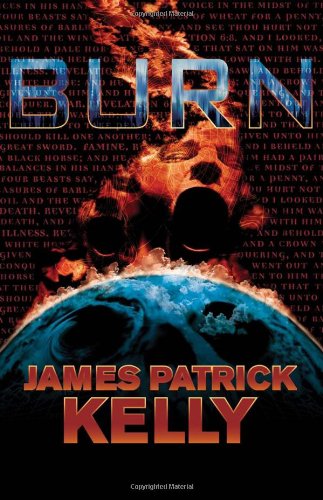
James Patrick Kelly’s Burn is one of the very best novellas of 2005 – almost a novel, at over 39,000 words. There is a conflict on the planet Walden between the original settlers, who pretty much ruined the place, and a later wave who enforce rules of technological simplicity, and who are trying to alter this particular world to a sort of simulacrum of the wooded American Northeast of Henry Thoreau’s time. The original settlers’ tactic of choice is forest fires, in an attempt to halt or reverse the spread of newly engineered trees. This story’s hero is Spur, a volunteer firefighter who as the book opens is recovering not only from terrible injuries suffered in a fire but from the collapse of his marriage. But as he recovers, on a space station, he is perforce confronted with the wonders of the greater human Galaxy – and to make things more interesting, he accidentally engages the interest of a precocious child of a rather strange human culture. This child insists on visiting Walden, against all the rules, and of course in so doing he forces Spur (and Spur’s friends) to learn a great deal about their way of life, and its compromises – not to mention some wrenching personal secrets. I was struck in particular by Kelly’s presentation of the central conflict as one in which both sides are partly right and partly wrong – the reader veers from anger at the evil forest burners to anger at the repressive Waldenites to an understanding that both have at least some good reasons for their stances, if not really for their actions.

Locus, June 2009

June at Asimov’s means a James Patrick Kelly story – this makes 26 Junes in a row, as celebrated by a tribute this issue. Kelly represents himself very well with “Going Deep”, about Mariska, whose mother is genetically fitted to be starship crew – which means so is Mariska. This fact conditions her whole life – her friends, her intended, her contracted father, the AI who helps raise her – and of course Mariska has a rebellious streak. This strikes me as very satisfying pure SF, turning on a plausible and original SF idea, furnished with a variety of believable background details – it’s not a story that could have been told in any other mode.

Locus, December 2010

At the December Asimov’s, James Patrick Kelly’s “Plus or Minus” is a sequel to last year’s “Going Deep”, about Mariska Volochkova, daughter of a famous starship crewmember, indeed her mother’s clone, and as such sharing her capability for deep hibernation. But Mariska wants to be her own person, and so she has run from her mother’s influence – now to the Shining Legend, a ship in the asteroid belt. She’s the lowest person on the crew’s totem pole, and she’s fairly miserable, partly because she doesn’t get along with any of the rest of the crew, for a variety of reasons. Kelly nicely portrays a rather grimy space environment, populated by rather ordinary people. And then disaster strikes, as it will do, it seems. There aren’t any easy solutions, but there is believable, and moving, heroism – ordinary people heroism, perhaps. Pretty fine work.

Locus, March 2011

In print I saw the March/April F&SF. There is also a fine time travel story from James Patrick Kelly, “Happy Ending 2.0”, in which an old married couple, marriage gone rather sour, visit the mountain cabin where they first fell in love, in an attempt to revitalize their relationship. And perhaps they do – or not! – in an unexpected and a bit creepy resolution.

Locus, May 2011

Two strong stories in Eclipse 4 are set on Mars. ... James Patrick Kelly’s “Tourists” is the latest of his pieces about Mariska Volochkova, the cloned daughter of a starship pilot who keeps trying to escape her mother’s legacy. Now she comes to Mars, and ends up involved with a rebellious Martian boy, whose only wish is to escape his culture and go to the stars – the same fate Mariska has been avoiding. The story, with its Martian setting and adolescent characters, could have fit just as well in Strahan’s new YA anthology, Life on Mars. It nicely depicts yet another Martian culture – and seems to close, perhaps, the first set of Mariska stories (the others appeared in Asimov’s) – pointing, though, to further stories, or perhaps a novel.

Locus, July 2013

A shortish set of stories in May at Clarkesworld. My favorite is James Patrick Kelly's “Soulcatcher, a revenge tale about a woman trying to save her clone-sister from the fatal attraction of an alien ambassador. Her means a rather ghoulish rug … things, of course, never go quite as planned in such stories. This one is fine, striking, work.

Locus, December 2013

At the September Clarkesworld James Patrick Kelly's “The Promise of Space” is a subtle and moving variation – or so it struck me – on the space booster sort of story. Stories in the mold, in a way, of Sturgeon's still astonishing “The Man Who Lost the Sea”. This piece is told as a sequence of exchanges between a science fiction writer and her husband, an astronaut. Some terrible happened to the astronaut on a trip to Mars, and what's left of him seems to be mostly an AI-assisted reconstruction, which might remember the writer's famous heroine better than she herself. An interesting and somewhat off-center look at “the promise of space” – and the costs.

Locus, May 2014

Finally, James Patrick Kelly's “Someday” (Asimov's, April-May) is a well-done look at gender roles and relationships on an off-Earth colony. Daya is a brilliant young woman in a small village – surely she will head to the “big city”, as it were, on her perhaps backwater planet. But there is the matter of bearing a child … a responsibility, it seems – and choosing the multiple fathers for the child … and what of the visitors from the stars? Kelly unpacks multiple surprises here … cool stuff in the purest of Sfnal modes.

Locus, December 2016

James Patrick Kelly, in “One Sister, Two Sisters, Three” (Clarkesworld, October) tells of a planet colonized by a religious group and two sisters growing up there, resistant to the wider galactic technology (including “replication” of peoples’ minds as they grow old or sick, and uploading to new bodies). The narrator, Jix, is somewhat jealous of her beautiful sister, Zana; and both miss their mother, who chose replication when she got very sick, to their father’s disgust. When an Upsider tourist seems interested in Zana, the jealousy increases, and result is a tangle of not quite tragedy.

Locus, July 2018

Tor.com’s May offerings are exceptional. James Patrick Kelly’s “Grace’s Family” is set on Grace, a spaceship. As the story opens, Jojin, a young man, is living with his story Qory and their Mom and Dad on Grace. But their Dad is getting old, and his mental functions seem to be degrading. They have entered a new star system, one of many they are surveying – that is their purpose. But instead of continuing their survey, they meet up with another ship – Grace’s sister Mercy – and Mom and Dad leave, in trade for another woman, Orisa. They are to be a new family – but, we begin to ask, what is family here? And what of the mention that Qory, and their Mom, are bots? And what is the purpose of the virtual story environments they all repeatedly enter? This is fascinating original SF, deeply concerned with the purpose of intelligence in the universe.

Locus, December 2019

James Patrick Kelly, in “Selfless” (Asimov's, 11-12), portrays the boss of a pulp museum, who is also the son of an imperious but dying woman, and husband to a fine man, father to a great kid. And none of these are his Selves, really: he seems to have been forced into a scary sort of dissociation as a bullied child, and takes on different personae. One of them is called Hunter, which points to a potential horror story, but then a “hunt” ends unexpectedly, and points to a couple of possibilities – a larger community of people like him, or – something like redemption, maybe.

Tuesday, April 9, 2019

Birthday Review: Some Novels of Barrington J. Bayley

Barrington J. Bayley was born April 9, 1937, and he died in 2008. He was one of the weirdest of SF writers. In his memory, here's a set of capsule reviews of some of his novels. Unfortunately, I'm not covering his best novels -- as noted below, these are probably Collision Course, The Fall of Chronopolis, The Garments of Caean, and The Soul of the Robot. But these are still a pretty interesting set of books.

Let's begin with two Ace Double reviews already posted here:
Annihilation Factor
The Star Virus

Capsule review of The Great Hydration

Barrington J. Bayley is a British writer best known for a series of unusual novels in the 70s and 80s, mainly for DAW and Doubleday. His novels often featured unusual cosmological notions, and a dour and cynical viewpoint, often reflected in somewhat offbeat humour. Among the best, by most accounts, are Collision Course, The Fall of Chronopolis, The Garments of Caean and The Soul of the Robot. After the mid-80s he found it hard to sell further novels, and nothing has appeared since then but a media tie-in and a number of short stories, some quite good. But last year Cosmos Books (an imprint of Wildside Press) published two new Bayley novels, apparently written in the late 90s. These are The Sinners of Erspia and the novel to hand, The Great Hydration, a very short novel at just over 40,000 words.

The Great Hydration is set on a nearly completely dry planet. A number of humanoid species, adapted to require no water (indeed, water is a poison to them) live under the loose rule of the lobster-like Tlixix. Apparently the Tlixix were masters of the world when it was full of water, and they genetically engineered these new species to work for them in the dry world produced when a fault slipped allowing the oceans to drain into the spongy interior.

A couple of shady businessmen from human space show up and offer to release the trapped water with a series of nuclear explosions, which will restore the planet to a pleasant environment for the Tlixix, but will result in the death of the other species. A disaffected employee, one of their top nuclear engineers, somewhat accidentally becomes involved with a sort of resistance movement among the dry-adapted species. Disaster, pretty much, ensues, for everyone, magnified when the galactic police force shows up.

It's kind of weird, and casually worked out, and not very plausible. At the same time, it's pretty fun, if horribly cynical. The various aliens are interesting enough, and the basic concept, if unlikely, is brash enough to impress. Not bad, if not great.

Capsule review of Star Winds

Star Winds, by Barrington J. Bayley (DAW, 1978), is a rather delightfully goofy novel set in the very
far future.  The story opens on Earth, as a sailing ship lands in the local port. You see, ship travel uses special sails which interact with the "ether" to allow them to fly. It turns out that at one time ships could even go between planets.  But that trade has died out, and with it the hope of replacing the ether sails, which cannot be made on Earth.  Rachad Curban, a dilettantish young man,wishes desperately to be a sky sailor, but there are no openings, and the whole business is decaying.  At the same time, he is rather vaguely studying with an old alchemist. When the old man tells him that the only hope of making the Philosopher's Stone is to find a book somewhere on Mars, an idea is born.  Rachad convinces a down-and-out sky captain to refit his ship to make a desperate attempt to fly through space to Mars.  Once on Mars, the sky captain will be able to obtain new ether sails, and revitalize the whole sailing business.  From here the story begins to open out, as it were, section by section.  Bayley keeps changing the stakes.  The flight to Mars is a rather exciting adventure which ends in disaster: capture by a nobleman from another star system, who by coincidence was looking for the same book Rachad's alchemist was seeking.  It turns out that the nobleman needed the book to find a way into the keep of another corrupt nobleman, whose lands the King has promised him if he can root him out.  The corrupt nobleman is host to ... another alchemist.  And so the story goes, changing direction again and again.  It's dotty, and oddly lighthearted despite a series of failures by our heroes, and despite a rather sad view of the future fate of the galaxy.  It's also based on a nonsensical but fun premise: that the atomic theory of matter is wholly wrong, and that the alchemists were right: the Philosopher's Stone is a real possibility, all matter is made of Earth, Air, Fire, Water, and Ether, etc. etc.  This is quite a fun book.

Capsule Review of The Grand Wheel


I hadn't read a Barrington Bayley book for a while, and I saw The Grand Wheel (1977), one of his least-known books, used and picked it up.  It's typically weird, about a far future where the Earth's portion of Galactic space is ruled by a strictish government called the Legitimacy, and opposed by an organization called The Grand Wheel, which runs gambling houses and pushes the idea that all life is contingent, random, based on luck.  Human space is under siege from inimical aliens.  The Legitimacy wants to find the rumoured "Luck Equations" of the Grand Wheel, to use against the aliens, and they blackmail a gambler named Cheyne Scarne to infiltrate the Grand Wheel.  But he finds that the megalomaniac head of the Wheel has something else in mind: a gambling game with another group of aliens: the prize, perhaps the entire human race.  But wait, there's more ... This isn't really Bayley at his best -- he doesn't quite convince the reader of the significance of all his blather about randomness and chaos and so on, and the story is a bit slack and slow.  It's an OK read, though.

Capsule Review of The Pillars of Eternity

Barrington J. Bayley is one of SF's true wild men.  His novels are fascinating, just stuffed with serious philosophical and scientific speculation, but with that speculation stretched to and beyond its limits.  One of his obsessions seems to be the nature of Time.  He's played with different concepts of Time and Time Travel in novels like The Fall of Chronopolis and Collision Course.  He plays with it again in The Pillars of Eternity.  This features Joachim Boaz, a shipkeeper (that is, shipowner/captain) who is kept alive by his intelligent bones, and who cannot forget the terrible accident that occurred after his bones were first installed, when his bone-enhanced senses exaggerated his pain after an alchemical experiment gone awry, while his bone-enhanced preservation function wouldn't let him die, prolonging the pain.  Boaz' real fear is rooted in his philosophical belief in "eternal recurrence": thus, he is sure that when the Universe collapses and reforms, he will again have to undergo the pain.  Unless he can change the past.  Hence, he joins the treasure hunt to the wandering world Meirjain, where the mysterious "time gems" might be found.  But that's not all ...

It's wild, wild, stuff.  Very entertaining, and but honestly thoughtful beneath it all.  The writer he reminds me most directly of is Charles Harness.  Some might think of van Vogt, but I will confess to being allergic to van Vogt, so I can't really comment.  In a quite different way, R. A. Lafferty has some of the same wildness.

Monday, April 8, 2019

Birthday Review: Stories of Sarah Pinsker

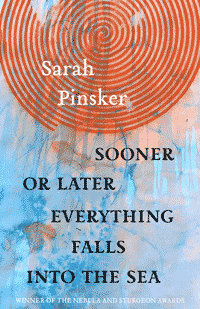
Today is the birthday of the exceptional writer Sarah Pinsker, who has just had her debut collection, Sooner or Later Everything Falls Into the Sea published by Small Beer Press, and who is also on the Hugo and Nebula ballots for her very good story "The Court Magician". Here's a selection of my reviews of her short fiction:

Locus, May 2016

I also liked Sarah Pinsker’s “The Mountains His Crown” (Beneath Ceaseless Skies, 3/17) for its central idea: an Emperor becomes obsessed with his daughters’ notion that his land looks a bit like him, and decides to force the farmers to plant crops to reinforce that resemblance. The plot – about a farmer woman who tries to find a way to change his mind – perhaps doesn’t quite live up to the main idea, though it’s OK, and the characters are strong.

Locus, July 2016

In the June Asimov's I also liked I also liked Sarah Pinsker’s “Clearance”, which uses the device of a woman leafing through the Clearance items at a tourist shop to reveal that there are alternate worlds that sometimes intersect. There is also a teenaged daughter that the protagonist is trying to please. This is clever, low key, funny without being silly, with a nice underplayed SFnal notion driving a believable human story.

Locus, April 2017

The March-April Asimov’s has an effective story in response to (or in dialogue with) Ursula Le Guin’s “The Ones Who Walk Away From Omelas”. This is Sarah Pinsker’s “The Ones Who Know Where They Are Going”, and it is told from the point of view of the abused child … who gets a chance to escape. The moral logic is powerfully resolved – a more wrenching choice than those who walk away make is presented.

Locus, May 2017

Another mystery story, this one Science Fiction, is the best piece in Uncanny’s latest issue (and also the longest story they have yet published). This is Sarah Pinsker’s “And Then There Were (N – One)”. This is set at a convention of Sarah Pinskers from alternate worlds, held on an isolated island (natch – see title!) off the Canadian coast in one particular alternate world. The narrator is a Sarah who ended up an insurance investigator – others are musicians, scientists (one of the Sarahs invented the process of traveling to alternate worlds), dog trainers, hotel managers, etc. (Even, yes, a Nebula winning SF writer.) Our Sarah (that is, the narrator, not the author!) is roped into investigating the death of one of the Sarahs, due to her insurance investigation chops. The criminal herself can be deduced from first principles (as with many mystery stories), but that’s not the key here. The story is well and warmly told, with dollops of real humor (the convention, and its panels, is certainly familiar in style to any SF con-goer), and the central issues, concerning identity, identity’s ties to circumstance, and choices, are absorbing and effectively examined.

Locus, December 2017

Those are good, but even better at the September-October Asimov's are two stories with some similar themes that open and close the issue. Sarah Pinsker’s “Wind Will Rove” is a story about the folk process, and memory, and the occasional importance of forgetting, set on a generation ship. Rosie is a middle-aged teacher on the ship, and a pretty good fiddle player. A malicious virus wiped most of the ship’s memory not too long into the journey, and Rosie and her fellows work on restoring what’s been lost by remembering everything they can, including folk tunes. But some of her students resent being taught history – another form of remembering – why should they re-create Earth on the ship, or even the new planet (that they will never see)? Even Rosie’s daughter has doubts. But purposeful forgetting – or malicious erasing – hardly seems right either. These questions are considered in the light of Rosie thinking about a particular folk tune, “Windy Grove”, a favorite of her grandmother’s, and how it changed over time – and might still change. Thoughtful and quite moving.

Locus, February 2018

The January Lightspeed is full of fable-like pieces ... The piece I really liked was Sarah Pinsker’s “The Court Magician”. This tells of the career of a young boy selected to learn magic. So he does, over time, mastering sleight-of-hand, always wanting more, until he is finally offered real magic. Which must be in service of the Regent of his land, and which comes at a cost – a terrible cost to himself, and, he eventually realizes, possibly to other as well. It is in a way another variant on “The Ones Who Walk Away From Omelas” (a story Pinsker riffed on even more explicitly last year with “The Ones Who Know Where They Are Going”).

Locus, April 2018

And from March 1 at Beneath Ceaseless Skies Sarah Pinsker’s “Do As I Do, Sing As I Sing” is pretty solid work as well, set on a world where “cropsingers” are required to sing to the crops, to encourage them to grow properly. The narrator is to become the newest cropsinger for her community – a difficult and lonely job. Her brother rebels, and leaves, only to return with what he hopes are mechanical approaches to the problem. The story is at once a fine look at its main characters, and a worthwhile and not insistent meditation on both the difficulty of crude efforts to replace traditionally effective methods (such as this story’s cropsinging), and on the somewhat paradoxical resistance to changes that really might improve peoples’ lives, if disruptively.

Locus, March 2019

Sooner or Later Everything Falls Into the Sea is Sarah Pinsker’s first collection, which surprised me – she has done so much outstanding work in the seven years since her first appearance. The original story here is a curious one – “The Narwhal”, set in a world pretty much like ours, except for the apparent presence of superheroes. Lynette is a young woman trying to make her way in the gig economy, and she’s hired to help a woman drive a whale-shaped car across the country. The trip is frustrating, and strange, and eventually they land at a Midwestern town at which some disaster apparently occurred some time in the past – which of course turns out to involve the woman who has hired Lynette, and her strange car. This is solid and interesting work, though not quite Pinsker at her very best. The book, to be sure, includes some of Pinsker’s very best work, and even the only good stories are good enough to place this as a must-have first collection.

Thursday, April 4, 2019

Birthday Review: Ilium, by Dan Simmons

Today is Dan Simmons' birthday. In his honor, then, I'm reposting this review that I had posted at SFF Net and on my now defunct website back in 2004.

Date: 01 May 2004

Review: Ilium, by Dan Simmons (2003)
Eos, New York, ISBN: 0380978938

a review by Rich Horton

Dan Simmons' Ilium is, as of this writing, a nominee for the 2004 Hugo for Best Novel. It's a long novel at some 240,000 words. It comes well-recommended, with mostly quite good reviews in addition to the award nomination. I had hesitated to read it, partly because of the length and partly because the most common capsule description -- "the Iliad reenacted on Mars in the far future" -- just didn't seem all that appealing. It turns out, as I might have expected, that that description is not really very good applied to the entire book. And as for the length, it's notable that it is very similar in size to the combined books of Scott Westerfeld's diptych Succession, but it was published as one book for $27.95, while Westerfeld's books were published as two books for $23.95 per. (To be sure, Ilium is itself only the first book of a diptych!)

Having finally read Ilium, I was pretty pleased. It's full of SFnal imaginative brio (if not always very plausible), and it's also full of pretty absorbing action. My main complaints are a) that it's only the first half of its story (though it does come to at least a somewhat satisfying stopping point -- similar in a way to that of Westerfeld's The Risen Empire but I think more successful as a book conclusion); and b) that so far it doesn't seem to be about much -- it's fun and has lots of interesting ideas but it seems somewhat slight.

The story is told on three main threads. The most prominent centers on Thomas Hockenberry, a 20th century college professor who specialized in Homer. He has been mysteriously resurrected in this far future, and he is one of a number of "scholics" employed by the gods (yes, Zeus, Aphrodite, etc.) to observe the progress of the Trojan War, which is being fought (reenacted? refought for real? fought for the first time somehow? who knows?) on what seems to be Mars. (The gods, of course, live on Mt. Olympos -- that is to say, the great volcano Olympus Mons.) The scholics keep track of how closely the war tracks Homer's poem, which turns out to be pretty closely. But the gods' arbitrary violence, and a general despair at the bloody-mindedness of everyone, drive Hockenberry to rebellion -- at first just a night with Helen (!), but soon a plot against the gods themselves.

Meanwhile, the AIs called moravecs who live in the Jupiter system have detected unsettling activity on Mars, and they send an expedition. One member of this expedition is Mahnmut, who lives on Europa and drives a submersible exploring the Europan seas. He is also an expert on Shakespeare's sonnets. His best friend is Orphu of Io, a Proust enthusiast. The two are marooned on Mars when the expedition comes to disaster, and they head for Olympus Mons on their own to try to complete the mission.

And finally, in Earth, Daeman is a foolish young man living in the rather stale society of the few remaining humans on the planet after the long past exodus of the "posthumans" to Earth orbit. The Earth humans live lives of idle eroticism and sloth, unable to read, unaware of geography as they "fax" (i.e. teleport) everywhere, served by robotic "servitors" and the alien Voynix. Every 20 years they are "faxed" to orbit and repaired, but they live only five "Twenties". Daeman visits a beautiful young woman named Ada in hopes of seducing her, and finds himself all unwilling drawn into the schemes of Ada, her friend Hannah, an ancient Jewish woman named Savi, and a 99 year old man named Harman who wants to avoid extinction when he reaches his fifth "twenty". This group ends up wandering the Earth: Antarctica, Israel, the dry Mediterranean Basin, in hopes of finding a way to the home of the posthumans in orbit.

Which is pretty much it for this book. Which isn't to say that nothing is resolved -- lots happens, and there is a lot of change. There are bloody battles, rampaging Allosauruses, some weird technology, aliens, gods of various sorts, heroism, sex, disasters. It's lots of fun, and the scene is well set for what could be a pretty exciting concluding volume. [But perhaps it says something -- though more about me maybe than the book, to be fair -- that I never got around to reading the sequel, Olympos.]

Monday, April 1, 2019

Birthday Ace Double Review: Captives of the Flame, by Samuel R. Delany/The Psionic Menace, by Keith Woodcott

Ace Double Reviews, 85: Captives of the Flame, by Samuel R. Delany/The Psionic Menace, by Keith Woodcott (#F-199, 1963, 40 cents)

A review by Rich Horton

(Covers by Jack Gaughan and Ed Emshwiller)
This Ace Double includes novels by two of the great writers in the field. "Wait!", you might say, "Samuel Delany I understand. But Keith Woodcott! I never even heard of him." Ahh ... but Keith Woodcott was a pseudonym for John Brunner. At any rate, neither of these novels is among their author's best, though Delany's is the promising work of a young writer who would get better, and who even here shows much promise, while the "Woodcott" is terribly disappointing work by a writer who had already done first rate work, and who could usually be trusted to be quite entertaining, even in his hackwork. He'd get better too -- but you can't say that The Psionic Menace provides any evidence of that. Captives of the Flame is the longer book, about 52,000 words. The Psionic Menace is about 38,000 words.

Captives of the Flame is Delany's second novel. It appeared when he was just 21 years old. It is the first of a trilogy, collectively known as The Fall of the Towers. It opens enigmatically, with Jon Koshar confused and lost ... we soon learn that he has been imprisoned for the past 5 years, despite his prominent position as the son of a leading merchant in the city of Toron. Toron is the island capitol of Toromon, a small "empire" on a future Earth, an Earth on which the inhabited parts (which seem to include Aptor, setting of Delany's first novel, The Jewels of Aptor) are isolated by belts of radiation, the result of the "Great Fire". As the novel begins, Toron is lurching towards war with the mysterious people beyond the nearby radiation belt. The young King Uske, mostly a puppet, wonders what he is doing, declaring war. Jon Koshar's sister Clea, a brilliant mathematician, looks forward to her graduation party, and worries about her military boyfriend. The mysterious Duchess of Petra plots to kidnap the King's younger brother Let. A boy named Tel has landed on the island, and is immediately swept up in the Duchess's plot, along with the acrobat Alter, her aunt Rana, and Jon Koshar. Also involved is a giant from the slightly mutated forest people, who live near the radiation barrier.

If all this seems a bit busy, well, it is. And it stays that way, though it's mostly easy to follow and fun to read. The war starts on schedule. Economic chaos, partly driven by artificial fish production, and exacerbated by a poisoning of the fish supply, accompanies the war. (Delany includes some rather incoherent and unconvincing economic rants.) The kidnap plot comes off, and Prince Let is taken to the forest people, to learn how to be a better King than his ineffectual brother. Clea's mathematical abilities identify a way to end the war. Jon Koshar, with Alter and Petra, battles the alien Lord of the Flames, who seems to be behind the provocations that led Toromon to war. This battle takes them to numerous different planets, to inhabit different life forms, in a colorful sequence that reminded me of Harlan Ellison's very minor early novel The Man With Nine Lives. And ... well, the book pretty much stops. Good thing this is just part one of a trilogy!

In many ways this book is kind of a mess. But some of that might be resolved in the concluding novels of the trilogy, to be fair. (I've read the whole thing, but 40 years ago, and I don't remember it at all.) And as I said it's readable and fun throughout, with prosodic flashes that, while not wholly successful, point the way to the kind of writer Delany would become.

It should be noted that both Captives of the Flame and the second novel in The Fall of the Towers trilogy, The Towers of Toron, were significantly revised prior to publication of the omnibus edition of all three books. That's omnibus edition is what I read, back in 1975 or so, and maybe that's why I don't remember Captives of the Flame! (Or maybe not.) For one thing, it was retitled Out of the Dead City (a much better title) for the later editions. It is possible that some of the revision was restoration of cuts demanded by Donald Wollheim -- I have read that Delany's first novel, The Jewels of Aptor, had to be cut significantly to fit in an Ace Double, and that in the end, frustrated, he was just tossing out paragraphs more or less at random. I would say there is definite evidence in Captives of the Flame that scenes are missing.

The Psionic Menace, by contrast, is a bad book unrelieved by any indication of the possibility of better work to come. I wonder if Brunner purposely used the Woodcott name because he knew how bad the novel was. ("Keith Woodcott" wrote some 5 books for Ace, 4 of them Doubles -- the name also appeared on a couple of short stories. I haven't read any other "Woodcott" novels so I can't say if their quality was generally lower than the novels under the Brunner name. But certainly the other Brunner Ace Doubles I've read (under his name) were much better than The Psionic Menace.)

The book is set in a future in which a mostly peaceful and well-controlled Earth has isolated "psions". Conditions are worse for Psions in the interstellar confederation controlled by the "Starfolk", who live on starships (like Anderson's Kith or Heinlein's Free Traders). The main character, a "cosmoarchaeologist" named Gascon, is a psinul -- his thoughts cannot be sensed by psions. One night he encounters a runaway psion boy who is panicked by a broadcast psionic message warning of the "end of everything".

Meanwhile, on the Starfolk-dominated planet Regnier, a young girl, Errida, is chosen to be a Starfolk concubine. (It appears they need to refresh their genetic pool on occasion, and they do so by force.) But her brother is a psion and it becomes necessary for them to escape to an isolated alien city -- once home to a colony of the "Old Race"... alas, the rest of her family is swept up in a fomented anti-psion riot.

Gascon's academic field, cosmoarchaeology (study of the relics aliens have left on various planets), combined with his being a psinul, makes him ideal to send to Regnier in an Earth plot to solve the mystery of the psion panic about the "end of everything", and also to put pressure on the Starfolk. So he goes to Regnier, and meets Errida. The Starfolk, who have come to Regnier because a Starfolk ship has been lost and psions are suspected, get involved as well, and in a typically too rapid Brunner ending Gascon steals a Starfolk ship and follows clues to the location of the "Old Race" and to the, in the end very disappointing, solution to the mystery of the "end of everything".

It's just a book that didn't work for me at all. I wasn't engaged by any of the characters. I was thoroughly unimpressed by the SFnal aspects, particularly the lamish resolution to the central mystery. Brunner wrote a lot of his early stuff pretty fast, for the money, but he usually gave decent value. Not this time, though.